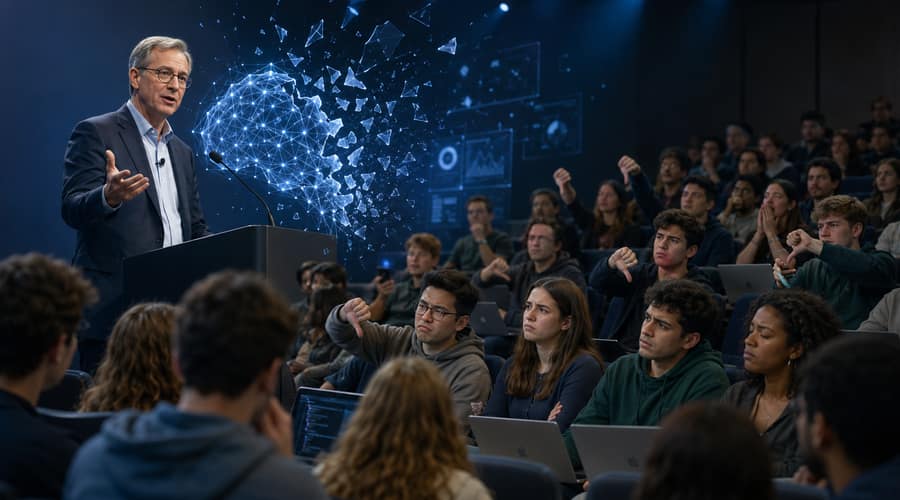
Eric Schmidt walked into a commencement speech promising AI as opportunity and walked out as a reminder that young workers are hearing something else entirely.
That gap matters. The former Google chief executive was booed at the University of Arizona on Friday as he tried to sell graduates on artificial intelligence, a reaction that says less about one speaker than it does about the mood around AI itself. TechCrunch reported that Schmidt drew loud boos when he told students they would help shape artificial intelligence, while Business Insider said the reaction grew sharper as his speech moved further into AI and automation.
Schmidt did not seem to miss the tension. According to Business Insider, he told the crowd he understood the fear, describing a generation that thinks the future has already been written, machines are coming, jobs are disappearing, and the world they are inheriting is one they did not create. That line landed because it was closer to the truth students are living through than the usual Silicon Valley pitch about efficiency and scale. For graduates looking at their first jobs, AI is not a neat productivity story. It is a force that can feel like a warning.
The most revealing part of the episode is that the audience was not rejecting technology in the abstract. They were rejecting the idea that a lecture about AI opportunity can glide past the obvious labor anxiety sitting in the room. Business Insider noted that AI is already changing how companies screen candidates and what skills they want, while some firms have cut back on entry-level hiring because rote tasks can now be automated.
That fear is not fringe. Pew Research Center found that about half of Americans are more concerned than excited about AI in daily life, and only 10% say they are more excited than concerned. In other words, Schmidt's reception was not some isolated campus tantrum. It fit a much wider pattern of skepticism that has been building as AI becomes less of a concept and more of a workplace force. When graduates hear executives describe a coming transformation, many hear a translation of that transformation into fewer openings, thinner ladders, and more uncertainty about where to start.
The contrast with corporate messaging is sharp. IBM's chief human resources officer said in February that the company is tripling entry-level hiring in areas people assume AI will take over, while Klarna has also been trying to redraw its workforce around AI and automation. Those are real examples of how companies are trying to present the future. But they also show why the public conversation has become more brittle. For many students, the promise that AI creates opportunity sounds less persuasive when the same industry has spent years talking about replacing work before it talks about retraining people for better work.
A narrative problem for AI firms
Schmidt's speech is a useful test for the broader AI industry because it exposes a messaging problem, not just a PR problem. Executives have leaned heavily on abstractions such as productivity, innovation, and transformation. Those words make sense in boardrooms. They sound hollow to a graduate wondering whether the first rung of the career ladder is disappearing under them.
That is why the backlash matters for founders and AI companies. The public does not need another vague claim that AI will unlock value someday. It needs a more honest account of who gains, who loses, and what gets done for the people caught in between. The Guardian also reported that Gloria Caulfield, another commencement speaker at the University of Central Florida, faced boos after calling AI the next industrial revolution, which suggests Schmidt's reception was part of a broader student reaction rather than a one-off flash point.
There is also a cultural shift underneath the labor concern. Students who have grown up with AI tools, recommendation systems, and algorithmic feeds are not necessarily anti-technology. They are more willing than older audiences to accept that the tools exist, but less willing to trust the people selling them. That is a harder audience to persuade because it is not impressed by scale alone. It wants evidence that the gains from AI will not be captured entirely by employers and investors while the costs are handed to everyone else.
Schmidt's moment became news because it compressed all of that into a few seconds of noise. A prominent tech executive tried to frame AI as a generational opportunity. Students responded like people who suspect the opportunity is being priced in for someone else. That is the message AI companies cannot keep ignoring. If the industry wants public support, it will have to talk less like a demo and more like an employer that understands fear is part of the product now.
Also read: AMD's tiny AI PC points to a more local future for model inference • Torvalds' AI complaint exposes a growing problem in open source security • Ken Griffin's AI reversal shows how fast institutional money is changing