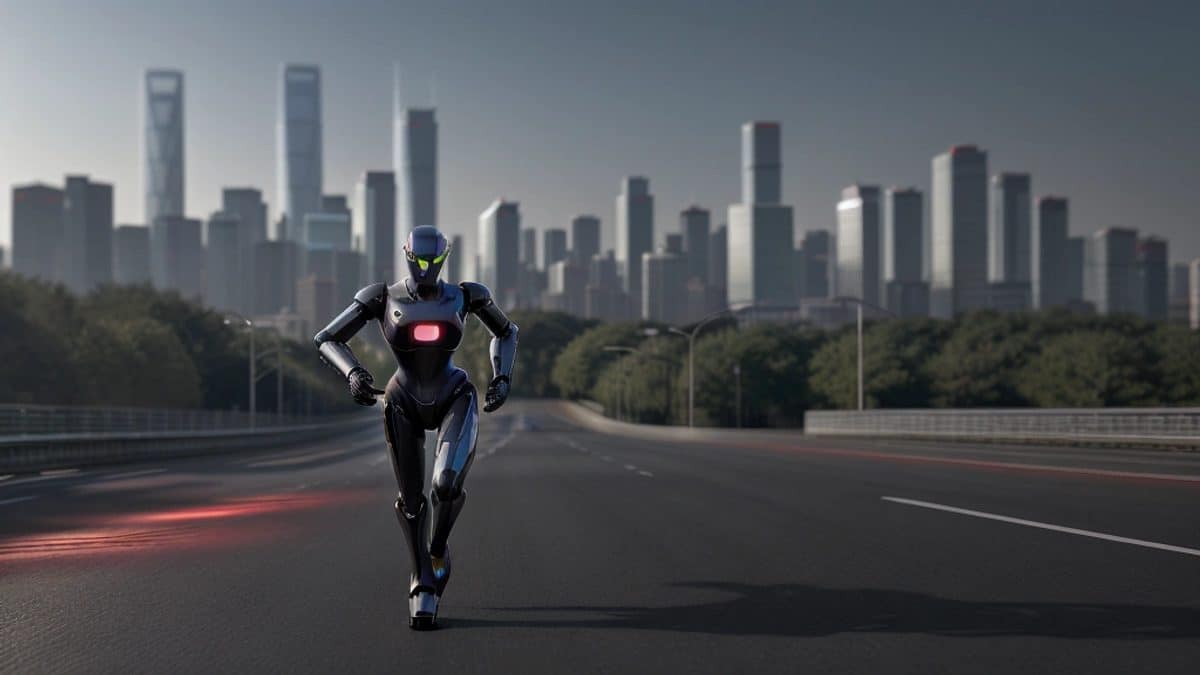
Honor's Lightning humanoid completed Sunday's Beijing robot half-marathon in 50 minutes 26 seconds, beating the human world record by more than six minutes and leaving every human runner in the race well behind.
The record books don't usually make room for machines, but after Sunday's race in Beijing, it's hard to ignore what just happened. Lightning, a humanoid robot developed by Chinese consumer tech firm Honor, crossed the half-marathon finish line in 50 minutes and 26 seconds. The men's world record, held by Ugandan distance runner Jacob Kiplimo, stands at 57 minutes and 20 seconds. Lightning didn't inch past it. It obliterated it.
The event drew more than 100 competing robots and thousands of human participants, making it one of the largest human-robot races ever staged. The fastest human on the day, a local amateur runner, finished roughly 17 minutes behind Lightning. That's not a rounding error. That's a different race entirely.
What makes this result particularly striking is who built the winning machine. Honor is best known as a smartphone and consumer electronics brand, spun off from Huawei in 2020. The company only entered the humanoid robotics sector last year, which makes Lightning's performance less a product of decades of robotics research and more a signal of how quickly well-capitalized tech firms can move when they decide to take a sector seriously.
China has been deliberately cultivating its humanoid robotics industry, with state support flowing toward companies working on bipedal locomotion, motor control, and real-world deployment. Sunday's race was partly a showcase of that investment. Dozens of Chinese firms entered robots, and while most didn't finish anywhere near Lightning's pace, the sheer volume of competing machines reflects how broad and well-funded the field has become domestically.
What endurance running actually tests in a robot
A half-marathon isn't just a speed test. Over 21 kilometres, a robot has to manage heat dissipation, balance on varied terrain, maintain consistent joint mechanics as components fatigue, and do all of it without a human operator making real-time corrections. These are genuinely hard engineering problems, and they're not the same challenges that show up in factory automation or warehouse logistics.
The fact that Lightning held together for the full distance, at that pace, suggests Honor has solved some non-trivial problems in energy management and locomotion stability. We don't yet have a detailed technical breakdown of how the robot achieved its time, and Honor hasn't published specifications that would let engineers scrutinise the result. That transparency will matter as the robotics community processes what Sunday actually proved.
The competitive context beyond the finish line
It's worth noting that comparing robot performance directly to human athletic records has limits. Human world records are set under strict competitive conditions, on certified courses, with anti-doping oversight and timing precision. Sunday's Beijing race, while impressive in scale, operated under different rules. The comparison is useful as a headline, but the more meaningful number is the gap between Lightning and the other robots in the field, which speaks to where Honor sits relative to its domestic competitors.
Still, the broader narrative is hard to dismiss. Boston Dynamics has spent decades building robots that can run, jump, and perform backflips, and its Atlas platform remains a global reference point. Chinese firms are now producing machines that can compete on endurance metrics that were, until recently, considered safely in the human domain. The pace of iteration in this space is accelerating in ways that are increasingly difficult to track quarter by quarter.
For investors and technology watchers, the question is less about whether robots can run fast and more about what this generation of bipedal machines can do in environments that matter commercially: construction sites, care facilities, logistics networks, and anywhere labour is expensive or dangerous. Endurance running is a proxy, a demanding one, but the market application is what will determine which of these companies actually scales.
Honor's entry into robotics is one to watch closely. If a company that only joined the sector last year can produce a machine that clears the human half-marathon world record in its first major public outing, the competitive dynamics of the industry are shifting faster than most analysts expected. Beijing just made that very clear.
Also read: Stanford report reveals China has overtaken the United States in AI model production while the flow of global researchers into America slows to a halt • Apple and Google are still promoting nudify apps to children three months after the problem was first exposed • Tencent democratizes spatial intelligence by open sourcing the HY-World 2.0 multi-modal framework for 3D reconstruction