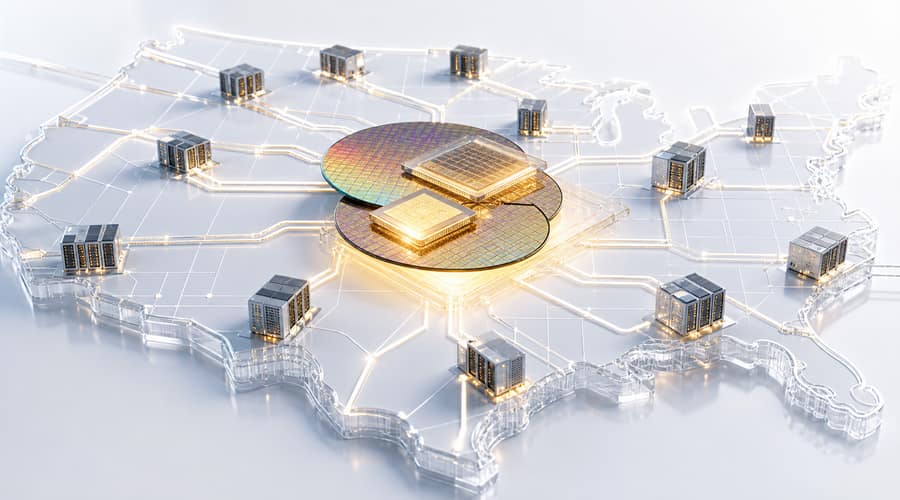
China is preparing a huge state-backed AI buildout that could make domestic chips the default option for the country’s next wave of computing power.
China’s AI infrastructure race is no longer just about who can buy the most Nvidia chips. Beijing is preparing to put the state behind a national network of AI data centers, and the most important part of the plan may be what it leaves out: foreign hardware at scale.
Bloomberg reported that the National Development and Reform Commission is drafting a plan to deploy roughly 2 trillion yuan, about $295 billion, over five years to build interconnected AI computing hubs across the country. State carriers China Mobile and China Telecom are expected to operate much of that network, while a proposed requirement would make at least 80% of the technology used in the buildout domestic, including AI chips.
That changes the conversation. A data center plan of this size is not simply a procurement exercise. It is an industrial policy tool. If the 80% floor holds, companies such as Huawei will not just compete for business. They will become part of the operating system of China’s AI economy.
For Huawei, the timing matters. China has been pushing domestic AI chips for years, but state-backed demand can do something private enthusiasm cannot: guarantee scale before the market fully proves itself. That is especially useful in chips, where software ecosystems, server design, cooling, networking, and customer support all improve when buyers commit in volume.
The latest signs suggest Beijing believes the gap is narrowing enough to bet harder. The South China Morning Post recently reported that a Huawei-led team used at least 1,000 Ascend 910C chips to post-train a 1.6 trillion parameter DeepSeek model, citing the Shenzhen municipal government. That does not mean Huawei has caught Nvidia in every measure that matters. Nvidia still has the stronger software stack, broader developer base, and a much deeper global supply chain. But it does show why China is more comfortable forcing the issue.
This is the pressure point for Nvidia and AMD. China is one of the world’s largest AI chip markets, but it has become harder to treat it as a normal export destination. Reuters reported in November 2025 that China had moved to bar foreign AI chips from state-funded data centers, with projects receiving more than $100 billion in state funding since 2021. The new plan would take that direction and attach it to a much larger national buildout.
Nvidia has tried to keep a path open through China-compliant chips such as the H20 and H200, while chief executive Jensen Huang has repeatedly argued that access to China matters for American technology leadership. But Beijing’s message is becoming clearer. Foreign chips may still be useful for private firms, overseas training, or specific non-sensitive workloads. They are less likely to be trusted as the backbone of government-directed AI infrastructure.
The US and China are building different machines
The contrast with the United States is sharp. In America, the AI buildout is being driven by hyperscalers, chipmakers, private credit, utilities, and power developers trying to keep up with demand from OpenAI, Microsoft, Amazon, Google, Meta, and Oracle. It is messy, expensive, and market-led. Capital moves quickly, but grid connections, permitting, and power supply can slow everything down.
China’s model is different. It can direct carriers, provinces, banks, and suppliers toward a shared goal. That can reduce duplication and make infrastructure appear faster. It can also create waste. China’s own chip executives have warned this year that rushed AI capacity could sit idle if demand, software, and workloads do not match the pace of construction. Big plans solve the funding problem, but they do not automatically solve utilization.
China Mobile’s numbers show why the state wants carriers involved. In its 2025 annual results, the company said computing services revenue reached 89.8 billion yuan, up 11.1%, while AIDC revenue rose 35.4% and intelligent computing services grew 279%. Telecom operators already have the fiber, sites, enterprise relationships, and operations teams needed to turn computing power into a utility-like service. That is exactly the structure Beijing wants for AI.
The private sector is still spending heavily. Alibaba said in February 2026 that it would invest more than 380 billion yuan over three years in cloud and AI hardware infrastructure. Tencent, Baidu, ByteDance, and others are also building or leasing compute. But the Bloomberg plan reportedly excludes private-sector spending, which means the real national total would be higher than the headline figure.
For founders, this creates a practical choice. If you are building inside China, the domestic stack is no longer optional in the same way it once was. Models, tools, and deployment pipelines will need to work well on Huawei Ascend and other local chips, not just Nvidia CUDA. If you are building for the US and allied markets, the opposite pressure applies. Customers will look more closely at where models are trained, what chips are used, and whether infrastructure touches Chinese state-backed systems.
The bigger point is that AI infrastructure is becoming political infrastructure. Chips, data centers, power supply, cloud credits, and model access are now part of national strategy. China’s plan may not produce the most efficient compute market, but efficiency is not the only goal. Control, resilience, and independence matter just as much to Beijing.
What comes next is execution. If Huawei and other domestic suppliers can meet demand without major performance or reliability gaps, China will have taken a large step toward a parallel AI infrastructure system. If they cannot, the country may end up with expensive capacity that still depends on workarounds. Either way, the chip market has been warned. The next AI race will not be won only by the fastest processor. It will also be shaped by who controls the places where those processors are allowed to run.
Also read: ICEYE becomes a €10 billion test for defense tech valuations • Michael Saylor is only partly right about AI hurting Bitcoin • Singapore gives its AI researchers a much bigger machine to work with