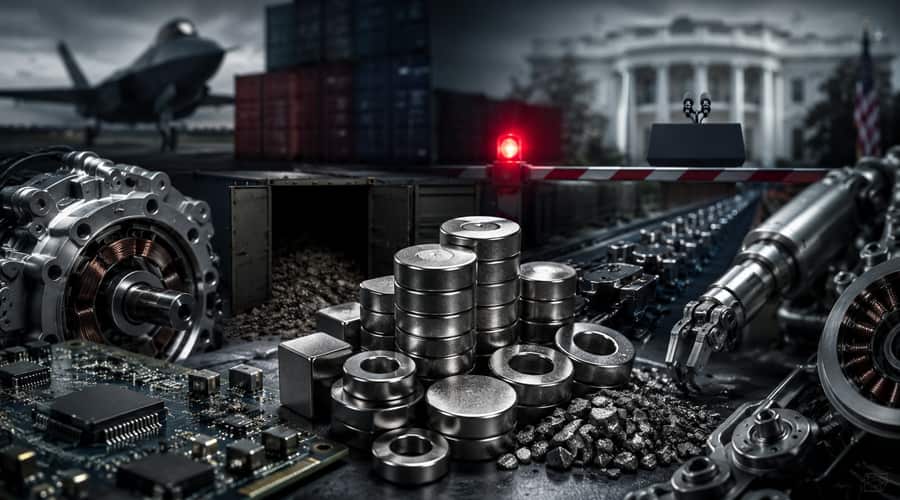
A coalition of U.S. defense and technology companies is asking the White House for a temporary delay to a planned ban on Chinese-made rare earth magnets, arguing there is no ready domestic substitute and an immediate prohibition would threaten production across defense and advanced manufacturing.
Defense contractors and industrial suppliers have privately and publicly warned the administration that the planned prohibitions on certain magnets sourced from China will cause near-term shortages for systems ranging from fighter jets to electric motors to specialized hardware used in AI infrastructure, according to reporting from Reuters and Bloomberg. Reuters described lobbying by firms that say the supply chain has no viable U.S. alternative in the months before the ban takes effect, while Bloomberg reported industry pleas that an abrupt cutoff would disrupt production lines for both defense and commercial customers.
China dominates the processing and refining step that turns mined rare earth ore into the permanent magnets used in motors, sensors, and other critical components, creating a structural chokepoint that is not easily fixed by new mines alone, experts and analysts told reporters. Multiple analyses have put Chinese control of downstream processing in the very high range, with industry commentary and analysts citing shares in the 85 to 92 percent band for processing and magnet production, which leaves limited near-term capacity outside China.
The timing makes the policy politically and operationally painful. The Defense Federal Acquisition Regulation Supplement and related legislative moves have set deadlines that push Pentagon suppliers to remove Chinese-origin magnets from weapon systems by 2027, but industry says supply-chain timelines and the capital- and energy-intensive nature of processing mean alternative capacity cannot be ramped that quickly without disrupting platforms now in production.
Options on the table, and their limits
Industry proposals to blunt the shock include short delays or phased waivers to give U.S. firms and allied suppliers time to build processing and magnet-manufacturing capacity, and greater government support for onshoring critical stages of the value chain, Reuters and Bloomberg reported.
Those fixes face two constraints. First, building processing plants and the specialized supply chain takes years and cannot be solved by switching ore suppliers alone, because the bottleneck is refinement and alloying, not just mining. Second, any visible backtracking by the administration risks undermining the political aim of strategic decoupling from China, which has become a centerpiece of broader industrial and national-security policy, a tension noted in coverage of the White House deliberations.
At the same time, China has adjusted its own export controls and licensing in recent cycles, and has signaled both leverage and willingness to selectively permit shipments under new frameworks, complicating long-term planning for U.S. buyers and policy makers, according to prior reporting and analysis.
Why founders building hardware should pay attention
The episode is a real-time case study in geopolitical supply-chain risk for startups that build robotics, electric motors, sensors, or specialized compute hardware. Founders assuming steady commodity access are vulnerable to policy shifts that cannot be hedged away with software fixes, because the choke points sit in industrial processing and production capacity, not code. Bloomberg and Reuters coverage highlights how even firms outside defense found their component schedules affected when export controls tightened and buyers scrambled for qualified sources.
For product teams that depend on permanent magnets or rare-earth-containing components, the practical responses are limited: design for material flexibility where possible, qualify multiple suppliers early including nontraditional partners, and factor longer lead times and potential price volatility into roadmaps and fundraising plans. Those are not elegant solutions, but they are the realistic ones while national-scale industrial projects and new plants are still being built.
Policy choices in the coming weeks will determine whether the immediate risk is a managed slowdown with transitional waivers, or a harder shock that forces program delays and higher costs. Both Reuters and Bloomberg note the administration faces a classic tradeoff, proceed with the ban to sustain strategic pressure on China at the cost of near-term industrial pain, or pause enforcement and cede a political point while buying breathing room for domestic capacity building.
For founders the takeaway is practical and immediate: assume geopolitical fragility for any hardware supply chain tied to rare earths, budget for contingencies, and be explicit with customers about material risks. The political argument over the ban will play out in Washington, but the operational implications are already cascading through factories and design schedules across the sector.
Also read: CXMT's sales surge shows China's DRAM push is moving faster than expected • Australia pushes tokenized bonds from pilots toward market reality • Shein's Everlane deal shows brand equity is now for sale