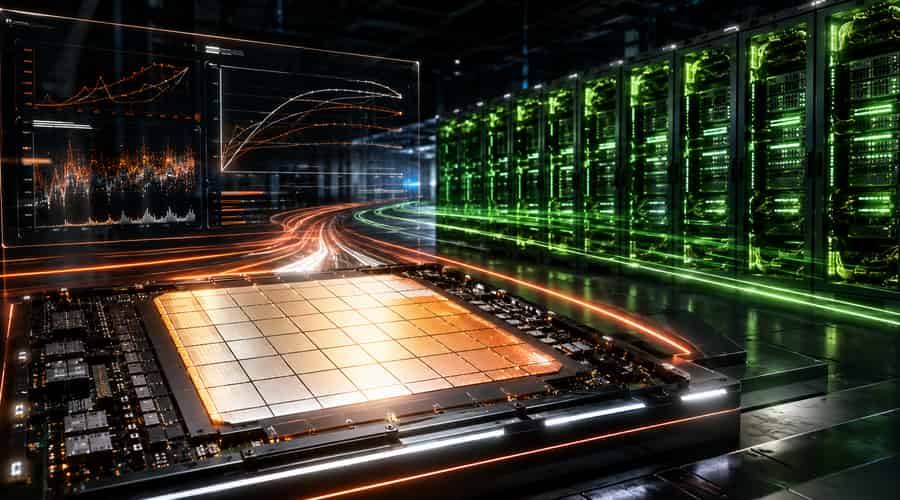
Cerebras is now serving Moonshot AI's Kimi K2.6 at nearly 1,000 tokens per second, a speed claim that puts wafer-scale silicon in direct conversation with Nvidia's dominance in AI inference.
The number matters because Kimi K2.6 is not a toy model and Cerebras is not pitching a curiosity. Cerebras said on Tuesday that it is running the trillion-parameter open-weight model for enterprise customers and that Artificial Analysis measured output at 981 tokens per second, a pace it described as far ahead of GPU-based cloud alternatives and 23 times faster than the median inference provider. That is the kind of benchmark that can change how startups think about latency, cost, and where their models should actually run.
The timing is also hard to ignore. Kimi K2.6 was released by Moonshot AI in April and quickly emerged as one of the most talked-about open-weight models in the market, with Artificial Analysis ranking it among the strongest open-weight systems on its Intelligence Index. The model has 1 trillion total parameters with 32 billion active per token, a scale that normally pushes buyers toward the biggest GPU stacks available. Cerebras is trying to prove that its wafer-scale architecture can do that work faster, and with less friction, than the default route through Nvidia hardware.
Inference is where the business gets real. Training grabs the headlines, but the lasting bill shows up when a company has to serve models all day, all week, to actual users and internal teams. If Cerebras can keep Kimi K2.6 near 1,000 tokens per second in production, then the conversation shifts from whether a startup can afford frontier models to whether it can afford not to use them. That matters most in coding and agentic workflows, where speed changes the user experience from waiting to iterating.
Cerebras said a 10,000-token request, including prompt processing, reasoning, and 500 output tokens, was completed in 5.6 seconds on its system, versus 163.7 seconds on the official Kimi endpoint. George Cameron, co-founder of Artificial Analysis, said the 981-token-per-second result was the fastest they have ever measured on a trillion-parameter model, which gives the claim a useful third-party frame. It is still a private endpoint measurement, so independent scrutiny will matter, but the size of the gap is enough to make the market pay attention.
The technical details help explain why Cerebras is leaning into the result. The company said it stores Kimi K2.6 in the model's original 4-bit weights while computing at 16-bit floating point, with weights distributed across wafers and activations streamed between them. Cerebras also said its wafer-scale engine keeps expert communication on-wafer at SRAM speeds rather than across a slower network fabric, which is exactly the kind of design choice that starts to matter when the model itself is enormous. In plain English, this is a hardware bet that the shortest path to faster inference is to stop behaving like a conventional GPU cluster.
The startup angle
For startups, the significance is less philosophical than financial. Large-scale AI products already live or die on unit economics, and the difference between a response that feels instant and one that feels sluggish can determine whether a tool becomes part of a workflow or gets abandoned. Cerebras is framing Kimi K2.6 as a real-time coding model, not just a benchmark leader, because agentic coding is one of the clearest places where speed translates into value. If developers can iterate inside the same session without waiting through long generation pauses, the model becomes more than a model, it becomes infrastructure.
That is also where Nvidia's position gets tested. Nvidia remains the default choice for most AI infrastructure, but the market is getting more selective about what it wants from compute. As model sizes rise and open-weight systems become more capable, buyers are looking for alternatives that can cut latency without forcing them to redesign their stack around a single vendor's assumptions. Cerebras is now arguing that wafer-scale hardware belongs in that conversation, not as an experiment, but as a commercially relevant serving platform for frontier models.
Moonshot AI, meanwhile, gets a second boost from the partnership. Kimi K2.6 already had momentum after its release, with support from multiple third-party platforms and broad attention for its coding and multimodal abilities. Having Cerebras attach a hard performance number to the model helps validate the idea that open-weight frontier models are no longer only about availability or cost. They are increasingly about where, and how fast, they can be served at scale.
The bigger picture is straightforward. If the 981-token-per-second result holds up under broader real-world use, Cerebras has a credible story for enterprises that want frontier-class inference without leaning entirely on GPU-based stacks. That does not end Nvidia's lead, but it does sharpen the pressure around a part of the market where efficiency now matters as much as raw capability. In AI infrastructure, speed is no longer just a feature. It is a competitive weapon.
Also read: CLARITY Act vote gives crypto startups a real shot at federal rules • Republicans push a hard CBDC ban as crypto rules advance in Washington • Standard Chartered's AI pivot and what it means for banks, vendors and fintechs