Observable Space has secured $90 million in Series A funding and a $94 million Space Force contract, putting fresh capital behind the less glamorous infrastructure that makes a crowded orbit manageable.
The space industry has a visibility problem. Satellites are multiplying, debris is not going away, and the orbital routes that once looked empty are becoming operationally crowded. Observable Space is trying to turn that problem into a business by combining telescope hardware, software, and defense demand into one vertically integrated company.
The company announced a $90 million Series A led by Lux Capital, with Upfront Ventures, Detroit Venture Partners, Island Green Capital, RTX Ventures, BRV Capital, Fathom Fund, Venrex and others participating. It also won a U.S. Space Force indefinite-delivery, indefinite-quantity contract worth up to $94 million, with $22 million in initial task orders already awarded. According to Bloomberg, the contract will help expand Observable's fleet of ground-based optical telescopes for satellite tracking, a capability the Pentagon increasingly needs as space becomes more contested and more commercial.
That distinction matters. Observable did not simply raise $184 million in venture capital. It secured $90 million in private funding and a separate government contract ceiling worth up to $94 million. For a young space company, that mix can be more valuable than a larger financing round by itself, because it pairs investor belief with an early customer that has a clear operational need.
Observable was formed in February 2025 through the merger of PlaneWave Instruments and OurSky. PlaneWave brought telescope manufacturing experience from Adrian, Michigan. OurSky brought software built around space observation data, led by Dan Roelker, a former SpaceX software executive. The combined company now sits in a useful part of the market: close enough to defense and commercial satellite operations to benefit from rising demand, but broad enough to sell into research, education, and advanced astronomy as well.
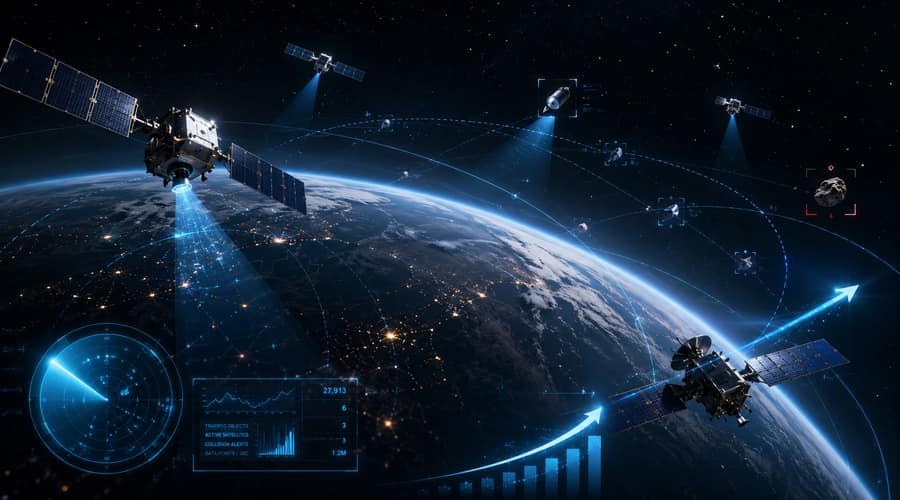
The company says its platform has executed 2.6 million automated tasks, identified more than 20 million targets, and completed 84,000 hours of continuous orbital monitoring. Those figures are not just marketing decoration. In space domain awareness, more observation time means better tracking, better prediction, and fewer blind spots when operators need to know whether an object is behaving normally or moving into a dangerous path.
Why vertical integration is back in favor
For much of the last decade, investors liked software layers that could sit on top of expensive physical systems. Observable points to a different mood in deep tech. The company designs and manufactures telescopes, runs the software that coordinates them, and sells the resulting capability to customers who need reliable space data. That gives it more control over performance, cost, and delivery speed than a business stitched together from outside suppliers.
The Space Force contract is also a reminder that orbital infrastructure is becoming a national security requirement, not a niche scientific service. The APFIT program is meant to move commercial technology into government use faster, and Observable's work centers on expeditionary optical ground stations that can support tracking across low Earth orbit, medium Earth orbit, and geostationary orbit. In plain terms, the government wants more eyes on space, and it wants them deployed quickly.
Observable is also preparing to launch its Iguana in-space imager this year on an Apex Space satellite bus. The compact payload, described as a 200mm three-aperture multispectral sensor, is designed for space domain awareness and rendezvous and proximity operations. The company says customers can buy the system with eight weeks of notice, which is a striking claim in a sector where hardware timelines often stretch for months or years.
The commercial side should not be overlooked. Satellite operators need collision avoidance. Research institutions need observation time. Advanced amateurs and educational customers still buy telescopes. Observable has also introduced consumer-facing products such as the Delta Rho 280 and FSCT8, while expanding manufacturing capacity in Michigan and entering European markets through a partnership with Baader Planetarium. That spread does not remove execution risk, but it gives the company more than one way to grow.
The AI angle is practical
The AI connection here is not about sprinkling fashionable language over a space story. Continuous orbital data can train models that support collision prediction, anomaly detection, spacecraft navigation, and automated tasking. If the space economy keeps expanding, the companies that own high-quality sensing networks will sit close to the data layer that future autonomy depends on.
Observable also has experience in optical communications, including work tied to NASA laser communications efforts. That places the company near another important infrastructure problem: moving large volumes of data between space and Earth. As satellites become more capable and orbital data centers move from speculation toward early business planning, bandwidth becomes a constraint. Optical links are one of the ways the industry hopes to ease it.
Roelker framed the opportunity directly in the company's announcement, saying companies and nations that can precisely track objects, navigate spacecraft, and communicate at terabit scale will define the next era of the space economy. That is the right way to read this funding round. It is not only a startup financing story. It is a signal that investors and defense buyers are putting money behind the physical systems that make space usable at scale.
The next test is execution. Observable has capital, a government contract, a manufacturing base, and a market that is moving in its direction. Now it has to prove that vertical integration can deliver speed without sacrificing reliability. If it can, orbital awareness may become less like a specialized service and more like the utility layer every serious space operator has to buy.
Also read: Morgan Stanley sees AI putting European bank jobs under pressure • Microsoft's AI cost data puts the labor savings story under pressure • AI hiring tools face fresh scrutiny after study finds racial bias