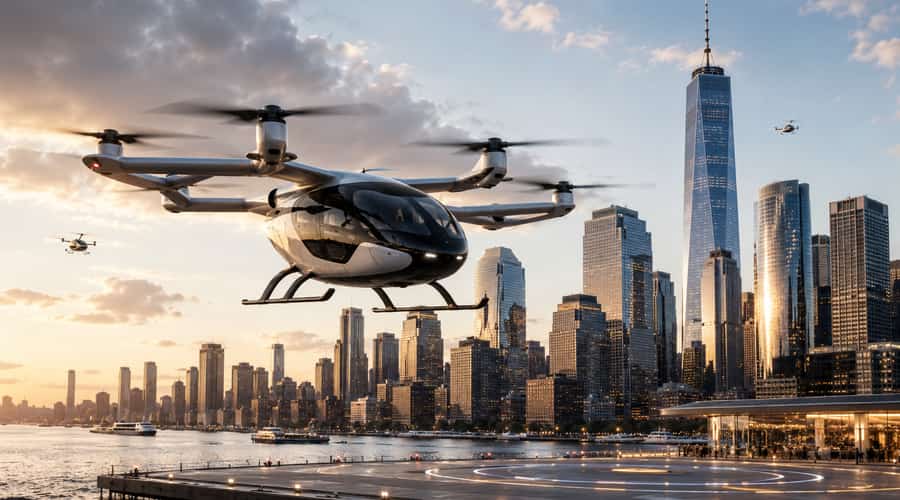
Joby's Manhattan flight was not a commercial launch, but it gave the air taxi market something it badly needed: a real-world proof point in one of the hardest cities to fly.
Joby Aviation has taken its electric air taxi over New York again, and this time the point was bigger than showing that the aircraft can rise quietly from a heliport. The company used Manhattan as a stage for the harder message: electric vertical takeoff and landing aircraft are moving from concept videos into the messy world of airports, regulators, city infrastructure and passenger habits.
That distinction matters. Plenty of startups have promised flying taxis. Far fewer have flown routes that look like the service they eventually want to sell. Joby's recent New York campaign connected John F. Kennedy International Airport with Manhattan heliports, including Downtown Skyport and the East 34th Street and West 30th Street sites. The flights were demonstrations, not passenger service, but they showed the basic commercial idea clearly enough: take a trip that can crawl through traffic for an hour and turn it into a short airport connection.
According to NYCEDC, Joby's aircraft flew from JFK to the city-owned Downtown Skyport in under ten minutes as part of a week-long demonstration campaign across the New York metropolitan area. That is the kind of number that gets attention in New York because the city already understands the pain point. Airport transfers are slow, unpredictable and expensive. The promise of electric air taxis is not that everyone will suddenly commute by aircraft. It is that a premium, high-frequency route may work first where time has a clear price.
For all the images of an aircraft above the skyline, Joby's market still depends on the Federal Aviation Administration. The company says its first FAA-conforming aircraft, registered N547JX, is now flying and will support Type Inspection Authorization testing. That is a serious step because TIA is where FAA pilots and inspectors begin the final for-credit work needed to validate whether the aircraft can be approved for commercial service.
The company has also been pulled into the White House-backed eVTOL Integration Pilot Program, known as eIPP. The FAA describes the program as a way to accelerate the safe deployment of advanced air mobility vehicles through public-private partnerships with state and local governments. Joby says it was selected through five applications covering up to 11 states, including New York, Texas and Florida.
This is where the market should pay close attention. Certification is not one document. It is aircraft design, pilot training, maintenance standards, airspace rules, charging infrastructure, local approvals and operational reliability all arriving close enough together to support a service people can actually book. A beautiful aircraft without a certified path is just an expensive prototype. A certified aircraft without places to land is not much better.
Joby appears to understand that. Its New York flights used existing heliport infrastructure, which is a practical starting point. The company is also leaning on the Blade network it acquired, which served more than 90,000 passengers in 2025 across the same kind of premium routes Joby wants to electrify. That gives it something many aerospace startups do not have: a customer base and operating footprint before the new aircraft is fully commercial.
Capital may decide who reaches service first
The other part of the race is money. Electric aviation is not software. It burns capital through certification, manufacturing, testing, facilities, pilots, parts, insurance and regulatory work long before recurring passenger revenue can carry the business. In that environment, balance sheet strength is not a footnote. It is a competitive weapon.
Joby's May 5 shareholder letter showed $2.5 billion in cash, cash equivalents and short-term investments as of March 31, 2026. First-quarter revenue was $24 million, driven mostly by the Blade business, while the company posted a $110 million net loss and a $179 million adjusted EBITDA loss. Those losses are not surprising for a company trying to certify and manufacture a new aircraft category, but they show why access to capital matters.
Archer Aviation, Joby's most visible U.S. rival, also remains well funded. Archer reported about $1.8 billion in liquidity at the end of the first quarter and is pursuing its own 2026 operational plans. The competition is useful for the sector because it keeps pressure on both companies to turn demonstrations into certifiable, repeatable service. It also means investors should not treat a skyline flight as a finish line.
Toyota's role gives Joby another advantage. The automaker has been a strategic backer and manufacturing partner, and that kind of industrial experience is valuable when the challenge shifts from building a few aircraft to producing many aircraft consistently. In aviation, scale without discipline is dangerous. Manufacturing credibility may be just as important as battery performance.
The next phase will be less glamorous than a Manhattan flyover, but more important. Watch for FAA pilots beginning deeper TIA work, eIPP agreements turning into actual operating scopes, and infrastructure upgrades at heliports moving from announcements to usable capacity. Joby has shown that the route can be flown. Now it has to prove that the business can be certified, staffed, maintained and repeated.
Also read: OpenAI's Codex limit reset shows coding agents are entering costly scale • Asian AI startups are becoming the next stop for Silicon Valley windfalls • Bloomberg's Africa list shows Nigerian startups are solving harder problems