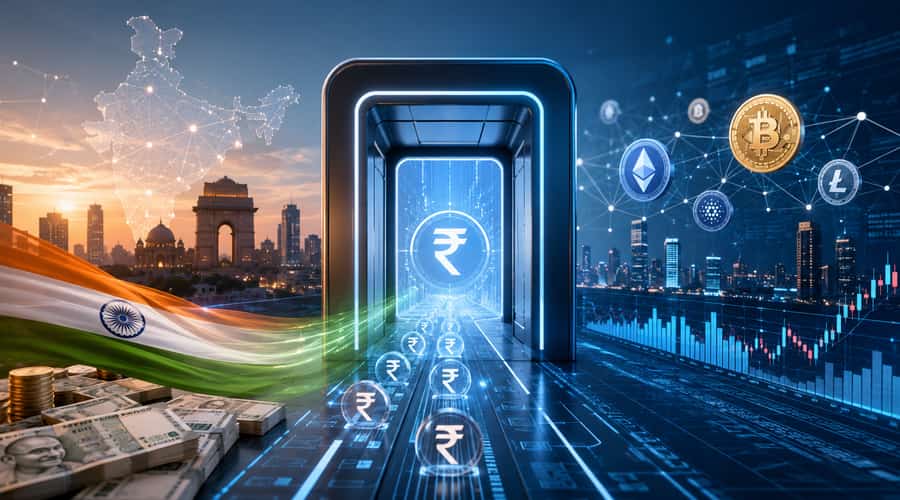
Coinbase is giving Indian users a simpler way into crypto, and that changes the fight for one of the industry's most important retail markets.
Coinbase has opened direct Indian rupee deposits and withdrawals for users in India, turning a market that was once awkward to enter into a much more serious battleground. Indian customers can now move INR through IMPS, trade spot crypto markets, and access perpetual futures on the same platform, instead of depending on peer-to-peer workarounds or offshore routes.
This matters because India has never been a small prize. It has a large base of retail traders, a deep developer community, and a young population that already understands mobile-first finance. The problem has always been the same: regulation has been unclear enough to slow serious operators, while taxes have been heavy enough to push activity into less transparent corners of the market.
According to Reuters, Coinbase is now allowing users in India to trade using the rupee, a notable expansion for the U.S.-listed exchange after it discontinued services in the country in 2023 and later returned following registration with India's Financial Intelligence Unit. That registration is not a minor detail. In India, crypto companies need to show they can operate inside the anti-money-laundering framework before they can credibly talk about scale.
India's crypto market has been shaped by a hard mix of demand and restraint. The government introduced a 30% tax on gains from virtual digital assets in 2022, along with a 1% tax deducted at source on certain transfers. That did not kill crypto interest, but it did change behavior. Domestic exchanges saw pressure. Many users shifted toward offshore platforms, informal funding routes, or simply traded less often.
Coinbase is trying to reverse part of that friction. Direct INR rails mean a user can deposit from a local bank account, buy and sell without first finding a peer-to-peer counterparty, and withdraw back into rupees when needed. That sounds basic, but in a market where payment access has been a recurring problem for crypto exchanges, basic can be powerful.
The company is also leaning into infrastructure, not just brand recognition. Coinbase says it has built local INR order books for Indian customers, which should help liquidity and execution if volume arrives. It also says there are no INR deposit fees, while advanced users get APIs, order book streaming, and integrated TradingView charting. Those details matter because the next phase of Indian crypto is not only about first-time buyers. It is also about traders who care about spreads, execution quality, and whether the venue will still be there when rules tighten.
This is where the competitive pressure starts. CoinDCX and other local exchanges have built their businesses around Indian users, local compliance, and domestic support. WazirX, once one of the best-known Indian names, has spent the period after its 2024 security breach fighting to regain confidence after more than $230 million in crypto assets were reported stolen. Trust is no longer a marketing line in this market. It is the product.
Coinbase is selling compliance as much as access
Coinbase's advantage is not that Indian users have never heard of crypto. They have. The advantage is that a regulated, Nasdaq-listed exchange can present itself as a cleaner route into a market where users have become familiar with hacks, blocked withdrawals, confusing tax rules, and payment interruptions. For a certain type of customer, especially higher-volume traders, that may be enough to test a new platform.
The company is also already tied into the local ecosystem. Coinbase says it is an investor in CoinDCX, has supported Indian builders through Base grants and hackathons, and has put more than $1 million into developer programs connected to its layer-2 network. More than 4,000 builders in India have built on Base, according to the company, with about 150 projects becoming startups. That gives Coinbase a second path into India, through developers and founders rather than only retail trading.
There is still a real risk here. India has not suddenly become an easy crypto market because one exchange added rupee support. The tax structure remains demanding. Regulators remain cautious. Banks may still treat the sector carefully. And perpetual futures, while attractive to active traders, bring their own questions around suitability and consumer protection.
But the direction is worth watching. Coinbase is not entering India as if it expects a quick policy miracle. It is entering as if the market is too large to wait for perfect clarity. That is often how serious international expansion works in crypto: secure the registration, solve the payment problem, build liquidity, and let the rulebook catch up.
For Indian users, the practical change is simple. A major global exchange has made rupee access easier at a time when trust in trading venues still matters. For local exchanges, the message is sharper. The next fight will be about compliance, execution, liquidity, and who can make crypto feel less like a workaround.
The bigger signal is that global crypto companies are no longer treating India as a market to revisit someday. They are positioning now. If regulators offer more clarity in the months ahead, Coinbase will already have its rails in place, and that could make India one of the most important tests of whether compliant crypto can scale in a high-demand, high-friction market.
Also read: A home Bitcoin miner won a rare block with a $300 machine • Stablecoins are turning dollar dominance into a digital policy fight • MegaETH's token slump is putting its real-time blockchain thesis on trial