Binance is no longer trying to keep crypto and stock trading in separate lanes. Its new stock product puts the exchange directly into brokerage territory, where compliance matters as much as convenience.
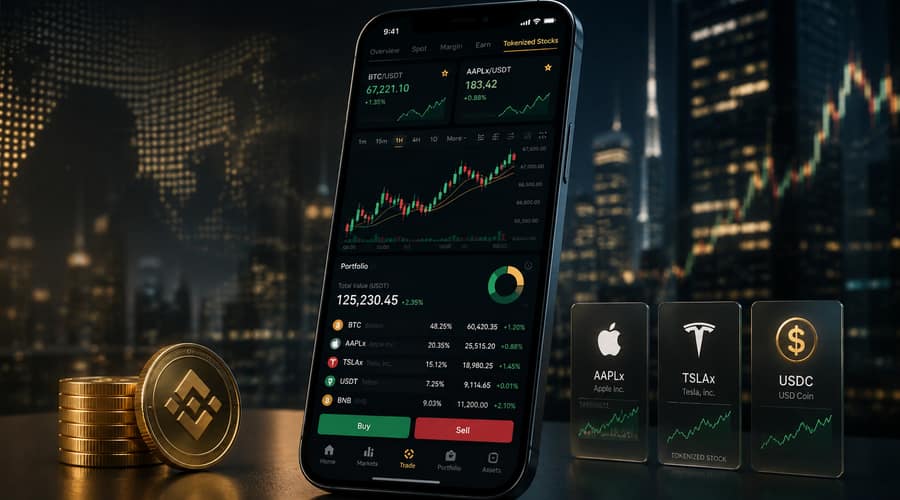
Binance has made its clearest move yet into mainstream investing by adding access to more than 7,000 U.S. stocks and ETFs for customers outside the United States, with zero commissions and fractional purchases starting at $5. That is not just a product launch. It is a statement about where the world's largest crypto exchange thinks retail finance is heading.
For years, crypto exchanges tried to persuade users that digital assets were a separate financial system. Now the smarter play looks different. Bring stocks, ETFs, stablecoins and tokenized assets into one app, then let users move between them without feeling as if they have crossed into a different market. Binance is calling this part of a broader super app strategy, and the logic is easy to understand. If a trader already holds USDT, USDC or BNB, Binance wants that same balance to become a gateway into Apple, Nvidia, the S&P 500 or whatever comes next.
According to Fortune, Binance co-CEO Richard Teng said the service is aimed at non-U.S. customers who often face higher costs and more friction when trying to buy American shares. Nest Trading is expected to arrange the stock trades, while Alpaca, the New York-based brokerage infrastructure firm, will handle custody, dividends and corporate actions. That structure matters because it tells regulators and users that Binance is not simply wrapping equities in a crypto label and hoping nobody asks questions.
The first part of the product is familiar. Zero-commission stock trading has been around for years, and Robinhood made it a default expectation for a generation of retail investors. What is different here is the user base. Binance is not chasing the same customer from a standing start. It already has a global audience that understands stablecoins, wallet balances and trading around the clock.
That gives the company a practical wedge. Many overseas investors want exposure to U.S. equities, but the path can be fragmented, expensive or slow depending on where they live. If Binance can make that access feel as simple as swapping one crypto asset for another, it can pull traditional financial activity into a crypto-native interface. That does not mean users are abandoning crypto. It means the app becomes harder to leave.
The second part is more ambitious. Binance says it plans to introduce bStocks, a product that would let users tokenize equities they purchase and move them onto BNB Chain. In plain English, the company wants a route from regular stock exposure into programmable, on-chain assets that could eventually be used in lending, liquidity provision or other DeFi-style applications. That is the bigger bet. A stock is no longer just something held in a brokerage account. It becomes collateral, a transferable digital object and a piece of market infrastructure.
This is where the promise and the risk sit close together. Tokenized shares can make markets more accessible and more flexible, especially for investors outside large financial centers. But they also raise hard questions about ownership, redemption, custody, investor rights and what happens when a token trades outside normal market hours while the underlying security does not. A user may see a familiar ticker, but the legal and operational reality may be very different from owning a share through a traditional brokerage account.
Regulators will not treat this as a simple app feature
The timing is important. In January 2026, SEC staff published a statement explaining how existing securities laws apply to tokenized securities, including issuer-sponsored and third-party models. That is useful for the industry because it gives the market a clearer map. It is not a free pass. Tokenization may change the plumbing, but it does not make a security stop being a security.
Binance also carries history into this launch. In November 2023, the company pleaded guilty to U.S. anti-money laundering and sanctions violations and agreed to pay $4.3 billion in penalties, while also accepting compliance remediation and an independent monitor. That settlement still frames how policymakers view the exchange. A move into U.S.-listed equities, even for non-U.S. customers, will be judged against that record.
The broader regulatory backdrop is moving too. Stablecoin rules in Washington have advanced from years of argument into a more formal framework, with U.S. agencies now writing implementation rules under the GENIUS Act. That matters because Binance's stock product depends on stablecoins and digital balances feeling normal enough to use for traditional assets. The clearer the rules become around dollar-backed tokens, the easier it is for exchanges to build products that look less like crypto speculation and more like everyday investing.
For traditional brokers, the warning is straightforward. The next competitor may not look like a brokerage at all. It may be a crypto app with a global user base, stablecoin balances and a product team willing to collapse several financial activities into one screen. That puts pressure on incumbents to make cross-border investing cheaper and more useful, not just more compliant.
For Binance, the test is sharper. It has to prove that convenience does not come ahead of controls. If bStocks works cleanly, the company could help push tokenized equities from niche experiment toward mainstream habit. If regulators see weak disclosures, unclear rights or sloppy market plumbing, the launch could become another reminder that financial super apps still have to earn trust one regulated product at a time.
Also read: Coinbase opens a direct rupee gateway into India's crypto market • A home Bitcoin miner won a rare block with a $300 machine • Stablecoins are turning dollar dominance into a digital policy fight