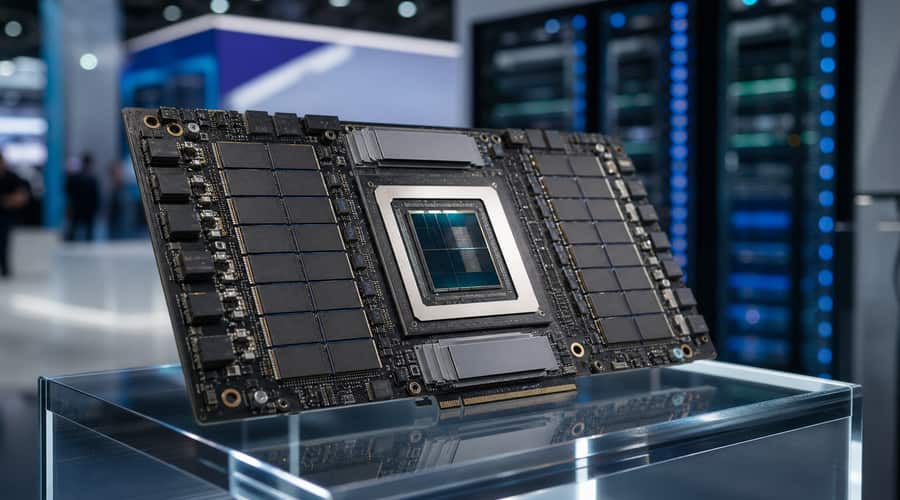
Intel used Computex 2026 to sharpen the pitch for Crescent Island, a data center GPU built for AI inference with up to 480GB of LPDDR5X memory and a much lower power envelope than Nvidia's top-end accelerators.
Intel's Crescent Island is not trying to beat Nvidia by copying Nvidia. That is the point. The chip, detailed at Computex 2026, is aimed at a market where AI inference is becoming as much a memory and deployment problem as a raw compute contest.
As Tom's Hardware reported, Crescent Island is based on Intel's Xe3P architecture and is designed for AI inference workloads rather than training. The standard reference configuration carries 160GB of LPDDR5X memory, while Intel says the platform can scale to as much as 480GB. That figure is the headline, because it gives Intel a clean way to talk about large-model deployment without pretending it has already solved Nvidia's software advantage.
Nvidia's Blackwell B200 remains the benchmark for high-end AI acceleration, with 192GB of HBM3e memory and roughly 8TB/s of bandwidth. It also sits inside a broader infrastructure story involving dense racks, high power draw, and advanced cooling in many deployments. Intel's counterargument is more practical: Crescent Island is built around a 350-watt, air-cooled PCIe design that could fit into a wider range of enterprise servers.
The memory choice matters as much as the capacity. By using LPDDR5X instead of HBM, Intel is stepping around one of the tightest supply constraints in AI hardware. HBM capacity from suppliers such as SK Hynix, Samsung, and Micron has become a central bottleneck for accelerator production, and every major AI chip vendor is fighting for allocation. LPDDR5X is not as fast as HBM, but it is cheaper, lower power, and available in a supply chain that server builders already understand.
That tradeoff should not be waved away. Bandwidth is often the limit in inference, especially when large models need to stream weights quickly through the processor. A B200's HBM3e bandwidth is in a different class from LPDDR5X, and that gives Nvidia a clear advantage in many workloads. Crescent Island's case is different. It is about fitting more of the model on one card, reducing power and cooling demands, and giving buyers another option when HBM-heavy systems are expensive or hard to source.
Hardware ambition has never been Intel's biggest problem in AI accelerators. Its Gaudi chips attracted real enterprise attention, but the market kept coming back to the same question: can Intel make the software experience good enough for teams that are already comfortable with Nvidia's CUDA ecosystem? CUDA is not just a toolkit. It is fifteen years of libraries, optimization habits, developer muscle memory, and production workflows.
Intel is answering that with oneAPI and a broader open software pitch. The company is also using its Arc Pro Series B products as a proving ground before Crescent Island reaches customers in volume. That matters because enterprise buyers do not want a promising chip that becomes a systems integration project. They want frameworks, kernels, drivers, and deployment tools that behave predictably from the first serious pilot.
The Buyers Intel Can Reach First
The best early audience for Crescent Island may not be the average enterprise AI team. It is more likely to be cloud providers, model companies, and large technology groups with enough engineering depth to tune their own stacks. Companies such as Meta, Amazon, and Google already work across custom silicon, internal frameworks, and non-CUDA infrastructure when the economics justify it. For those buyers, a high-memory, lower-power accelerator could be useful even if it does not replace Nvidia across the board.
The broader enterprise market will be harder. Teams that depend on PyTorch defaults, Hugging Face integrations, vendor examples, and proven deployment patterns will be slower to move unless Intel's software story is unusually polished. A procurement team may like the power profile and memory capacity, but developers still decide whether the hardware becomes a productive platform or a stranded purchase.
Timing Is The Real Test
Intel says customer sampling is targeted for the second half of 2026, which means meaningful revenue is probably a 2027 story. That gives Intel time to harden the product, but it also gives rivals time to move. Nvidia's Rubin architecture is on the roadmap, and AMD continues to push its MI-series accelerators deeper into enterprise and cloud accounts.
That is why Crescent Island is best understood as a credible opening, not a victory lap. Intel has identified a real pressure point in AI infrastructure: memory capacity, power draw, cooling complexity, and supply chain exposure are becoming boardroom issues, not just engineering details. If Crescent Island can deliver its promised capacity without making software adoption painful, Intel finally has a sharper argument in a market where it has spent too long sounding like a distant alternative.
For buyers planning AI infrastructure today, the practical takeaway is simple. Nvidia remains the default, AMD is gaining room, and Intel now has a product worth watching for inference-heavy deployments where memory capacity and power efficiency matter more than peak bandwidth alone.
Also read: Hewlett Packard Enterprise surges 37% as its AI infrastructure bet turns into the biggest earnings beat in years • Alphabet is raising $80 billion in equity to win the AI infrastructure arms race and Warren Buffett is buying in • Anthropic's Claude Opus 4.8 outpaces GPT-5.5 on benchmarks while making AI agents smarter and more honest