Cerebras is trying to make Nvidia's absence look like proof of its independence. That matters because enterprise AI buyers are no longer just asking who has the fastest chip, they are asking who can help them avoid being locked into one stack.
Cerebras Systems has picked a sharp way to describe its place in the AI infrastructure race: it says it is working with every major AI hardware manufacturer except Nvidia. That is not just a partnership update. It is a positioning statement aimed directly at the market's biggest pressure point.
Nvidia still owns the center of gravity in AI compute. Its GPUs, networking gear, software stack and developer ecosystem remain the default choice for companies training and serving large models. But that dominance has created a second market alongside the first one. Cloud providers, model labs and enterprise buyers now want credible alternatives, not because Nvidia is weak, but because relying on one supplier for the most important technology budget of the decade is a risk.
According to a Bloomberg Technology report published Thursday, Cerebras is now presenting itself as the company that can work across the rest of the AI hardware ecosystem while Nvidia stands apart. The wording is deliberate. It frames Cerebras less as a single chip challenger and more as infrastructure that other chip companies, cloud operators and AI builders can plug into as they look for leverage.
That is where the story becomes bigger than one startup. AI video, agentic software, search, coding tools and enterprise assistants all depend on fast and affordable inference. Training gets the headlines, but inference is where cost discipline becomes painful because users keep coming back. If a model answers millions of prompts or generates video clips on demand, the economics can quickly become brutal.
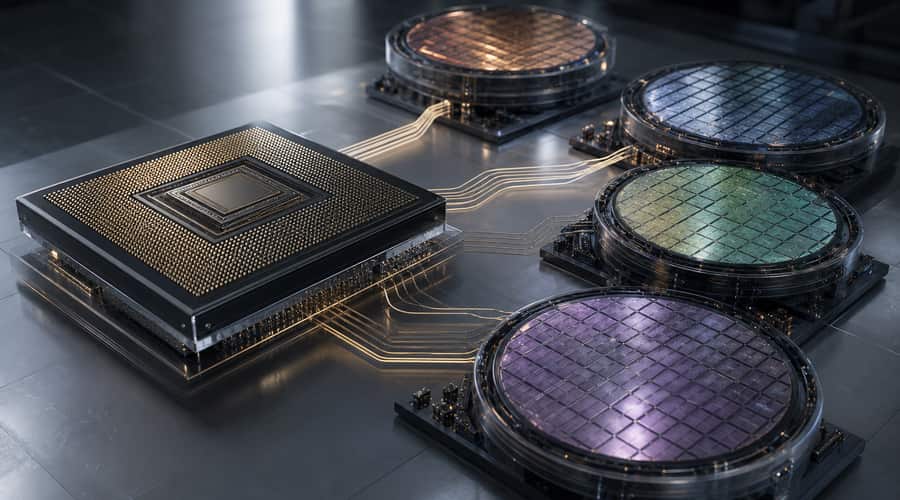
Cerebras is best known for its wafer-scale chips, including the CS-3 system powered by the Wafer Scale Engine 3, which the company says contains about 4 trillion transistors and 900,000 AI-optimized cores. The point of that design is simple to understand even if the engineering is not: instead of breaking workloads across many smaller chips, Cerebras puts a much larger slice of compute on one wafer and tries to reduce the movement of data between separate devices.
That architecture has helped Cerebras market itself to buyers that care about speed, latency and the ability to serve large models without building everything around Nvidia GPUs. The company has also been expanding its cloud inference business, which makes the competitive claim more practical. A chip company selling access to compute can meet customers where they are, especially when many AI teams do not want to own every layer of infrastructure themselves.
This is why the Nvidia exclusion is useful for Cerebras. It tells the market that if a buyer is assembling an AI strategy with AMD, cloud providers, custom silicon, open models or specialized accelerators, Cerebras wants to be part of that conversation. It also tells Nvidia that Cerebras sees no value in pretending the relationship is neutral.
For companies building AI video products, this is not a switch that suddenly makes generation cheap. Video remains one of the most compute-hungry areas in AI because it combines image quality, motion consistency, prompt understanding and long context. But any serious improvement in inference performance changes the product conversation. It can mean shorter wait times, more experimentation and lower unit costs for features that once felt too expensive to ship broadly.
Competition is moving beyond chips alone
The hard part for Cerebras is that nearly every AI chip startup wants to be the alternative to Nvidia. Groq has made speed its calling card in inference. Tenstorrent is pushing a broader vision around AI processors and open hardware. AMD has the scale, customer relationships and balance sheet to keep pressing forward. Cloud providers including Amazon, Google and Microsoft have their own silicon strategies because they also do not want to rent the future from one vendor forever.
That means Cerebras has to prove that its partnerships are more than a clever contrast with Nvidia. Investors and customers will want to know whether these integrations translate into recurring revenue, higher utilization and durable software adoption. Hardware alone is not enough in this market. Nvidia's real advantage is not only the GPU, it is the full system around it.
There is also a public market angle here. Cerebras has moved from IPO candidate to newly listed AI infrastructure name, which raises the pressure on every claim it makes about demand, differentiation and customer reach. Its filing showed both impressive growth and heavy customer concentration, a combination that can excite investors while also making them more sensitive to whether revenue depends too much on a small group of buyers.
Still, the timing is good for Cerebras. Enterprises are past the stage of treating AI infrastructure as a science project. They are asking harder questions about cost per token, latency, model portability, supply availability and whether their architecture will still make sense in two years. A vendor that can credibly say it works across the non-Nvidia world has a clearer opening than it did during the first wave of the GPU shortage.
The next thing to watch is whether Cerebras turns this broad industry alignment into named deployments and measurable cloud demand. Partnerships are useful, but the market will judge the company on workloads. If AI video, real-time agents and high-volume enterprise inference keep growing, buyers will keep looking for compute that is faster, cheaper and less dependent on a single supplier. That is the opening Cerebras is trying to own.
Also read: Liftoff tests whether the tech IPO window is really open • TSMC's AI chip warning puts video startups back on a clock • Monterey Park has turned data centers into a local political fight