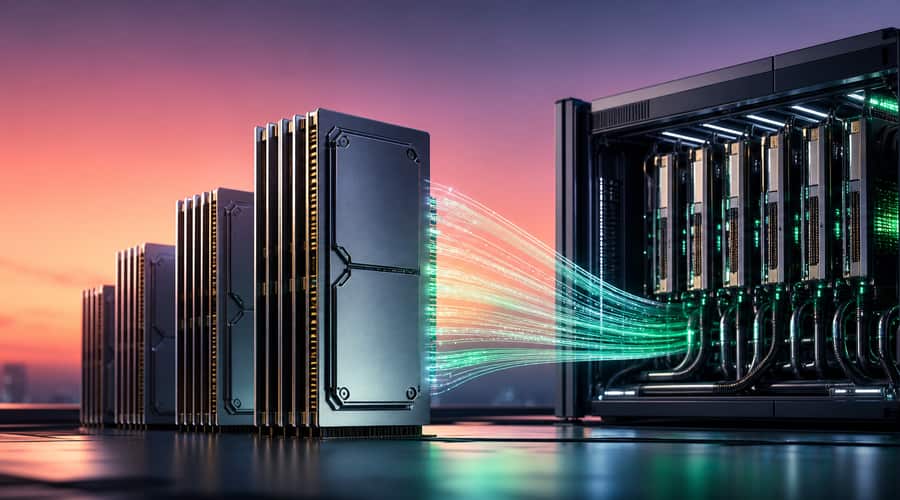
Nvidia is moving Vera Rubin from promise to production, and the memory supply chain is now the part to watch.
Nvidia has qualified Samsung Electronics, SK Hynix and Micron Technology as HBM4 suppliers for its Vera Rubin AI platform, giving the company a broader memory base just as the next phase of AI infrastructure spending begins to take shape.
That matters because GPUs are no longer judged only by raw compute. For large AI models, memory bandwidth is one of the hard limits. If data cannot move quickly enough between memory and the accelerator, expensive chips sit waiting. HBM4 is designed to ease that constraint, and Vera Rubin is the first Nvidia platform where the new memory generation becomes central to the commercial story.
As Bloomberg reported Friday, the qualification of all three dominant HBM makers marks a key step in Nvidia's production ramp. It also changes the balance of power in a market that has been unusually tight since the Blackwell cycle began. SK Hynix built an early lead in advanced HBM supply, Micron pushed aggressively into HBM3E and HBM4, and Samsung has been working to recover ground after lagging in earlier Nvidia qualifications.
The bigger point is simple. Nvidia does not want the next AI chip cycle to depend too heavily on one memory supplier. Hyperscalers such as Microsoft, Amazon, Google and Meta are planning data center orders at a scale where a single component shortage can delay entire racks. Qualifying three suppliers gives Nvidia more room to allocate volume, negotiate pricing and absorb manufacturing bumps that are common when a new memory standard moves into mass production.
High-bandwidth memory is not a glamorous part of the AI stack, but it is one of the most valuable. It sits close to the GPU and feeds it data at far higher speeds than conventional memory. That is why Nvidia's newest systems are increasingly discussed as full rack-scale platforms rather than individual chips. The GPU, CPU, networking, cooling and memory have to be designed together.
Nvidia has said Vera Rubin NVL72 combines 72 Rubin GPUs and 36 Vera CPUs, connected through its next-generation NVLink system. The company also says the platform uses HBM4 and is built for heavier agentic AI workloads, reinforcement learning and inference at scale. These are not small desktop workloads. They are the kind of systems that cloud providers buy by the thousands when they believe demand is durable.
Micron has already disclosed that its 36GB 12-high HBM4 stack for Vera Rubin entered volume shipment in the first quarter of calendar 2026, with bandwidth above 2.8 terabytes per second and more than 20 percent better power efficiency than its comparable HBM3E product. Those figures show why memory is becoming a strategic asset. Better bandwidth and efficiency can lower the cost per token, which is now one of the most closely watched numbers in the AI business.
Samsung is fighting for the same prize. The company has showcased HBM4 designed for Vera Rubin and has said it can deliver consistent processing speeds of 11.7 gigabits per second, with room to move higher. SK Hynix, meanwhile, remains the supplier everyone else is trying to catch. Recent reports have put its share of the HBM market well ahead of rivals, and its chairman has signaled that wafer capacity will need to rise sharply as AI demand continues.
The memory race will shape data center costs
For customers, the question is not only whether Vera Rubin ships. It is what the system costs once memory, networking, power and cooling are included. HBM is expensive to make, difficult to package and capacity constrained. When Nvidia increases performance by adding more advanced memory, the bill moves through the supply chain and eventually lands in cloud pricing, AI model economics and enterprise deployment budgets.
That is why having three qualified suppliers is more than a procurement detail. If Samsung, SK Hynix and Micron all compete for Vera Rubin allocations, Nvidia has a better chance of keeping the platform on schedule and limiting the worst pricing pressure. It does not mean HBM4 will be cheap. It means the market has more paths to volume at a time when customers are already worried about the cost of building AI factories.
The timing is also important. Nvidia announced at GTC Taipei that Vera Rubin is ramping into full production, while the broader ecosystem of server makers, memory companies and networking suppliers is already positioning around second-half 2026 deployments. Supermicro and other system builders are showing Rubin-based rack designs. Micron is pairing HBM4 with new SSD and SOCAMM2 products for the same platform. This is what a hardware cycle looks like before revenue fully shows up.
Investors should be careful, though. A supplier being qualified does not mean equal share. SK Hynix may still receive the largest early allocation. Samsung may win more business if it proves yield and performance at scale. Micron may benefit from being deeply integrated across memory and storage, but it is still competing against two larger Korean memory groups with massive production footprints.
The next signal to watch is not another keynote. It is allocation. Once Nvidia's orders become clearer, the market will have a better read on which memory maker captures the richest share of Vera Rubin and how much HBM4 pricing holds as production expands. For now, the message is clear enough: the next AI spending wave is moving from GPU headlines into the memory supply chain, and that is where some of the most important economics will be decided.
Also read: AI has crossed a new line in the Turing test • Singapore is putting AI agents on a government register • AI designed vaccines are moving from theory into human trials