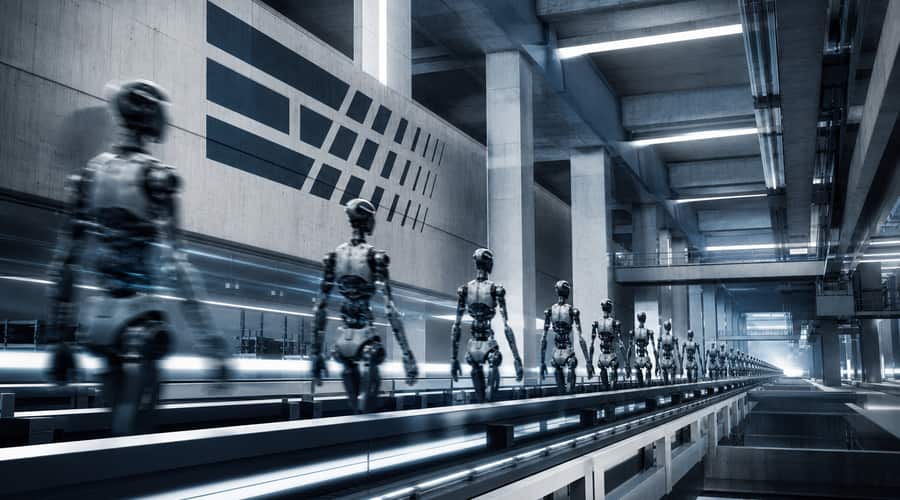
China's humanoid robot race is no longer just a contest of demos. AgiBot has reached a production scale that forces Western robotics startups to answer a harder question: who can actually manufacture this category at volume?
AgiBot's 10,000 robot milestone landed quietly in the West, but it says a great deal about where humanoid robotics is moving. The Shanghai company, also known as Zhiyuan Robotics, announced on March 30 that its 10,000th humanoid robot had rolled off the production line, putting it in a different commercial conversation from companies still proving pilots one warehouse or factory at a time.
The timing matters because the broader market is now catching up to the claim. As the Associated Press reported on June 6, Omdia data shows more than 13,000 humanoid robots shipped globally in 2025, with AgiBot shipping 5,168 units and Unitree shipping 4,200. Figure AI, Agility Robotics and Tesla each shipped about 150. That does not mean Chinese robots are already better in every practical task. It does mean China has moved faster from prototype theater to repeatable production.
For founders and investors, that is the part worth paying attention to. Hardware categories rarely reward the company with the cleanest demo for long. They reward the company that learns faster through manufacturing, service, defects, customer feedback and supplier discipline. Ten thousand units create a different learning loop from 150 units. Every actuator failure, battery issue, damaged joint, software crash and customer complaint becomes data that improves the next production run.
Humanoid robots are expensive because they combine almost every hard problem in modern hardware: precision motors, sensors, batteries, compute, balance, manipulation and software that has to survive outside the lab. A small batch keeps all of those costs stubbornly high. A larger run does not magically make the machine cheap, but it starts to pull the cost curve in the right direction.
That is why AgiBot's number matters even if some of the shipped robots are used for service, education, demonstrations or structured industrial tasks rather than fully autonomous factory work. Volume gives a company bargaining power with suppliers. It gives its engineers more chances to simplify parts. It lets manufacturing teams standardize assembly and testing. It also gives sales teams something more concrete than a roadmap.
The margin story follows the same logic. Early humanoid makers are unlikely to enjoy clean software-style margins because the machines are physical, service-heavy and failure-prone. But the first companies to reach meaningful production can begin to separate fixed engineering cost from unit economics. Once that happens, gross margin stops being a distant investor slide and becomes an operating target.
China's advantage is not only one company. TrendForce said in April that China's humanoid robot output is expected to surge 94% in 2026, with Unitree and AgiBot projected to capture nearly 80% of shipments. The country also has a deep electronics supply chain, aggressive local governments and large industrial customers willing to test domestic platforms. In 2025, AP noted, more than 2 billion yuan, or about $295 million, in orders came from Chinese state-owned enterprises for uses including power plants, data centers and entertainment.
The Western response has to get practical
Western robotics startups still have strong cards. Figure AI has shown work with BMW, Agility has real logistics experience through Digit, and Tesla has manufacturing ambition few companies can match. Nvidia's push into physical AI also gives the sector a stronger software and simulation backbone. But the gap between a controlled pilot and a scaled installed base is not a branding problem. It is an execution problem.
This is where venture-backed robotics faces a difficult adjustment. Investors love the story of general-purpose humanoids because it looks like a massive labor market in machine form. Customers are more practical. They want uptime, safety, service contracts, task completion and a payback period that can survive a CFO review. A robot that looks impressive on video but cannot reliably perform narrow work will not carry a premium forever.
AgiBot's milestone also puts pressure on pricing. Unitree has already pushed attention toward lower-cost humanoids, while AgiBot's own X2 compact humanoid has appeared internationally at a reported price far below the six-figure expectations often attached to advanced robots. Cheaper does not always mean enterprise-ready, but lower prices expand the testing pool. More testing creates more usage data. More data improves the product.
The risk for Chinese companies is demand quality. Building 10,000 robots is one achievement. Keeping them useful, serviced and economically justified is another. State-backed demand can accelerate an industry, but it can also hide weak commercial pull if customers are buying for policy alignment rather than productivity. The next test is not whether AgiBot can produce more robots. It is whether those robots can keep working in places where the buyer measures output every day.
For Western founders, the lesson is blunt. The humanoid market is entering the phase where manufacturing capacity, supplier relationships and deployment discipline matter as much as model intelligence. The companies that win will not be the ones that talk most convincingly about general intelligence in a body. They will be the ones that turn messy physical work into a product customers keep renewing. AgiBot has not settled that race, but it has changed the starting line.
Also read: Alphabet turns to shareholders to fund its AI buildout • Private credit is cooling just as founders need cleaner financing options • Strategy's Bitcoin bet is testing the limits of conviction