Washington's warning to ASML is not just about one machine. It is about whether the West can still police the most important chokepoint in advanced chipmaking.
If you want to understand how fragile the U.S.-led chip export regime is, start with the message Washington reportedly delivered to ASML on June 18. Bloomberg reported that Commerce Secretary Howard Lutnick's team told the Dutch company that one of its EUV lithography machines may have reached China, even though ASML has never been allowed to sell that class of tool there. ASML shares fell after the report. They should have. One machine is enough to make the whole system look less solid.
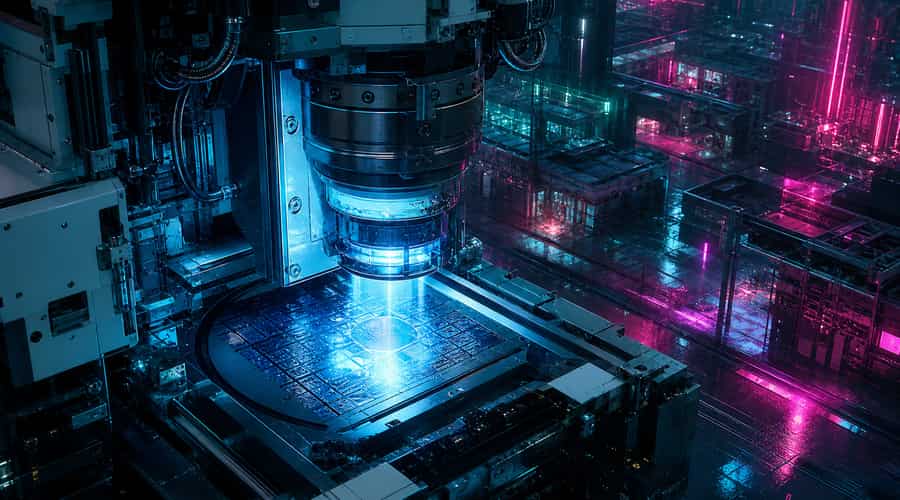
EUV, or extreme ultraviolet lithography, is not a server blade that disappears in a warehouse. ASML's machines are bus-sized systems that weigh about 180 metric tons and sell for hundreds of millions of dollars. The newest High NA models are even more expensive. They use lasers, molten tin and a mirror system made with absurd precision to print the smallest chip patterns at industrial scale. ASML is the only company in the world that sells them. Since 2019, under U.S. pressure and Dutch export rules, China has been blocked from buying them.
That is why the Bloomberg report matters. For years, the core assumption behind the controls was simple: China could buy older deep ultraviolet equipment, but it could not get EUV. SMIC and Huawei could push DUV harder, use multipatterning and accept lower yields, but the most valuable tool remained out of reach. If an EUV system, or enough of one to study and rebuild, has made it into China, that assumption is broken.
The business pressure on ASML is real. China accounted for about a third of ASML's 2025 revenue, according to the company's own reporting and analyst coverage, largely through legal sales of older DUV systems. ASML has said it expects China to fall toward about 20% of revenue in 2026 as restrictions tighten. That is still a large customer for a company that sits at the center of the chip supply chain. ASML has been trying to keep two statements true at once: it can keep selling and servicing permitted equipment in China, and it has kept EUV out of the country. Washington has now put the second statement under public strain.
Here's the thing: this didn't come out of nowhere. Reuters reported in December 2025 that China had built a prototype EUV machine in a high-security Shenzhen facility with help from former ASML engineers. That report said recruits were offered signing bonuses of roughly $420,000 to $700,000 and that the prototype could generate EUV light, but had not yet produced a working chip. That last caveat matters. Generating EUV light is not the same as making reliable chips at scale. Still, you don't need to be ASML's chief engineer to see why Washington is nervous.
ASML chief executive Christophe Fouquet has previously said China remains years behind the frontier. He may still be right. But timelines in semiconductors move when a blocked country can study real hardware instead of patent filings, conference papers and second-hand fragments. A working ASML machine in China would be more than a trophy. It would be a reference model.
The weaker point in the control regime has always been the older gear. Chinese fabs have been buying and upgrading ASML's Twinscan NXT DUV systems, then using independent engineers and third-party suppliers to squeeze more performance out of tools that were not designed to carry the full burden of advanced-node production. The Center for a New American Security flagged that pattern this year, warning that stockpiled components, service workarounds and DUV upgrades were helping Chinese manufacturers move closer to the nodes U.S. policy was meant to slow.
Congress has noticed. The MATCH Act, introduced in April, would tighten restrictions on semiconductor manufacturing equipment sales to leading Chinese firms including SMIC, YMTC, CXMT, Hua Hong and Huawei. Reports from Barron's and Tom's Hardware noted that the proposal would also reach servicing and reexports, which is where the fight gets harder for ASML. A lithography machine is not useful forever without parts, maintenance and trained people. Cut off service, and you don't just stop the next shipment. You start degrading tools already sitting on factory floors.
Enforcing that is ugly work. An EUV system is assembled from thousands of parts supplied across the Netherlands, Germany, the United States and Japan. The machine is installed at the customer site, supported over years and surrounded by a web of suppliers that most readers never hear about. If a full system moved through an intermediary, that would be extraordinary. If key modules, parts or knowledge moved instead, the trail may be harder to follow and just as important.
ASML declined to comment on the June 18 warning, Bloomberg reported. Beijing and Washington did not respond to the outlet's requests for comment. Those non-answers are useful in their own dry way. They tell you this is not being treated as a routine compliance question.
The hard truth is that export controls work best when the chokepoint is clean. ASML's EUV monopoly gave Washington and The Hague exactly that for years. Now the chokepoint looks messier: legal DUV sales, service contracts, secondary-market equipment, former employees, Chinese prototypes and a possible EUV breach all pressing on the same wall. If the machine did reach China, the West has to rethink verification at the component and service level. If it didn't, Washington has still signaled that it no longer trusts the perimeter as much as it did.
For ASML, that is a miserable place to stand. Its machines are essential to TSMC, Samsung, Intel and every serious advanced chip plan in the West. Its China revenue is too large to shrug off. And now its most restricted product may become the test of whether semiconductor containment is enforceable in the real world, not just in policy documents.
Also read: Congress wants to put a GPS tracker on every Nvidia chip that leaves the country • Baseten closes a $1.5 billion round at up to $13 billion valuation as inference becomes its own infrastructure war • General Intuition is raising $300 million on the bet that gaming data is AI's most underrated asset