Unilever and Accenture are trying to make industrial AI look less like a slide deck and more like factory math: lower waste, more line capacity, and 40 new digital twins in 18 months.
The useful part of this deal is not the phrase AI-powered digital twin. It is Raeford, North Carolina. At Unilever's plant there, a digital twin supporting deodorant stick production for Dove, Degree and Axe has predicted 95% of process-flow restrictions before they became problems, with a 20% cut in waste and a 10% increase in line capacity. Those are the numbers you should pay attention to. Everything else is packaging until the same gains show up at more sites.
According to The Economic Times, Unilever said on June 16 that it would work with Accenture to build more than 40 new digital twins across its global manufacturing network over the next 18 months. Accenture is bringing AI, advanced analytics, cloud infrastructure and AI agents to the work. Unilever is bringing the harder thing: production lines where a missed constraint, a bad dosing call or a quality defect costs real money.
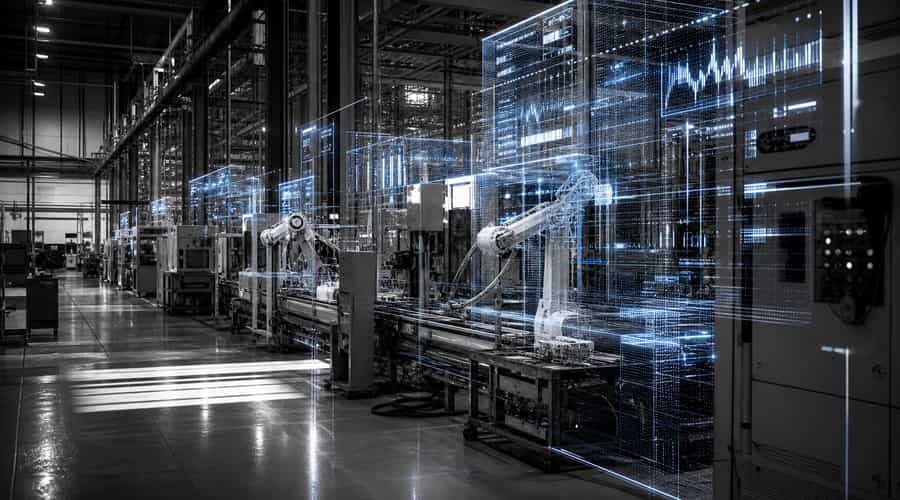
Digital twins can sound abstract because the term gets thrown at almost every industrial software pitch. In this case, the claim is narrower and better. A twin is a virtual model of factory equipment or a production line, fed by live data from physical systems. If it works, your factory team can test a change before running it, see a restriction before it slows output, and adjust the process while there is still time to save the batch.
Raeford is not the only example Unilever put on the table. The Economic Times also reported that Unilever's Haldia factory in India, which makes Surf and Sunlight detergents, uses an energy twin to optimize fan speeds, temperature settings and moisture controls. At Gandhidham, one of its largest personal care sites in South Asia, a digital twin helped cut quality defects in Dove soap by 30% over four years. In Vietnam, AI-powered systems have saved 1% to 2% in premium raw materials while maintaining product quality. That is not a revolution. It is a set of small operational wins, and in manufacturing those can be worth more than a loud promise.
Accenture needs examples like this. Business Insider reported on June 18 that Accenture's shares fell nearly 20% after its fiscal third-quarter results and were down about 50% from a year earlier. The company reported $18.7 billion in quarterly revenue, up $1 billion from the same period in 2025, but still below expectations. New bookings were also down 2% year over year, and Julie Sweet's message to investors was blunt enough: AI scaling will take time.
The Financial Times put the pressure in sharper market terms, reporting that Accenture's shares had fallen to their lowest level since 2017 after the firm cut its full-year revenue growth forecast. That is the backdrop to the Unilever announcement. A consulting firm can talk all day about reinvention services, but investors want to know whether AI work becomes durable revenue or just another advisory wave that clients trim when budgets tighten.
Here is the thing: a factory deal is a stronger proof point than a conference-stage AI demo. If Accenture helps Unilever squeeze more capacity from deodorant lines, reduce defects in Dove soap and cut raw-material waste in detergents, the work is tied to something a finance team can count. If the next 40 twins do not deliver, the gap will be obvious too. There is less room to hide when the metric is waste, capacity, energy consumption or product quality.
Unilever also gets something more practical than an AI headline. Consumer-goods manufacturing is full of tiny process decisions that look boring from the outside: temperature, moisture, fan speed, dosing, flow restrictions. Those details are exactly where digital systems can earn their keep, provided they are tied to factory teams rather than dropped in from a central technology office. You don't need a grand theory of industrial AI to understand a 20% waste reduction on a deodorant line.
The risk is scale. A single plant result, even a good one, is not proof that the same approach works cleanly across product lines, factory ages, regional infrastructure and local operating habits. Unilever has not specified which factories will get the next wave of deployments. Accenture has not put a revenue figure on the deal. Those missing details matter, because the next 18 months will decide whether Raeford was a repeatable operating model or a well-chosen showcase.
Still, this is the right kind of AI story to watch. It has dates, plants, brands and numbers. It has a rollout timeline. It has a public company under pressure and a manufacturer willing to attach AI to factory-floor outcomes. If you are tired of enterprise AI announcements that say everything and prove nothing, this one at least gives you something to check later.
Also read: Bland raised $50 million after 180 investors said phone calls were a dying medium • Singapore is becoming the AI world's Switzerland, but China just showed the escape hatch has limits • The Fortune 500 just printed its most profitable year ever while shedding 301,000 jobs