Meta and Microsoft have turned the AI race into a real estate race, and the companies leasing the power and floor space now have more leverage than most people expected.
Bloomberg's review of quarterly filings from the big cloud providers gives you the useful number hiding beneath the AI spending headlines: future data center lease commitments have climbed past $700 billion across Microsoft, Meta, Oracle, Amazon, Google, and CoreWeave. Microsoft carries about $155 billion in total future lease obligations. Meta carries about $104 billion. In one quarter, Bloomberg reported, Meta and Microsoft each added roughly $50 billion in fresh data center lease commitments.
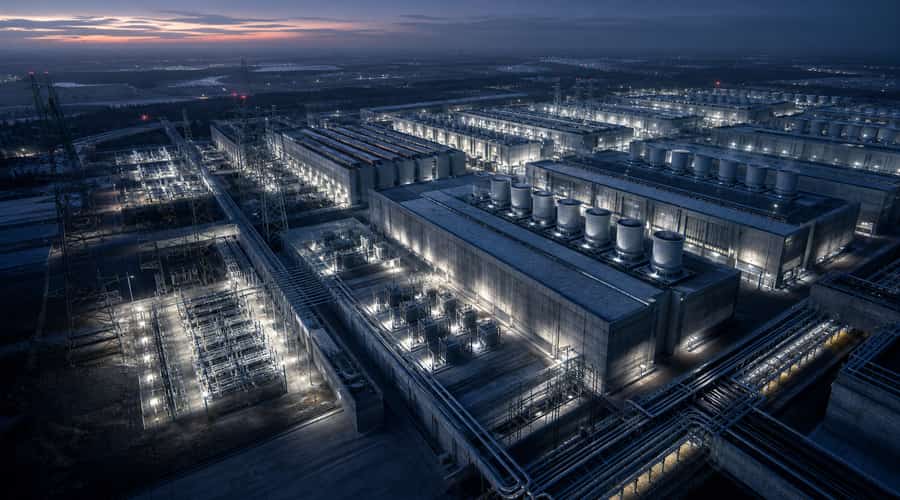
That's not normal expansion. It's a land grab for electricity, buildings, cooling, fiber, and time. The hyperscalers aren't only buying capacity for customers they already have. They're locking up capacity for the AI demand they believe will exist when the buildings, chips, and power contracts are finally ready.
The accounting makes the story easier to miss. Future lease obligations don't hit the balance sheet in the same way as current costs until payments begin, so the weight of the buildout sits in the footnotes before it shows up in the margins. You don't need to be an accountant to see the issue. A company can look flexible in the present while it has already signed away a lot of its future room to maneuver.
The winners right now are not only Nvidia, AMD, or the cloud platforms selling model access. Wholesale data center operators and the REITs behind the buildings are in the middle of the trade. Digital Realty and Equinix are the public names most readers will recognize, but the same pressure runs through private operators with large campuses near cheap power and usable grid connections. In the best markets, available large-block space is scarce and much of the serious capacity is spoken for years ahead.
Power is the choke point. Land matters, permits matter, cooling equipment matters, but electricity allocation is what turns a promising data center site into a real one. AI racks draw far more power than ordinary cloud workloads, and that has changed the leasing conversation. The tenant used to arrive with the leverage of size. Now the landlord with powered space can choose who gets in.
The rent bill comes before the revenue
The uncomfortable question is simple: what happens if AI revenue doesn't arrive on the same schedule as the lease payments?
Spending estimates vary by source, but they all point in the same direction. Axios reported in February 2026 that hyperscaler spending was expected to reach about $610 billion this year at the midpoint of company guidance. A later Financial Times compilation put planned 2026 capex for Google, Microsoft, Meta, and Amazon at roughly $725 billion, according to reporting cited by Tom's Hardware. Either way, the direction is clear enough. This is no longer a side budget inside cloud. It is becoming the cloud business.
Fixed obligations change the risk. If demand slows, a GPU order can be delayed only so much, and a signed lease doesn't politely shrink because customers are taking longer to pay. Lower utilization turns into margin pressure. Empty or underused capacity still needs power contracts, maintenance, staff, and debt service behind it.
OpenAI and Anthropic are among the most important buyers of AI infrastructure, and both are still spending ahead of durable profits. That doesn't make the buildout foolish. It does mean the revenue chain is more fragile than the sales pitches make it sound. If model companies and enterprise customers don't turn usage into cash fast enough, the pressure moves upward to the hyperscalers and downward to the infrastructure owners that built around their promises.
Frankly, this is where a lot of AI infrastructure commentary gets too neat. It treats every signed lease as proof of future demand. A lease proves commitment. It doesn't prove utilization.
The supply chain is getting paid, for now
For founders working around power systems, liquid cooling, grid software, fiber, construction management, and workload placement, the opportunity is real. Penn Capital's recent analysis of hyperscaler spending patterns pointed to small-cap suppliers that sit around the buildout rather than directly inside the model race. You can understand the appeal. These companies don't have to invent the next frontier model. They have to help build the rooms where that model runs.
But concentration risk is not a footnote when the customer list is this small. If Microsoft, Meta, Amazon, Google, Oracle, and CoreWeave are driving the order book, a single procurement pause can travel through the whole supply chain. The cooling vendor, the electrical contractor, the fiber provider, the land banker, and the software startup all feel the same change at different speeds.
KKR has already warned about single-tenant concentration and weaker secondary-market exposure in data center assets. That warning is worth taking seriously because today's strongest buildings are priced as if the tenant demand will stay deep. A facility built around one buyer in a market with thin replacement demand is a very different asset from a powered campus where several cloud and enterprise tenants are fighting for space.
So yes, the landlords have pricing power today. The hyperscalers have locked in capacity because they believe AI demand will fill it. The suppliers have revenue because the buildout needs them. All of that can be true at once.
The point is not that the $700 billion bet will fail. The point is that it is a bet, and the lease terms don't wait around for the business model to catch up. If AI usage keeps compounding, these commitments will look early and disciplined. If it doesn't, the footnotes Bloomberg surfaced will become the part of the story everyone wishes they had read more closely.
Also read: The British Army just proved AI can compress 72 hours of war planning into one, and the race to replicate it has begun • A San Jose legal-tech startup just sued the US government over losing Anthropic's Fable 5 and it won't be the last • SK Hynix is betting $29 billion that the AI memory boom is nowhere near over