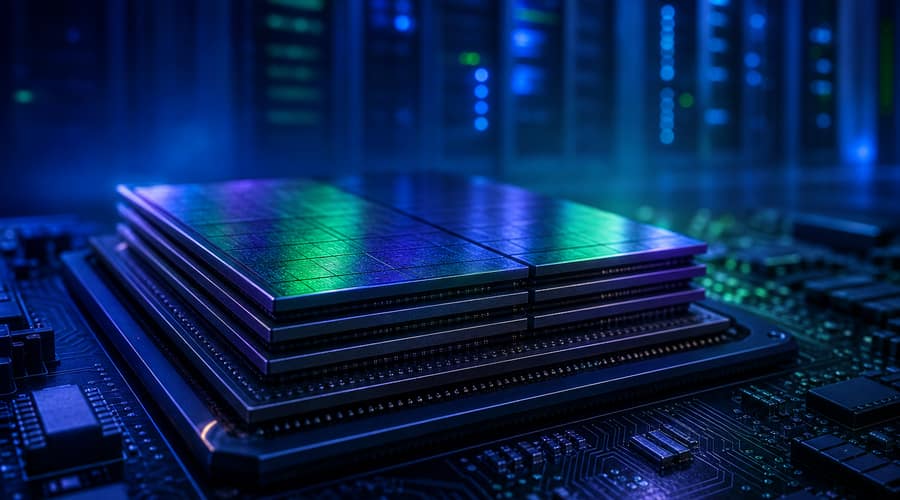
Micron's fiscal Q3 showed the AI memory boom is still running hotter than Wall Street expected, with $41.46 billion in revenue, $25.11 in adjusted EPS and a Q4 guide that moved the goalposts again.
Micron didn't just beat estimates. It made the old estimates look stale. Investor's Business Daily reported that the memory chipmaker earned an adjusted $25.11 a share on $41.46 billion in revenue for the quarter ended May 28, far ahead of FactSet expectations for $20.86 a share and $35.91 billion in sales. A year earlier, Micron earned $1.91 a share on $9.3 billion in revenue. That is not normal cyclical recovery. That's AI infrastructure rewriting the income statement.
You can see the shift in the margins. Barron's put Micron's adjusted gross margin at 85%, while MarketWatch noted before the print that Wall Street had been looking for roughly 81%. Either way, this is the part investors should focus on. Micron is not merely shipping more memory. It is selling into a market where customers need the chips badly enough to keep pricing high.
The reason is high-bandwidth memory, the stacked DRAM that sits next to Nvidia's AI accelerators and feeds them data fast enough to make the whole system worth buying. HBM is not commodity memory with a new label on it. It uses far more wafer capacity than standard DRAM, and only Micron, SK Hynix and Samsung can make it at meaningful scale. When supply is that narrow and demand is coming from AI data centers, pricing power doesn't need much explaining.
Micron has already sold out its 2026 memory inventory, according to MarketWatch, and earlier reporting from Barron's noted that Micron, SK Hynix and Samsung had sold out HBM production for fiscal 2026. That one fact matters more than any loose talk about AI enthusiasm. The company is not trying to persuade you that demand might arrive. It is telling you that the product is already committed.
The Q4 outlook was the stronger signal. Micron guided for $50 billion in revenue and $31 in adjusted EPS for the current quarter, again above Wall Street expectations. If you were looking for evidence that AI spending had peaked, this was the wrong earnings report. The stock rose about 8% to 10% in after-hours trading, depending on the feed you were watching, after falling hard with other chip names before the print. The market had priced in nerves. Micron answered with orders.
Look at the capital plans and you get the same message in a different form. Micron has outlined about $200 billion of long-term investment tied to memory capacity, including major U.S. expansion, and it has already shifted away from lower-margin consumer channels by winding down its Crucial brand. That was not a cosmetic move. It was a blunt allocation decision: put scarce wafer supply where AI customers are paying the most.
Memory is now the bottleneck you can't ignore
For two years, the AI infrastructure story has been told mostly through GPUs. How many Nvidia chips can be made, who gets priority, and when the next Blackwell rack ships. Fair enough. But you can't run those accelerators properly without HBM, and that makes memory a co-equal constraint rather than an accessory. Frankly, any AI spending debate that treats memory as a side issue is missing the machine room.
SK Hynix is moving on the same logic. Bloomberg reported that the South Korean memory giant is preparing a Nasdaq listing of American Depositary Receipts worth about $29.4 billion, with trading expected to begin July 10. MarketWatch put the figure at about 45.4 trillion won, or $29.7 billion. SK Hynix is already the leading HBM supplier, and its shares have risen roughly 300% in 2026. It is not coming to U.S. markets because the cycle looks tired.
There is a risk here, and it is the old memory risk: when everyone builds capacity, supply can eventually catch up. Barron's has already raised the possibility that SK Hynix's expansion could pressure pricing later. You should take that seriously, because memory has punished investors before when booms turned into gluts. But timing matters. New fabs don't appear overnight, and several capacity additions will not meaningfully ease the crunch until 2027 or later.
That leaves Micron in a rare position for a company in a historically brutal business. It has rising AI demand, sold-out supply, widening margins and guidance that says the next quarter should be larger than the last. The $41.46 billion quarter is the headline. The real story is simpler: memory has moved from commodity afterthought to one of the hard limits on AI growth.
Also read: Anthropic's distillation problem reveals that export controls alone cannot hold the line in the US-China AI race • An AI law firm just beat two lawyers in court for £400 and the legal industry should be paying attention • Dubai Holding is in talks to buy into Hscale as Gulf capital moves to lock up Europe's AI infrastructure before the buildout peaks