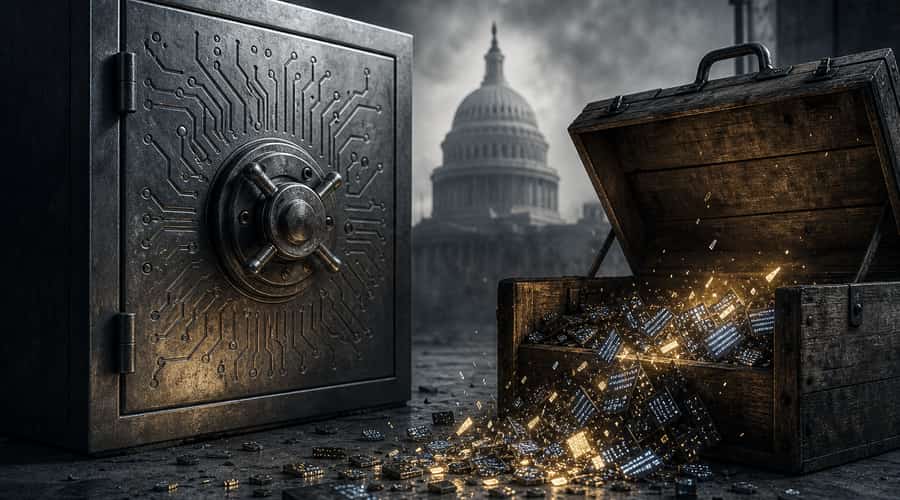
Chris Fall's exit leaves the Commerce Department's AI testing office without permanent leadership at the exact moment Washington is arguing over Chinese open-weight models it may not be able to control.
Chris Fall left the Commerce Department's top AI standards job on Monday, July 20, after only three months in the role. Nobody has explained the departure in public.
That's the problem. Fall had been director of the Center for AI Standards and Innovation, the federal office housed at the National Institute of Standards and Technology that is supposed to help the government test advanced AI systems, study national security risks and set technical standards. Axios first reported his resignation, and Business Insider also reported that the Commerce Department confirmed he was out. A White House spokesperson declined to comment to Axios.
Dr. Arvind Raman, who already runs NIST, will serve as acting CAISI director. According to Axios, a Commerce official said Raman has been reviewing candidates for a permanent replacement and that Fall's stay was not intended to be long term. Maybe so. But if you appoint someone in April and lose him in July, you still have a continuity problem. The calendar does not care how carefully the explanation is worded.
CAISI is not an old, settled agency with deep muscle memory. It was previously the U.S. AI Safety Institute, launched under the Biden administration and later reworked by Commerce as the Center for AI Standards and Innovation in June 2025. NIST's own public materials describe the office as leading work on testing risks from AI models across national security and public safety, including through the TRAINS task force with agencies such as Defense, Energy, Homeland Security and the NSA.
That is not a ceremonial brief. It is the office Washington turns to when it needs technical credibility rather than slogans.
Kimi K3 Made The Timing Worse
Fall's exit lands just as Chinese open-weight models have become the hardest AI policy fight in Washington. Axios reported on July 17 that Moonshot AI's Kimi K3, built by the Beijing company, beat Anthropic's Fable 5 and OpenAI's GPT-5.6 Sol in blind front-end coding tests run by Arena, while coming in about 40 percent cheaper than the U.S. models it challenged. Moonshot plans to release the model's weights on July 27, which would let companies and governments customize it and run it on their own systems.
You can see why that rattles people. A closed U.S. model can be governed through a company, a license and a public pressure campaign. An open-weight Chinese model, once downloaded, is a different creature for regulators. If Washington wants to warn agencies away from it, restrict procurement or argue for a broader ban, it needs a technical record that is better than fear.
David Sacks, the White House AI and crypto adviser, has used Kimi K3 to argue against heavier American model controls. On X, he said Kimi K3 fixed 15 critical security bugs that Codex and Fable refused because of cyber guardrails, adding that there is no reason to limit American models on tasks Chinese models can handle. SiliconANGLE later noted that the 15-bug case came from a developer's claim, not a formal benchmark. Keep that caveat. It matters.
Still, the anecdote landed because it points at a real policy tension. Anthropic published more detail on July 2 about Fable 5's cybersecurity safeguards and the categories of cyber assistance its classifiers are designed to block. Sacks is arguing that those safeguards can make U.S. models less useful for defenders, while Chinese and other open models face fewer practical limits. Frankly, that fight is exactly where CAISI should be useful: test the models, name the risks, separate the real danger from the political theater.
An Office Built For Credibility Needs Some
This is not CAISI's first leadership wobble. CSET noted last year that Elizabeth Kelly, the first director of the U.S. AI Safety Institute, resigned in February 2025 after President Trump rolled back Biden's AI executive order and before Commerce later rebranded the office. Now Fall is gone after three months. Two unsettled transitions in less than two years is a rough pattern for an office whose value depends on steady technical judgment.
Raman may be a strong acting director. He already runs NIST, and that gives him institutional weight. But running NIST and CAISI at the same time is not the same as giving the AI standards office a dedicated leader with a visible mandate, especially when the White House is debating how to respond to Chinese models that move faster than the federal hiring process.
If you are a founder building on open models, a security team testing frontier systems, or a lab trying to understand what Washington will demand next, the personnel story matters. Standards do not write themselves. Voluntary testing regimes depend on trust, and trust is harder to build when the director's chair keeps changing.
The Commerce Department says a permanent director is coming in the weeks ahead. Until then, the agency that is supposed to help judge the next wave of AI risk is being led on an acting basis, just before Kimi K3's planned open-weight release on July 27. That is the hard fact left on the table.
Also read: Trump Administration Weighs a Ban on Chinese AI Models Like Kimi K3 • Nvidia Pushes AI Agents Deeper Into 3D Design Tools at SIGGRAPH 2026 • Moonshot's Bet on a Bigger Kimi K3 Is Paying Off in China's AI Race