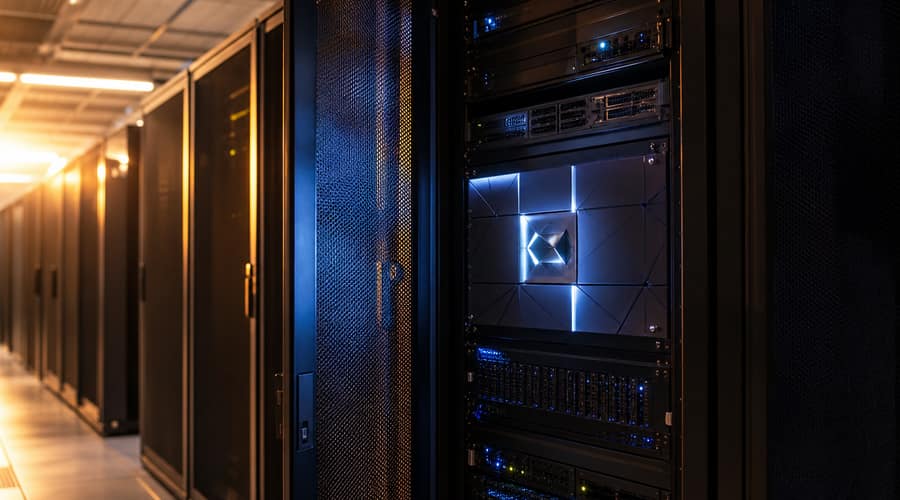
SAXON Q has put two room-temperature diamond quantum computers on the commercial market, and the useful part is not the qubit headline. It is the ordinary rack, the ordinary power, and the absence of the machinery that keeps most quantum systems trapped in specialist labs.
Quantum computing has spent two decades looking impressive in laboratories and awkward almost everywhere else. IBM, Google and other superconducting quantum programs still depend on machines cooled close to absolute zero, around minus 273 degrees Celsius, with cryogenic equipment and engineering teams around them. SAXON Q, a Leipzig University spinout, is making a different bet. On July 21, 2026, the company announced commercial availability of the SXQ128 and SXQ512, two nitrogen-vacancy diamond systems that run at room temperature, fit in a standard server rack and plug into conventional power.
That is the story. Not magic. Not a finished quantum revolution. A machine you can actually install changes the buyer list.
According to SAXON Q's announcement carried by HPCwire, the 128-qubit SXQ128 and 512-qubit SXQ512 are the first diamond-based NV-center quantum computers to exceed 10 qubits commercially. SAXON Q says the systems need no cryogenic cooling, no vacuum equipment and no specialized facility. Its own site says the current SXQ128 is orderable with three-month delivery, while the SXQ512 is scheduled from Q2 2027.
NV-center diamond computing has been attractive for years because the qubits can remain usable at room temperature. The hard part has been making enough of them precisely enough. SAXON Q points to a patented nitrogen implantation and sulfur co-implantation process in diamond, derived from semiconductor manufacturing. The company says it can place qubits with nanometre precision and build arrays with high yield, which is exactly the kind of dull manufacturing detail that decides whether this becomes a product or stays a conference slide.
The product claims are specific. SAXON Q says the SXQ128 provides eight fully entangled qubits per core, while the SXQ512 increases that to 16 per core. The company also says its platform can coordinate computation across multiple quantum processing cores at the same time through its own multi-core quantum operating system. That is not the same as proving commercial advantage. You should wait for customer workloads and outside benchmarks before treating it as settled. But it is enough to make the launch worth watching.
The rack matters more than the qubit count
The infrastructure problem has quietly killed plenty of enterprise interest in quantum computing. A pharmaceutical company can be curious about chemistry simulations without wanting to run a cryogenic facility. A materials lab may have the budget for new compute, but not for dilution refrigerators, vibration controls, constant calibration interruptions and staff whose job is simply keeping the system alive.
SAXON Q is selling against that pain. Its systems are described as continuously operating, rack-mounted machines that use ordinary electrical power. If that holds up in customer hands, the first serious users don't have to be national labs or hyperscalers. They can be research teams that want to test quantum convolutional neural networks, chemistry simulations or materials workloads without becoming quantum hardware operators first.
There is also a local, unfashionable fact here that matters. SAXON Q is not coming out of Silicon Valley. It was founded in Leipzig in 2021 by researchers including Prof. Dr. Marius Grundmann and Prof. Jan Meijer, both tied to Leipzig University's physics work. The company's site lists Grundmann as co-CEO and a professor of experimental and semiconductor physics, with more than 30 years of experience in nanotechnology and wide-bandgap semiconductors. His Leipzig University publication page lists 692 journal articles as of May 2026. That background doesn't guarantee a scalable product, but it does explain why the company talks less like a cloud software vendor and more like a manufacturing problem has been worked for years.
Do not compare this like a scoreboard
The easy mistake is to throw SAXON Q's qubit numbers beside IBM and Google as if this were a simple leaderboard. It isn't. IBM's Osprey processor had 433 qubits, and IBM's roadmap put Condor at 1,121 qubits. Google's Willow processor, used in its late-2024 error-correction work published in Nature, had 105 qubits. Those numbers sit inside different architectures, different error profiles and different definitions of usefulness.
Raw qubit count is a poor shortcut. You need fidelity, coherence, connectivity, error correction and actual workload performance before you know what a system can do. SAXON Q says its qubits reach up to 99.92 percent fidelity and that error-correction capabilities and logical qubit architectures are on the roadmap as it scales toward 10,000-qubit systems. Fine. The market should ask for data, not applause.
Here is the thing: deployability is still a real edge. You don't need to beat every superconducting system in a lab to matter commercially. You need to let a customer run useful experiments in a place where superconducting systems are too expensive, too fragile or too operationally demanding. That is the opening SAXON Q is trying to claim.
The startup-versus-incumbent frame is tempting, but it is too neat. IBM and Google are building enormous programs around fault tolerance and superconducting hardware. SAXON Q is trying to make quantum hardware less precious and easier to place near real users. If the SXQ128 ships this summer with the reliability the company is advertising, you will learn more from the first customers than from the launch release.
Also read: Glow raises $180 million at a $1.2 billion valuation to secure the AI agents that CrowdStrike wasn't built to see • Alphabet reports Q2 2026 earnings today with its $190 billion AI bet under the microscope • Computer science enrollment falls for the first time in 20 years as AI reshapes who gets hired