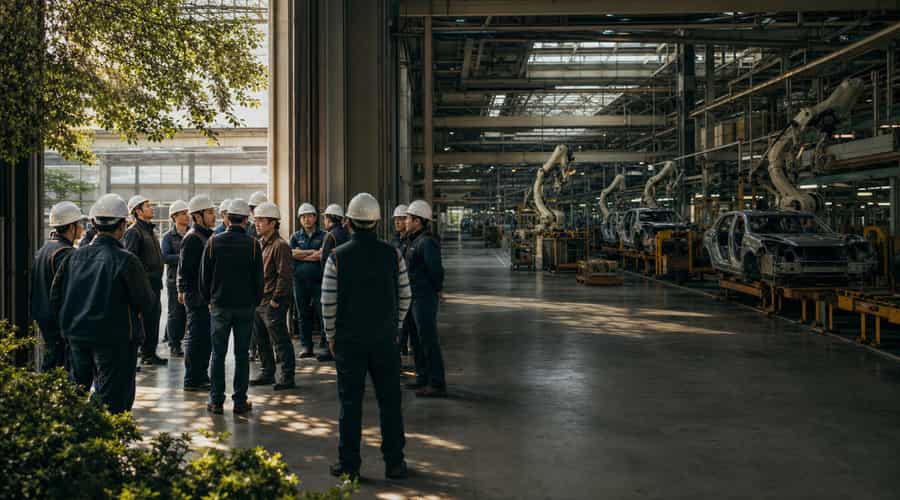
Hyundai's Atlas robots aren't working the Ulsan line yet. Workers are trying to settle the rules before they do.
The robots haven't taken a shift. That's the point. Hyundai Motor workers in Ulsan began partial walkouts on July 13 after wage talks stalled, with day and night shifts stopping two hours early for three days, according to Yonhap. The dispute is about pay, retirement age and bonuses, but Atlas has turned an ordinary labor fight into something much larger. You don't wait until a humanoid robot is bolted into the production schedule to ask who gets a say.
Hyundai's union had already won legal strike approval. Yonhap reported that 86.65 percent of the company's 39,668 union members backed strike action in a June 24 vote, with 94.15 percent turnout. By July 20, Korean reports said the union had escalated to four-hour partial strikes for each shift through July 22. That is real clout. It is also costly clout, because Ulsan is Hyundai's main production base, not a side facility used for a symbolic protest.
The company's robot plan is concrete enough to make workers nervous. Reuters reported on July 16 that Hyundai Motor Group would acquire SoftBank's remaining roughly 10 percent stake in Boston Dynamics, making the US robotics company wholly owned by the group. Hyundai also plans to begin deploying Atlas at its Georgia manufacturing plant from 2028, first for parts sequencing and later for broader manufacturing work, including component assembly by 2030. This isn't science fiction. It's a calendar.
Hyundai's own CES 2026 materials said the Atlas product version has 56 degrees of freedom, tactile sensors in human-sized hands, a 360-degree camera, a lift capacity of up to 50 kilograms and operation across temperatures from minus 20C to 40C. The company said it wants annual robot production capacity of 30,000 units by 2028. Electronic Times reported in May that Hyundai and Kia plan to deploy more than 25,000 Atlas robots across their production facilities, alongside a US actuator facility with annual capacity above 350,000 units.
Workers don't need a lecture on automation. They can read those numbers themselves. The Seoul Economic Daily reported in January that the Hyundai Motor branch of the Korean Metal Workers' Union warned that "not a single robot can enter the workplace without labor-management agreement." The same report said the union was pushing for job security measures and a fixed monthly salary system before humanoid robots reach production floors. That demand is blunt for a reason: hourly pay can be hollowed out even when headcount is not cut on paper.
Management has tried to keep the robot issue inside the broader wage negotiation. Workers don't buy it. Frankly, they shouldn't. If a company is planning a phased rollout of humanoid robots that can do sequencing and assembly work, then the terms of deployment are labor conditions. Calling it a technology strategy doesn't change what happens on the line.
The fight is over consent before deployment
The strongest part of the union's case is timing. Atlas is not yet replacing workers at Hyundai's Korean plants, which means the fight is happening while the rules can still be written. Once robots are inside the factory, the debate changes. It becomes about mitigation, retraining and compensation after management has already made the operational decision.
That is why this dispute matters beyond Hyundai. The Korea Times reported in June that the union had added a demand for guaranteed employment and working conditions related to AI to this year's wage talks. Yonhap separately reported the union's wage demands, including a 149,600 won monthly base-pay increase, a performance bonus tied to 30 percent of last year's net profit and a higher retirement age. Those are familiar bargaining items. The Atlas clause is different. It asks whether workers get prior consent rights over a new class of machine that can move through the same spaces and handle some of the same materials they do.
Boston Dynamics is not a side character here. The company has spent years proving that Atlas can move in ways most factory robots cannot. Forbes reported this month that Alberto Rodriguez, Boston Dynamics' director of robot behavior for Atlas, said the fifth-generation design has an "almost order of magnitude" reduction in complexity compared with the prior version, with fewer parts and faster manufacturing. A simpler Atlas is easier to scale. That is good for Hyundai. It is exactly why workers want contract language now.
Investors are watching the wrong clock
For investors, the clean story is ownership, production capacity and deployment dates. Hyundai controls Boston Dynamics. Atlas starts in Georgia in 2028. Parts sequencing comes first, then component assembly by 2030. If you only look at the roadmap, the whole thing reads like a manufacturing upgrade.
But workers are looking at a different clock. They are asking what happens to pay, job security and bargaining power before the first robot is scheduled. That is the harder question, and it won't be solved by another demo video. Reuters reported this week that UK robotics startup Humanoid raised $152 million at a $1.35 billion valuation, another sign that money is flowing into robots built to augment human labor. The capital is moving quickly. Labor contracts move more slowly.
Hyundai may still reach a deal that keeps Atlas on schedule and gives workers a formal voice over deployment. It may also hold the line and treat consultation as enough. Those are not small differences. A consultation right lets workers object after management has framed the choice. A consent right changes who controls the gate.
Atlas hasn't taken a shift in Ulsan. The workers have still forced the right fight at the right time.
Also read: Substack's new AI scanner tells paying readers exactly how much of their newsletter a human actually wrote • Ramp opens stablecoin accounts to all businesses as corporate finance quietly moves onto crypto rails • A Senate panel says it has compelling evidence of Chinese influence inside Amazon's marketplace