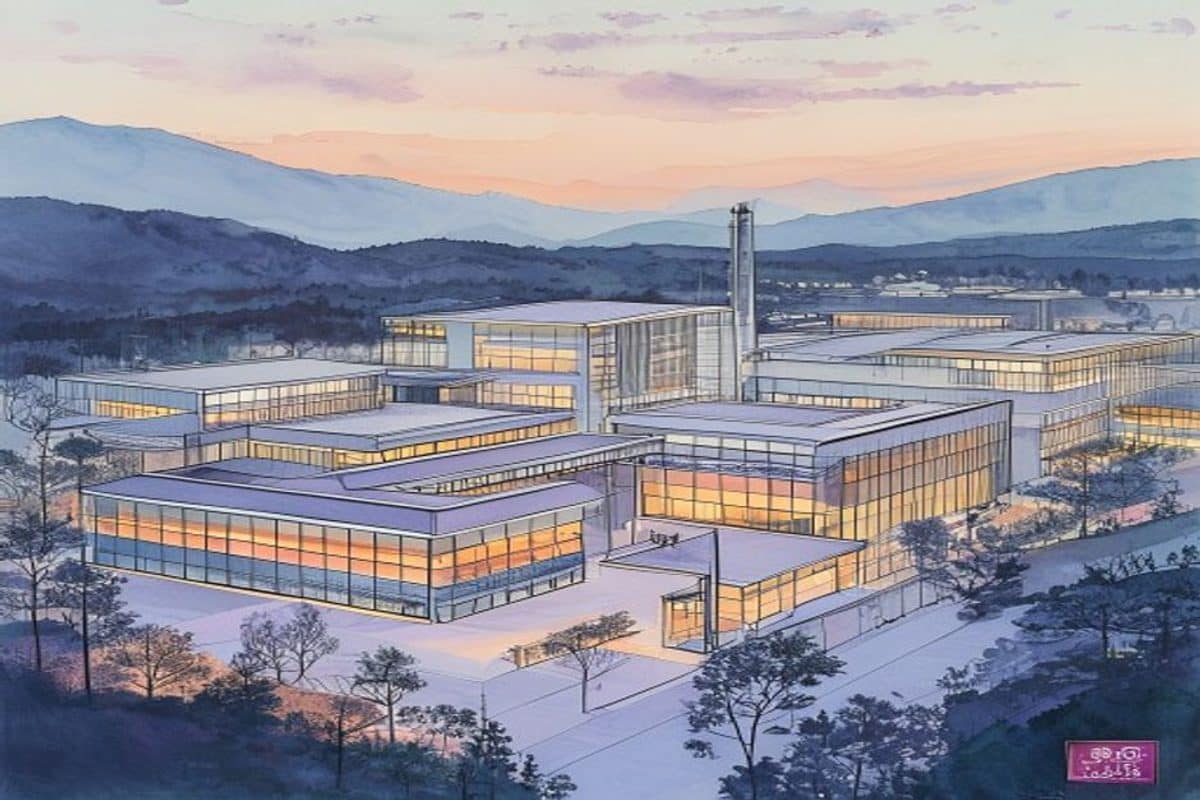
SK Hynix has announced its largest-ever capital investment , a $13.8 billion fabrication facility in Cheongju , to accelerate production of next-generation HBM chips for the AI market.
On April 22, SK Hynix CEO Kwak No-jung stood before investors and made it clear the company is not hedging its bets. The memory chipmaker will pour more than 14 trillion Korean won into a brand-new plant called M15X, built directly adjacent to its existing M15 complex in Cheongju, North Chungcheong Province. Construction starts immediately, with completion targeted for late 2027. It is the single largest investment in the company's 40-plus year history, and it is aimed squarely at one thing: making more High Bandwidth Memory than anyone else, faster than anyone else.
The timing is deliberate. SK Hynix framed the announcement around what management is calling an "AI super-cycle" , the sustained, structural surge in compute infrastructure spending by hyperscale cloud providers and AI hardware manufacturers. That framing is not marketing spin. NVIDIA's latest GPU architectures consume HBM at a rate that was nearly unthinkable three years ago, and the pipeline of AI training clusters being commissioned by Microsoft, Google, and Amazon shows no sign of contraction. Memory is not a peripheral component in this buildout; it is a bottleneck, and whoever controls HBM supply controls a critical lever in the entire AI stack.
M15X is specifically designed to produce HBM4, the next-generation standard that succeeds the current HBM3e. HBM4 is expected to deliver meaningful gains in power efficiency and raw data transfer speeds , both critical metrics as AI model sizes continue to scale and energy costs become a boardroom concern for data center operators. By dedicating an entirely new facility to HBM4 from the ground up, SK Hynix avoids the retrofit compromises that can limit throughput in older fabs repurposed for new product generations.
SK Hynix currently holds a dominant share of the global HBM3e market, having moved faster than rivals to qualify its chips with NVIDIA. But that lead is under real competitive pressure. Samsung Electronics has been aggressively working to close the qualification gap with major GPU customers, and Micron Technology has made no secret of its ambition to capture a larger slice of the HBM market through its own capacity expansions in the United States. The M15X announcement is effectively SK Hynix drawing a line: it intends to be entrenched in next-generation supply agreements before its competitors can meaningfully scale HBM4 of their own.
What this means beyond the factory floor
The geopolitical dimension of this investment is worth noting. South Korea has been working to reinforce its semiconductor supply chain resilience, and a $13.8 billion domestic fab commitment plays directly into that national priority. The Cheongju site will generate construction jobs in the near term and high-skilled manufacturing roles once operational , a meaningful economic stimulus for a region already anchored by SK Hynix's existing facilities.
For the broader AI infrastructure market, the announcement is a data point in a larger argument: the capital intensity of the AI era is not a short-term blip. When a company makes the single largest bet in its corporate history on a facility that won't produce chips until 2027, it is making a statement about where demand will still be in three years. That confidence, shared by chipmakers and hyperscalers alike, suggests the memory market is entering a prolonged expansion phase rather than a typical boom-bust cycle.
What to watch next is whether Samsung accelerates its own HBM4 timeline in response, and whether SK Hynix can lock down long-term supply agreements with its key customers before M15X comes online. The company that secures those contracts now will have leverage that lasts well into the next decade of AI infrastructure spending.
Also read: Local LLMs are no longer a hobbyist experiment and the cloud AI market should be paying attention • Gen Z uses AI more than ever but a new Gallup poll shows their excitement has collapsed • A routing error gave the public 47 minutes with OpenAI's unreleased Arcanine model and someone filmed the whole thing