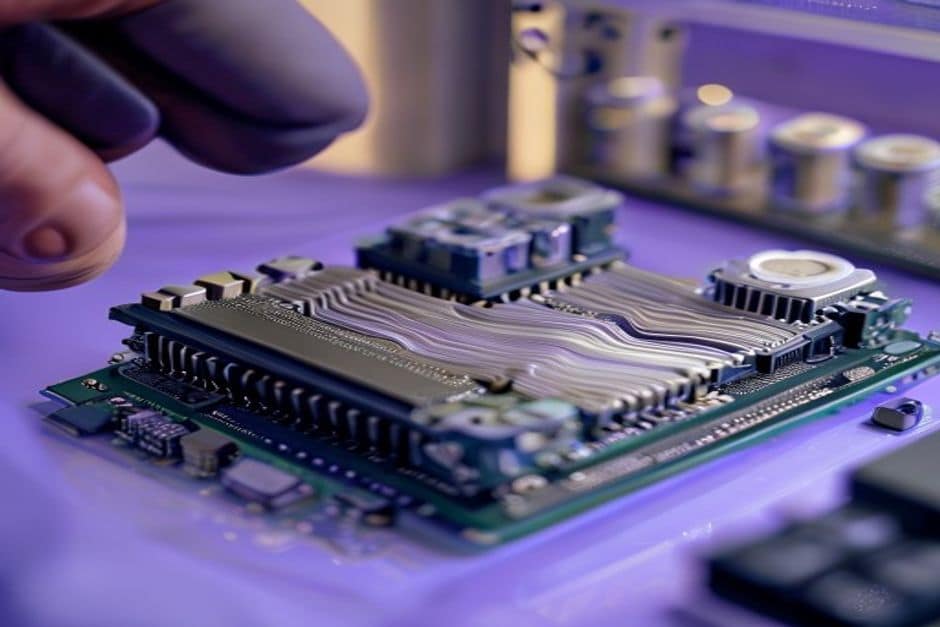
AMD has introduced the Instinct MI350P accelerator, bringing the 4th Gen CDNA architecture to PCIe cards for the first time and targeting AI labs, enterprises, and developers who need high-performance inference and training without the scale or cost of rack-scale GPU clusters.
The announcement addresses a specific pain point in the AI hardware market. Nvidia's H100 and B200 GPUs dominate through rack-scale systems optimised for hyperscalers and large cloud providers. PCIe cards are the workhorse for smaller deployments, on-premise inference, and research labs. AMD's MI300X and MI325X were SXM modules for rack integration. The MI350P changes that equation by offering CDNA 4 capabilities in PCIe form, with 288GB HBM3E memory, 8TB/s bandwidth, and expanded MXFP6/MXFP4 support for inference workloads. The r/LocalLLaMA thread with 85 points and 44 comments reflects early developer interest in whether this unlocks practical ROCm deployments for non-Nvidia users.
CDNA 4 architecture is AMD's biggest generational leap. The MI350 series delivers up to 4x AI compute improvement and 35x inference performance over MI300X, with 256 compute units per GPU, 288GB HBM3E from Micron and Samsung, and power consumption up to 1,400W. The PCIe form factor makes it drop-in compatible with standard servers, Kubernetes clusters, and air-cooled racks supporting up to 64 GPUs. Direct liquid cooling configurations scale to 128 GPUs per rack with 1.3 exaFLOPS of MXFP4/MXFP6 performance. That positioning targets everyone from AI startups running Llama 3.1 70B on TP2 to enterprises deploying custom inference servers.
ROCm support is the critical differentiator. AMD ROCm 7.0 preview offers Day 0 compatibility with PyTorch 3.1, TensorFlow, JAX, ONNX Runtime, vLLM, and Hugging Face Accelerate. The AMD GPU Operator simplifies Kubernetes deployment. Libraries like DeepSpeed and SGLang have added MI350 support. That ecosystem maturity means developers can test models without hardware procurement through IBM Cloud, Azure, or Oracle. PyTorch 3.1 native ROCm support eliminates CUDA dependency for many workflows, making switching costs lower for inference and lighter training runs.
For SF readers, the MI350P is about democratising next-gen AI acceleration. Nvidia supply constraints and CUDA lock-in have created a multi-year bottleneck for smaller labs and enterprises. Hosted inference costs $3 to $15 per million tokens for frontier models. On-premise MI350P clusters running vLLM or SGLM can serve Llama 3.1 70B at under $0.50 per million for high-volume workloads. PCIe cards enable 4U servers with 4 GPUs, 1TB HBM3E, and PCIe 5.0 x16 bandwidth, a configuration that fits in most colocation facilities. The economics work for startups training fine-tunes or enterprises running RAG pipelines.
Whether PCIe cards are a practical path for smaller AI labs depends on ROCm ecosystem momentum. The software stack has matured substantially since 2025. PyTorch 3.1 offers native support. Hugging Face Accelerate and vLLM deliver production-grade inference. DeepSpeed enables distributed training. The gap with CUDA is closing on inference, where switching costs are lowest. Training remains Nvidia-dominant due to scale and ecosystem lock-in, but MI350P targets the 80 percent of workloads that are inference and fine-tuning. Availability and pricing are undisclosed, but PCIe form factor typically targets $20,000 to $40,000 per card versus $30,000 to $50,000 for SXM modules.
AMD's software ecosystem is ready enough to convert hardware interest into adoption for the right use cases. ROCm 7.0 supports all major frameworks, but the real test is production reliability. Cloud providers like IBM, Azure, and Oracle offer MI350 testing without upfront hardware costs. The GPU Operator and ROCm container registry simplify deployment. If MI350P delivers on CDNA 4's 4x compute and 35x inference claims against MI300X, it becomes the go-to for cost-conscious inference at scale. The risk is execution: AMD must maintain ROCm parity with CUDA updates and avoid regressions that erode trust.
The r/LocalLLaMA engagement shows developer curiosity about whether MI350P makes ROCm viable for local and small-cluster use. PCIe cards lower the entry barrier compared to rack-scale systems. A 4-GPU server costs $150,000 to $200,000 fully loaded, within reach for Series A startups. That accessibility could accelerate ROCm adoption if benchmarks confirm performance parity. Nvidia's supply issues give AMD a window. If MI350P ships on schedule with stable ROCm support, it challenges CUDA dominance for inference workloads. If delays or software issues persist, it remains a niche alternative.
Also read: Spotify wants to own AI-generated personal audio before anyone else defines the category • Ryan Cohen listed socks on eBay to fund a $56 billion eBay bid, and eBay banned his account • Grocery AI pricing is already live through loyalty apps and Instacart, and browsing data is the next layer