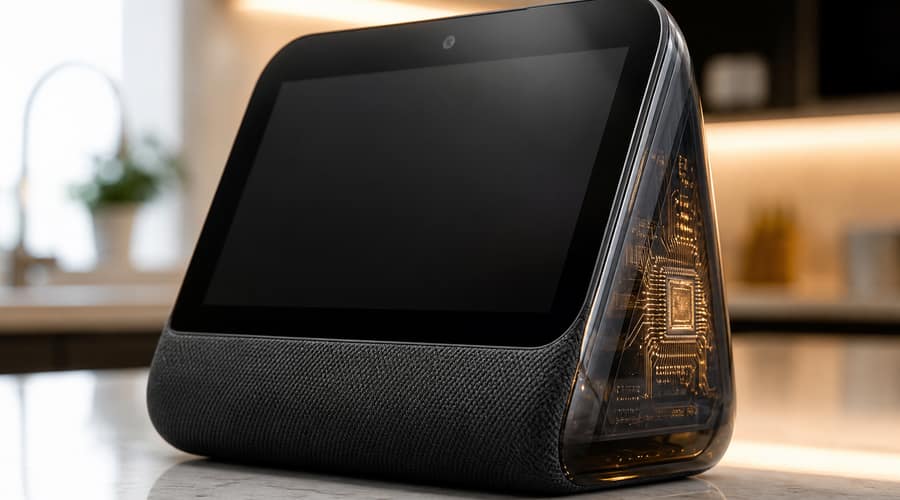
Amazon's next Alexa fight is moving into the chip. If the company wants AI to feel instant in your house, it can't keep sending every small decision back to the cloud.
Amazon has spent years talking about ambient computing, which usually sounds vague enough to fit on a conference slide. The new story is much more concrete. Panos Panay, the company's head of devices and services, told CNBC's The Tech Download podcast this week that Amazon is now focused on end-to-end silicon for some of its most important devices, including Echo hardware and Fire TV.
That is the part you should pay attention to. Not because every Echo owner suddenly needs to care which chip sits inside a speaker, but because chip control is how a company decides what happens in your home and what has to leave it. Apple proved that with the iPhone and then the Mac. Google has been trying to prove it with Tensor in Pixel phones. Amazon is now making the same argument from the kitchen counter, the TV stand and the doorbell.
The chips already in the market are the AZ3 and AZ3 Pro, which Amazon announced at its September 30, 2025 hardware event before the new Echo products shipped later that fall. You won't find them sold the way laptop processors used to be sold, with a big clock speed number doing all the work. They sit inside the Echo Dot Max, Echo Studio, Echo Show 8 and Echo Show 11, doing the dull, useful jobs that make Alexa feel less like a remote service and more like something in the room.
Wake word detection is a good example because it isn't glamorous and it matters every day. Amazon says the AZ3 in the Echo Dot Max, paired with its new microphone array, makes Alexa more than 50% better at hearing the wake word. The AZ3 Pro, used in the Echo Studio, Echo Show 8 and Echo Show 11, adds support for more demanding language models and vision transformers, the kind of work a smart display needs if it is going to understand more than a basic voice command.
Those chips also feed Omnisense, Amazon's sensor fusion system. Amazon describes it as a way to combine signals from cameras, microphones, ultrasound, Wi-Fi radar and other sensors so a device can understand presence and context without waiting for a shouted command. That can sound creepy if you dress it up. The practical version is simpler: an Echo Show noticing someone has walked into the room, or Alexa responding with less delay because some of the processing is happening on the device.
Panay's CNBC comments would be enough for a modest hardware story. The bigger move came from supply chain analyst Ming-Chi Kuo, whose Apple and electronics sourcing reports are followed closely because they usually name the parts of the machine other companies prefer to keep quiet. Kuo says Amazon is moving toward a customer-owned tooling model and has chosen Taipei-based ASIC design firm AIchip for back-end chip design and testing, with the strategy beginning in earnest in 2027.
That correction matters. The partner named in Kuo's report is AIchip, not Alchip, and those are not interchangeable names. According to the report, Amazon wants custom processors to move beyond Echo and Fire TV into Kindle, Alexa-enabled products, Blink cameras and Ring doorbells. Kuo also points to a long-term volume target that could eventually reach 40 million units a year.
Forty million chips a year is not a hobby project.
Tom's Guide reported that Amazon declined to comment on Kuo's claims. Keep that caveat in the story, because it is exactly where the line sits: Panay has confirmed the company is focused on end-to-end silicon for key devices, while the 2027 rollout, AIchip role and 40 million unit figure come from Kuo's supply chain reporting. Don't blur those together. We didn't get this from Amazon's procurement team.
The financial pressure behind the move is not hard to see. Business Insider reported that Amazon's free cash flow fell 95% in the first quarter of 2026 on a trailing 12-month basis, to $1.2 billion from nearly $26 billion a year earlier, as property and equipment purchases surged because of AI investment. Custom silicon costs real money up front, but at Amazon's scale, shaving cloud inference and supplier margin from millions of devices is not a rounding error.
Qualcomm and other chip vendors have powered Amazon devices for years, and they aren't disappearing from the house overnight. But the direction is clear. If Amazon controls the chip, it controls latency, battery life, product timing and how much AI work has to run through AWS. It also has less reason to wait for a supplier's roadmap to catch up with Alexa's roadmap.
For you, the near-term payoff should be boring in the best way: Alexa hears you more reliably, camera features respond faster, and some data has less reason to make a round trip to a server before the device acts. The harder question is whether Amazon can make Alexa+ good enough to justify all this hardware work. Better chips can make an assistant faster. They can't make it useful by themselves.
Also read: Macron and Modi Are Personally Courting Tech CEOs to Win the AI Infrastructure Race, Startups Are Racing to Put AI Data Centers in Orbit Before Big Tech Gets There, Micron Breaks Ground on a $9.3 Billion Bet to Crack SK Hynix's Grip on AI Memory