ByteDance just committed $39 billion to a single site on Brazil's northeastern coast, and it's not building anything you'll ever use directly.
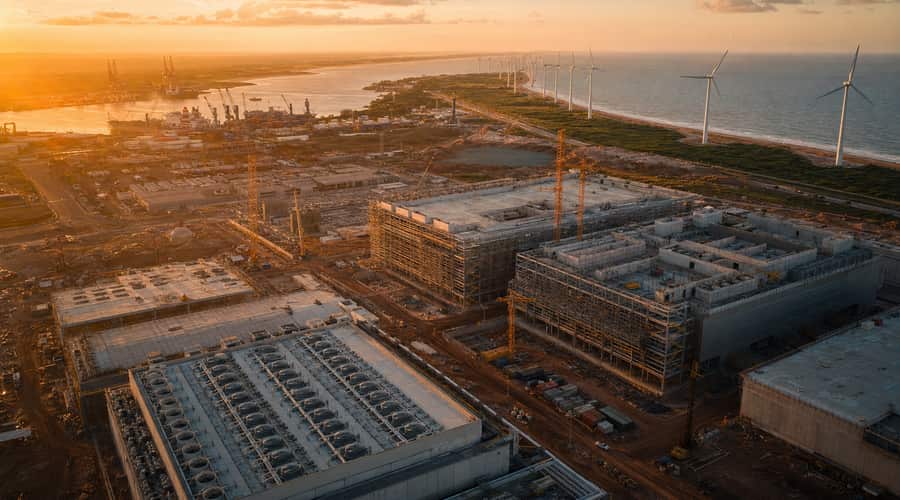
The complex going up at Pecém, an industrial port in Ceará state, will exist purely to keep TikTok running for everyone who isn't in Brazil, the United States, Europe or China. Bloomberg confirmed the scope of the project on July 1, 2026, calling it ByteDance's largest data center commitment outside its home country, with a price tag of roughly 200 billion reais.
The first phase alone calls for around 300 megawatts of power spread across 20 data halls, according to a report from Cryptobriefing. That's already ten times the size of a typical regional facility in Latin America. ByteDance plans to keep expanding until the campus approaches a full gigawatt, with initial operations expected in 2027 and phased buildout running through 2029.
That's a lot of servers for a company that still can't legally operate TikTok in the United States without a forced sale.
None of it runs without power, and ByteDance has already locked that down too. On May 18, 2026, it signed a $2 billion, 20-year power purchase agreement with Casa dos Ventos, a Brazilian wind developer, according to a report from Data Center Dynamics. The wind will come from the 630-megawatt Ibiapaba complex and the Dom Inocêncio farm in neighboring Piauí state. The deal runs through Omnia, a data center platform managed by Pátria Investments, structured so Omnia takes a stake in the wind assets themselves rather than simply buying electricity off the grid.
Brazil isn't winning this deal on tax breaks alone, though those matter too. Pecém already sits near the subsea cable landing at Fortaleza, plugging northeastern Brazil directly into transatlantic bandwidth. Wind blows reliably and cheaply along that coastline. And the final agreements still depend on new tax incentives for export-oriented projects at Pecém getting approved, according to a report from Private Equity Insights, which also noted that Brookfield has been in talks with ByteDance and the renewables firm Voltalia about a separate, similarly sized data center push in the same region.
Brookfield declined to elaborate beyond confirming it's in discussions. That tells you how early some of this still is: a private equity giant, a Chinese tech company under enormous political pressure in Washington, and a state government in northeastern Brazil are all negotiating a facility that could eventually cost more than the annual budget of some countries.
If you've been watching where AI infrastructure money actually goes, this fits a pattern you should recognize by now. Gulf sovereign wealth funds have poured money into Middle Eastern data centers specifically to avoid depending on either Washington or Beijing. Nordic countries built out AI capacity years ago by selling cheap hydropower and cold climates. Brazil is making the same pitch with wind instead of hydro, and it's working. ByteDance isn't choosing Ceará because it loves Brazil. It's choosing Ceará because splitting infrastructure across friendly, non-aligned territory is now standard practice for any company caught in the middle of a US-China tech fight.
The company hasn't said what happens to this facility if Washington's TikTok divestiture fight resolves differently than expected, or if Beijing tightens its own export rules on the chips a campus this size will eventually need. For now, the wind farms are contracted, the port site is chosen, and construction is already moving in Ceará.
Also read: Stockholm court orders Google to pay Klarna's PriceRunner nearly two billion dollars • Cisco is betting its whole workforce on AI agents while it cuts jobs • Meta Is Quietly Building a Business to Sell Its Leftover AI Computing Power