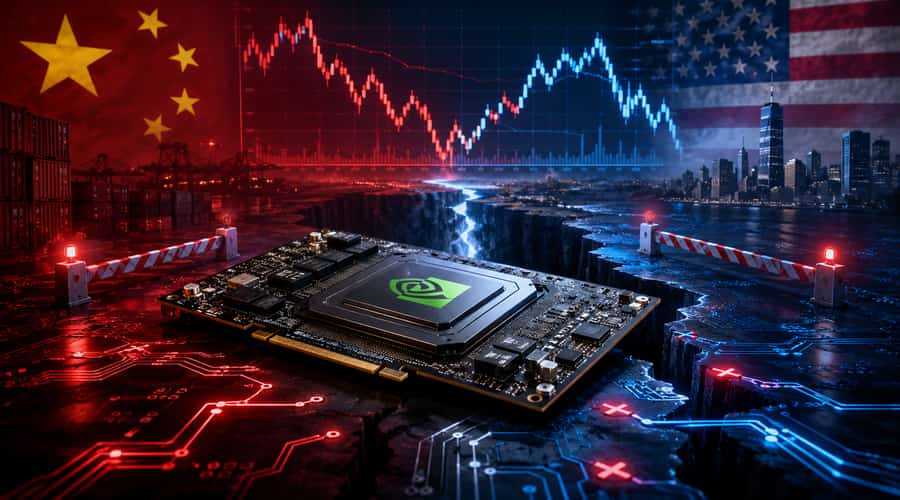
China is making Nvidia's return to the market harder even after Washington reopened a narrow path for H200 sales. The latest pressure shows the chip fight is now about control of supply, not just export rules.
Nvidia has permission from the U.S. to sell H200 AI chips to a small group of Chinese buyers, but that has not turned into shipments. That is the real story for Jensen Huang. He can win room in Washington, travel to Beijing, and keep telling investors that China matters, yet still find the business stalled at the border by Chinese security reviews and industrial policy.
According to Reuters, the U.S. cleared around 10 Chinese companies to buy Nvidia's H200 chips in mid-May, with Alibaba, Tencent, ByteDance and JD.com among the firms reported to be in the group. But the same reporting said no deliveries had been made, because Chinese approval had not followed. That detail changes the investment case. Nvidia is no longer dealing with a single gatekeeper. It needs both governments to leave the door open at the same time.
The H200 matters because it is not just another graphics processor. It is one of Nvidia's most powerful AI accelerators, sitting close to the center of the global race to train and run large models. For Chinese cloud providers and internet platforms, access would help close part of the performance gap with U.S. rivals. For Beijing, that same access creates an uncomfortable dependence on a foreign supplier at a moment when technology sovereignty has become a national priority.
That is why the politics are now more complicated than a simple U.S. ban. Washington has spent years trying to restrict China's access to advanced AI chips, first through broad export controls and then through tighter product-specific rules. Nvidia responded by designing China-compliant chips and lobbying for a route back into the market. But China has also been pushing its companies to reduce reliance on American components, especially in critical infrastructure. The result is a strange standoff: U.S. approval can arrive, and Chinese buyers can still be told to wait.
Huang has spent months arguing that Nvidia should remain connected to China rather than surrender the market to domestic alternatives. His logic is practical. China has been an important revenue pool for Nvidia, and if American firms are locked out for too long, Huawei and other local chipmakers get more time to build customer relationships, software support, and procurement habits that will be hard to reverse. Once a buyer rewires its stack around another supplier, access alone may not be enough to win it back.
Why China's hesitation matters
The important shift is that Beijing is using demand as leverage. It does not have to announce a sweeping ban on Nvidia to change market behavior. It can slow orders, raise security questions, apply customs scrutiny, and encourage state-linked buyers to choose domestic options. That gives officials more flexibility than a formal prohibition, while still sending the same message to foreign suppliers: access to China is conditional.
For Nvidia, that makes planning harder. The company has already had to manage separate product lines for different regulatory environments, which affects manufacturing, inventory, customer commitments and pricing. A chip designed to satisfy U.S. export limits can still run into Chinese political resistance. That weakens the old workaround strategy, where Nvidia could adjust performance specs and preserve the commercial relationship. Compliance is necessary, but it is no longer sufficient.
The pressure also reaches beyond Nvidia. AMD, cloud providers, server makers and Chinese AI startups are all watching the same signals. If approved chips can be delayed because policy priorities shift, procurement teams will hedge. Some will stockpile where possible. Others will accelerate local sourcing. That may be inefficient in the short term, but in a divided market, certainty can matter as much as raw performance.
There is still a commercial reason for both sides to avoid a full break. Chinese firms want access to high-end computing capacity, and Nvidia wants to stay relevant in the world's largest internet market. But the balance has changed. Beijing does not appear willing to let Nvidia simply resume business because Washington relaxed one channel. It wants bargaining power, domestic substitution, and the ability to decide which foreign chips enter the country on its own terms.
The market takeaway is straightforward. Nvidia remains the defining company in AI hardware, but China is becoming a negotiated exposure rather than a clean growth engine. Investors should watch shipments, not approvals. A license on paper is useful, but revenue only follows when chips move, customers deploy them, and both governments tolerate the transaction.
For Huang, the challenge is not whether China still wants Nvidia's technology. It clearly does. The harder question is whether China wants it enough to accept the dependency that comes with it. Until that answer is clearer, every Nvidia sale into the country will sit inside a broader contest over power, policy and technological sovereignty.
Also read: GitHub breach shows how one bad extension can reach deep inside software teams • South Korean funeral firm's Ether bet shows how leverage can travel far • Barnes & Noble's AI book stance could reshape retail shelves