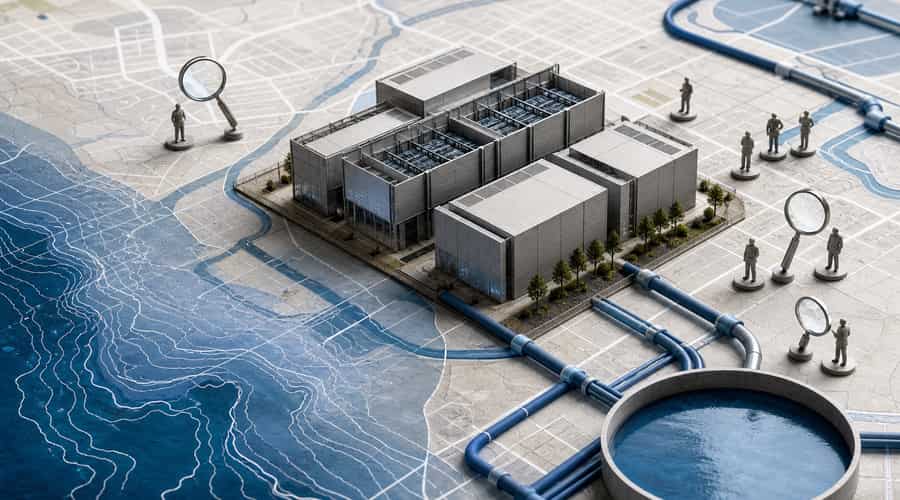
AI infrastructure is no longer just a race for chips and power. It is becoming a local trust problem, and residents are starting to build their own tools to see what is coming.
The most important data center story this week is not simply that residents are worried about another project near their homes. It is that a University of Washington student, Isabelle Reksopuro, built an interactive map because the usual public process was not giving people a clear answer fast enough.
That should make founders and infrastructure investors pay attention. When communities have to piece together water plans, land transfers, legislative filings and corporate denials on their own, the issue is no longer just permitting. It becomes leverage. The party with the clearest information gets to shape the argument.
As The Verge reported on May 14, Reksopuro built Track Policy after hearing confusing claims about Google-linked water and land issues in The Dalles, Oregon. The question was simple enough: was Google taking public land for data centers, or was the city seeking land for its own water system? The answer was more complicated, which is exactly the point. The Dalles is seeking control of roughly 150 acres of Mount Hood National Forest near its reservoir. Google says it is not behind that effort, and city officials have denied that the reservoir expansion is for the company. Still, Google is the city's largest water customer, and the local debate has become a case study in how quickly AI infrastructure can turn into a public trust fight.
Track Policy is not framed as an anti-data-center campaign. Its own About page says the tool is meant to show what is being proposed, what stage a policy is in, and what it would do if passed. It tracks jurisdictions, legislation, sponsors, recent news and data centers already on the ground. It was inspired by datacenterbans.com, but goes beyond bans to include incentives, disclosure rules and study bills.
That distinction matters. A lot of the public conversation around data centers gets stuck between two weak positions. One side says every project is progress because AI needs compute. The other says every project is a threat because it uses land, power and water. Neither position helps a town decide whether a specific facility strains the grid, whether a tax break is worth it, or whether a water plan quietly shifts public resources toward private infrastructure.
A map changes the rhythm of the debate. It lets a resident see patterns across states. It lets a reporter connect a local zoning fight to a broader AI buildout. It lets a founder understand that a site is not just a parcel with cheap power, but part of a political system with memory. Once people can see the pattern, companies lose the luxury of treating each approval as an isolated local matter.
The Dalles shows why opacity is expensive
OPB's records review gives the Oregon dispute its sharpest numbers. Google used 383.9 million gallons of city water in The Dalles in 2023 and 434.4 million gallons in 2024, or about 1.19 million gallons per day. OPB also reported that Google's use grew from 104 million gallons in 2012 to 434 million gallons in 2024, a 316% increase. In a city of roughly 16,000 people, that is not a detail. It is the story.
The Dalles gets much of its water from the Dog River system in the Mount Hood foothills, while also using groundwater from an area Oregon designated as critical decades ago. The city's 2024 water master plan includes an unnamed large industrial user projected to need about 1 million gallons per day, although officials have said that user is not Google. The reservoir expansion would increase capacity from about 900 acre-feet to around 3,000 acre-feet, with an estimated cost near $70 million.
There are benefits on the other side of the ledger. Google built its first owned and operated data center in The Dalles in 2006 and says it has invested more than $2.4 billion in Oregon. OPB reported that the company has invested nearly $29 million in The Dalles water system and employs about 200 people locally. For a smaller city, those numbers matter. Jobs, infrastructure money and tax revenue are not imaginary.
But this is where the startup lesson comes in. If a company captures the upside clearly and leaves the downside blurry, the community will eventually build its own model of the deal. That model may be imperfect, but it will be emotionally stronger than a corporate sustainability page because it is built from public records, water bills, council packets and frustration.
Founders building AI infrastructure should treat community-risk strategy with the same seriousness as power procurement. That means publishing water and energy assumptions early, explaining cooling choices in plain language, showing who pays for grid or reservoir upgrades, and being honest about how much of the facility is tied to AI workloads rather than general cloud demand. Waiting until a local controversy forces disclosure is not a strategy. It is a delay tactic, and delay tactics age badly.
The deeper shift is that data centers are becoming visible infrastructure. For years, the cloud felt weightless to most users. Now it has addresses, substations, pipes, tax agreements and neighbors. As AI demand grows, the bottleneck will not only be GPUs or transmission lines. It will be whether communities believe the bargain in front of them.
Citizen-built tools like Track Policy will not decide every permit or stop every project. But they can narrow the information gap between hyperscalers, municipalities and residents. That alone changes the market. The next generation of AI infrastructure companies will still need capital, chips and land. They will also need trust, and trust is much harder to buy after the map is already online.
Also read: ChatGPT Has Made College Grades A Weaker Hiring Signal • Poetiq shows model orchestration can beat bigger coding models • The metals selloff shows gold and silver are trading like liquidity assets