
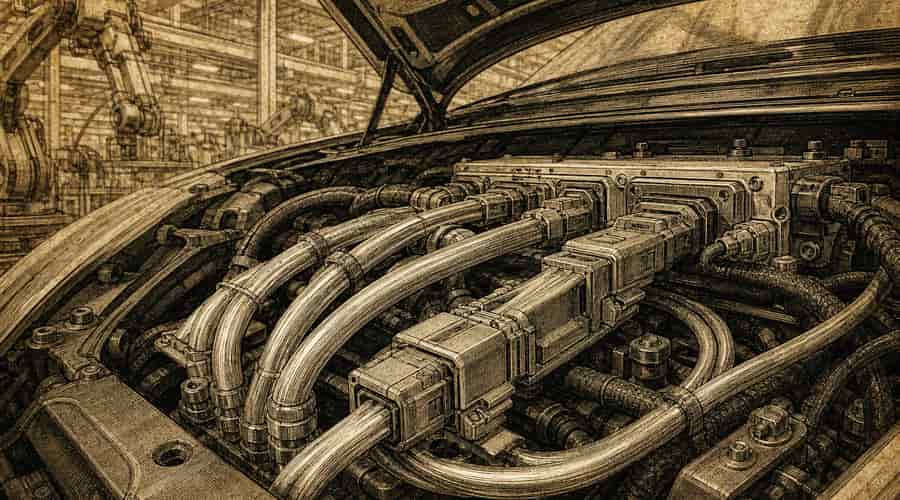
Copper still has the AI data center story behind it, but Ferrari and BMW are showing you why the EV part of that trade is less secure than it looked.
The switch sounds like a procurement footnote. It isn't. Reuters recently reported that Ferrari has used aluminium power cables in its 296 hybrid and carried the approach into the Luce, the electric Ferrari unveiled in May with a price around $640,000. BMW has also been moving aluminium conductors into high- and low-voltage systems through its sixth-generation eDrive platform, after testing the material as far back as the 1 Series in 2011. Tesla and Chinese EV makers were there earlier. What's different now is that Ferrari has joined them, and Ferrari doesn't usually get mistaken for a company trying to save a few dollars on wire.
If you bought the copper rally as a simple electrification story, this is the part you have to look at again. Copper ran to record territory in January, with benchmark LME prices briefly above $14,000 a tonne, according to The Guardian's market coverage at the time. Aluminium was trading at a fraction of that. It is also much lighter: about 30 percent of copper's density, even though it needs a larger cross-section to carry the same current. In a car, that trade can still work. Ferrari engineers have put total wiring weight savings at roughly 15 to 20 percent when aluminium is used instead of copper.
Weight matters in an EV in a way a spreadsheet can make too neat. A wiring harness is not a badge on the hood. It snakes through the car, links high-voltage systems, and sits inside the same engineering argument as the battery pack, the motors and the cooling. Shave enough kilograms out of that system and you are not just cutting material cost. You are buying range, packaging room, or performance. For Ferrari, where power-to-weight ratio is close to religion, that is not a side issue.
Here's the thing: copper's 2025 and 2026 bull case was built from several stories stacked together. AI data centers need the metal for busbars, power distribution and cabling. S&P Global's January 2026 work on copper in the AI era estimated that data center copper consumption would reach 710,000 tonnes in 2026, up from 467,000 tonnes in 2023. That demand is real. Inside a data center, where short runs and conductivity matter, aluminium is not about to walk in and take copper's job wholesale.
EVs are less protected. A battery electric car uses far more copper than a combustion-engine car, with industry estimates often putting the average at about 83 kg versus roughly 23 kg. That number helped make automakers look like copper's natural long-term customers. But Benchmark Minerals has warned that thrifting and substitution could cut per-vehicle copper requirements by about 38 kg by 2030. You don't need every carmaker to copy Ferrari tomorrow for that to matter. You only need purchasing departments and engineering teams to see the same price chart.
Goldman Sachs has already warned that copper could pull back from its record highs, even as the bank remains constructive on the broader metals demand created by AI, power grids and electrification. That distinction matters. The data center thesis is still standing. The EV wiring thesis is getting revised by the companies that were supposed to reinforce it.
Suppliers will feel this before investors do. Aluminium wiring needs different connectors, different crimping, and more careful corrosion management because the metal oxidizes more readily than copper. None of that is impossible. BMW's long testing history proves the opposite. But it does mean harness makers have to retool while automakers are still pressing them on price, weight and delivery schedules. That is a hard place to be if your factory was built around copper.
Ferrari's signal is outsized because of the brand. When Tesla uses aluminium, you can file it under manufacturing aggression. When a Chinese EV maker does it, you can point to cost pressure. When Ferrari does it in a hybrid sports car and then in the Luce, a five-seat EV whose launch was scrutinized by everyone from investors to Italian design critics, the excuse gets thinner. The engineering community is not treating aluminium as a compromise anymore.
Frankly, the copper trade was always more blended than the slogans made it sound. Data centers pull from one side, EVs from another, power grids from a third. The AI side still gives copper a strong case. But if the car industry can take dozens of kilograms out of each EV without damaging performance, you should not treat automotive copper demand as fixed. The next move is not whether Ferrari can make aluminium wiring work. It already has. The real question is how quickly the rest of the industry decides copper is too expensive to use by habit.
Also read: The Magnificent Seven just lost $2 trillion and the market is asking a question big tech cannot yet answer • The AI infrastructure boom is turning Q2 2026 into the market's best quarter in six years and founders should pay attention • Jana Partners is pushing Alkami Technology to sell itself as AI pressure mounts on community bank software