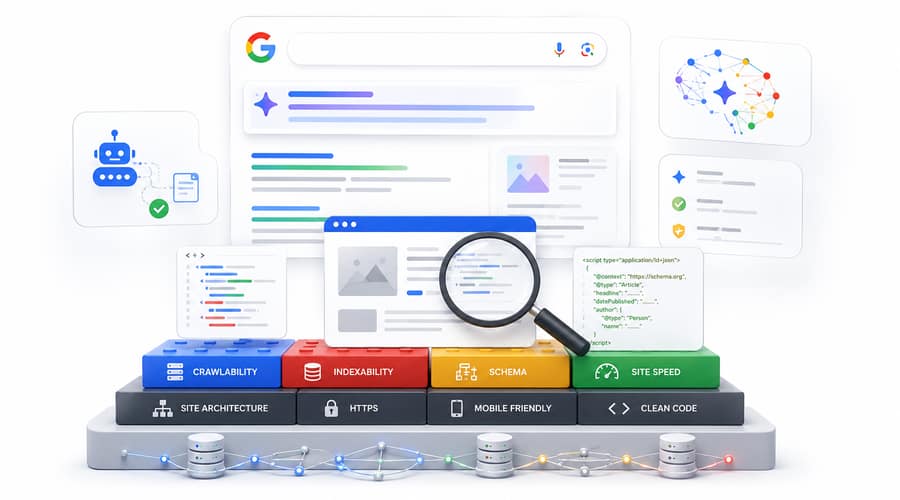
Google has given website owners a clearer message on AI search: stop chasing shortcuts and make your site easier to crawl, index, understand, and trust.
The rush to optimize for AI search has produced a new market of frameworks, acronyms and expensive advice. Google has now cut through much of that noise with a simple point. If a page cannot perform in Search, it should not expect special treatment inside AI Overviews or AI Mode.
That matters because Search is no longer just a list of blue links. Google is pushing deeper into generative answers, conversational queries and agentic features, and Google I/O 2026 made clear how much more of Search will be shaped by Gemini. For businesses, publishers and startups that still rely on discovery traffic, the question is no longer whether AI search matters. It is how much of the old playbook still works.
As Search Engine Journal recently noted, Google published its new guide on May 15, 2026, and the guidance is more direct than the scattered conference comments and blog posts that came before it. Google says generative AI features in Search rely on its core ranking and quality systems, using techniques such as retrieval augmented generation and query fan-out to pull information from the Search index.
The practical lesson is not glamorous, but it is important. Google can only use what it can find, process and serve. A page must be crawlable, indexable and eligible to appear in Search before it has a serious chance of surfacing in generative AI features. That does not guarantee inclusion, but it sets the floor.
For many businesses, that floor is still weak. Pages are blocked by poor JavaScript implementation, duplicate URLs consume crawl resources, canonical signals are messy, and important content sits inside structures that search systems struggle to interpret cleanly. These are not new SEO problems. AI search simply makes them harder to ignore.
Google is also telling site owners to keep crawlability practical. Publicly accessible, crawlable content remains the source material its Search systems can draw on. Large or frequently updated sites need to think about crawl budget, not because crawl budget suddenly became fashionable again, but because wasted crawling can keep important pages from being discovered quickly.
Semantic HTML gets a similarly grounded treatment. Google does not require perfect markup, and the web has never been a museum of valid code. Still, clear structure helps users, accessibility tools and search systems understand what is on a page. Headings, paragraphs, navigation and main content should describe the page naturally. That is not a trick. It is basic publishing discipline.
The AI hacks are losing their shine
The sharper part of Google’s guidance is what it tells site owners they can ignore. There is no special schema for AI Overviews. There is no need to break every article into artificial chunks for Google. There is no need to create unnecessary AI text files such as llms.txt for Google Search. There is also little value in manufacturing inauthentic mentions across the web and hoping the model repeats them.
This is a useful correction for a market that has been selling certainty where little exists. AEO and GEO may be convenient labels, but for Google Search they are not separate operating systems. They sit on top of the same need that always existed: useful content, technical access, strong signals of quality and a page experience that does not punish the user once they arrive.
That does not mean nothing has changed. Google’s guide puts more weight on non-commodity content, which means content that brings experience, judgment or original evidence to the page. A generic article on first-time homebuying has less value than a lender explaining what actually happened inside a specific inspection decision. The same idea applies across sectors. A software company that publishes first-party implementation data has more to offer than one more summary of public documentation.
Ecommerce and local businesses also have a clear path. Merchant Center feeds, Google Business Profiles and accurate product or service details can help Google understand what a company offers. Business Agent, Google’s conversational experience for brands on Search, points in the same direction. The search result is becoming less of a referral page and more of an interface where users compare, ask and sometimes act.
Agents make structure a business issue
The next phase is agentic search. Google’s guide frames this as optional and early, but the direction is visible. Browser agents may inspect screenshots, read the DOM and use the accessibility tree to complete tasks for people. Protocols such as Universal Commerce Protocol are emerging to let Search agents do more inside commercial workflows.
This is where technical clarity moves from the SEO team to the operating model of the business. If an agent cannot understand a product page, complete a booking path or distinguish the main offer from decorative clutter, the company may lose a transaction before a human even sees the site. Clean structure becomes part of revenue infrastructure.
The better approach is simple, but not easy. Verify the site in Search Console. Make important pages crawlable. Reduce duplicate content. Keep JavaScript from hiding the business value of the page. Use semantic structure for readers first. Publish content that reflects actual expertise. Then watch how AI features change traffic, conversions and customer behavior.
Google’s message is not that SEO is solved. It is that AI search does not reward panic. The businesses best positioned for the next version of Search will be the ones that treat technical structure, original content and user experience as one system. The shortcuts will keep changing names. The foundation will keep mattering.
Also read: ClickUp cuts 22% of staff, offers $1M AI salaries • StanChart CEO's 'lower-value human' remark draws regulatory heat • Class of 2026 boos AI optimism at commencement ceremonies