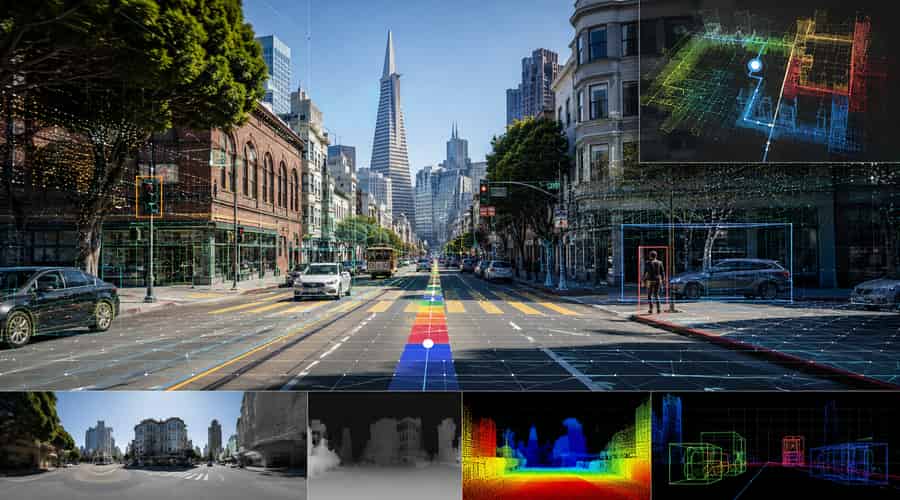
Google has tied its Genie world model to nearly 20 years of Street View imagery, turning generative, playable environments into place-anchored simulations with real stakes for robotics, mapping, and spatial AI startups.
Google is giving Project Genie a more practical edge. The experimental world-model prototype can now start from Google Street View imagery, letting users build explorable simulations that are anchored to real places rather than purely synthetic scenes.
According to Google's May 19 announcement, the new Street View grounding capability is rolling out inside Project Genie for eligible Google AI Ultra subscribers globally, while the Street View location feature is available first for places in the U.S. Google says it plans to expand the geographic coverage over time.
Until now, Genie has been known for creating dynamic, interactive worlds from text prompts or images, generating the next view in real time as a user or agent moves through a scene. Genie 3, previewed in 2025, was pitched as a general-purpose world model that can produce diverse virtual environments for training, research, and experimentation.
The Street View link changes the nature of the product. A user can tap a Maps pin for a U.S. location, choose a visual style such as "Desert Sands" or "Stone Age," describe a character, and have Genie generate an imaginative world that begins from actual Street View imagery. Google describes the feature as being powered by Maps Imagery Grounding, the same technology developers can use to create AI visuals with Street View.
Why this matters for robotics and spatial startups
Grounded simulations are valuable because they narrow the gap between training in a model and operating in the real world. The more a simulation carries authentic visual cues, geometry, and spatial continuity, the more useful it becomes for agents that eventually need to navigate physical environments.
For robotics teams and autonomy labs, that means more realistic testing without sending people or machines to every location. A developer could use grounded worlds to explore place-specific edge cases, time-of-day variations, or environmental changes before a robot ever arrives on site. Google also points to research uses, and says Genie has already supported agent learning and helped Waymo simulate hyper-realistic road environments.
The startup implication is straightforward. Google owns one of the world's most important street-level imagery assets, and now it is connecting that asset to a frontier world model. That creates a structural advantage for Google in spatial AI, because collecting comparable high-coverage imagery is expensive, operationally difficult, and legally complex.
That does not mean smaller companies are locked out. It does mean they need to be sharper about where they compete. A startup building for warehouses, factories, hospitals, ports, mines, or other private environments may have better data than Google for that specific domain. In those settings, Street View is less useful, and proprietary sensor data can still become a defensible advantage.
There is also room for companies that specialize in simulation infrastructure rather than base imagery. Synthetic-to-real adaptation, active learning, sensor-fusion testing, evaluation tooling, and lightweight validation rigs remain essential even when better visual grounding is available. Better source imagery helps, but it does not remove the hard work of proving that an autonomous system behaves reliably.
The limits are still real
Google is careful to frame Project Genie as an experimental research prototype, not a finished commercial engine. The company says it is still working to make details sharper and more accurate, and earlier Project Genie materials noted limitations around realism, prompt adherence, physics, latency, and short generation windows.
There are also privacy and safety questions when real-world imagery becomes the starting point for generated environments. Street View already raises questions about what gets captured and blurred. Adding generative layers makes those questions more complicated, especially if users can create plausible reconstructions or altered versions of sensitive places.
For now, the rollout is controlled enough to suggest Google knows the risks. Access sits inside Google AI Ultra, the new Street View grounding starts with U.S. places, and the company is presenting the work as research rather than a broad developer free-for-all.
What startups should watch next
The most important signal may be whether Google turns this into a platform. If Maps Imagery Grounding and Project Genie become accessible through enterprise APIs or partner programs, startups could build on top of Google's infrastructure instead of trying to recreate it from scratch.
That would create a familiar split. Google would own the foundational map and imagery layer, while smaller companies compete on workflows, vertical data, compliance, customer relationships, and specialized models. In spatial AI, that may be a better business than trying to beat Google at mapping the street.
The immediate change is not that Google invented world models. It is that Google has fused a serious world model with a global imagery asset, then opened an experimental version to more users. For robotics, simulation, and mapping startups, the next question is no longer whether grounded world models are coming. It is where their own data and domain expertise can still matter most.
Also read: Google's smart glasses push turns AI wearables into a bigger race • Google redesigns Search around Gemini agents, forcing startups to rethink SEO • OpenAI's image provenance push moves authenticity closer to a compliance baseline