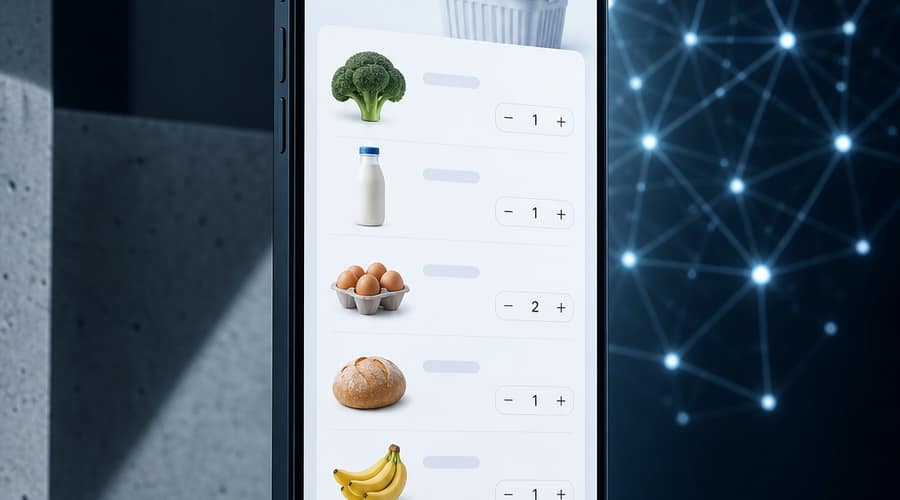
Gopuff's new Go shopping assistant puts Grok inside the checkout flow, and the choice says as much about AI economics as it does about grocery delivery.
Gopuff is turning Grok into a personal shopper. The company has launched Go, an AI assistant inside its app that can build a cart from voice or text prompts, anticipate repeat purchases, and suggest items based on context such as weather, local trends, and past orders. For a delivery company built on speed, the pitch is simple: less searching, faster carts, and fewer chances for a customer to drift away before checkout.
According to Axios, Go runs on Grok and is designed to move beyond recommendations into agentic shopping, where the software can actively assemble the basket for the user. That matters because convenience delivery has always been a margin-tight business. A smarter cart is not just a product feature. It is a test of whether AI can increase order frequency and average basket size without adding another costly layer to fulfillment.
The model decision is the sharper part of the story. Gopuff could have built around OpenAI or Anthropic, the two names most enterprise buyers instinctively put on the shortlist. Instead, it chose Grok. The public explanation from co-CEO Rafael Ilishayev was blunt enough to stand out: cost and quality. That is exactly the calculation more companies are making as AI moves from demo to daily production.
The pricing picture supports the point, even if the original version overstated some of the numbers. xAI's current public API documentation lists Grok 4.3 at $1.25 per million input tokens and $2.50 per million output tokens. OpenAI's current flagship GPT-5.5 standard pricing is $5.00 per million input tokens and $30.00 per million output tokens for short-context usage, while Anthropic lists Claude Opus 4.6 at $5.00 per million input tokens and $25.00 per million output tokens. Those gaps become meaningful quickly when a consumer app is processing prompts, product data, personalization signals, images, and voice requests at scale.
Gopuff's argument is that its own data is the real asset. The company has more than a decade of order history, direct control of micro-fulfillment centers, and visibility into what is actually available to deliver in minutes. That gives Go something a generic chatbot does not have on its own: a live view of inventory, repeat behavior, delivery windows, and the small habits that shape convenience shopping. If someone buys coffee every week, Go does not need to treat that as a fresh discovery every time.
That distinction is important because AI shopping is becoming crowded fast. OpenAI has been building commerce features into ChatGPT, Amazon has been expanding Rufus and Alexa shopping tools, and delivery platforms have strong incentives to make grocery search less tedious. The winning interface may not be the chatbot with the cleverest phrasing. It may be the one that knows which products can actually arrive at the door before the customer loses patience.
Gopuff has a structural advantage there, but not a guaranteed one. DoorDash, Uber Eats, Instacart, Amazon, and Walmart all have larger ecosystems in different parts of the market. Their strength is reach. Gopuff's strength is tighter control over a narrower operation. That can be powerful if the AI feature turns into better retention, higher basket sizes, and faster repeat orders. It matters less if customers treat Go as a novelty and go back to typing snacks, drinks, and household staples into the same search bar.
The broader signal for the AI market is clear. Brand strength alone will not decide enterprise model adoption. As companies move agentic products into live consumer workflows, inference cost, latency, multimodal capability, data controls, and operational fit will all be weighed together. A model that is good enough and materially cheaper can win serious business, especially when the company's own data does much of the heavy lifting.
Gopuff started in 2013 as a late-night convenience delivery service founded by Yakir Gola and Rafael Ilishayev in Philadelphia. Go points to a more ambitious version of that same idea: know what the customer needs, assemble it with less friction, and deliver it before the errand becomes a thought. The next test is not whether the assistant sounds impressive. It is whether customers let it shop for them again.
Also read: Adobe's record AI results could not outrun its growing leadership vacuum • OpenAI weighs drastic token price cuts as Anthropic eclipses its valuation • MediaTek doubles its AI chip target to $2 billion and enters the data center