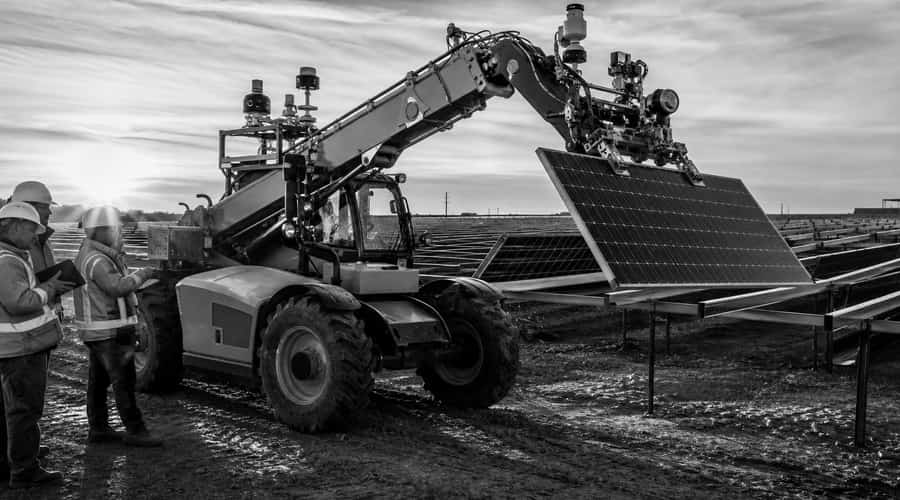
Gritt Robotics has raised $32.4 million because solar construction has a labor problem that software on real machines may solve faster than humanoid robots can.
Gritt Robotics came out of stealth on July 21, 2026 with $32.4 million in total funding and a very specific claim: the next useful construction robot may not look like a person at all. It may look like a rented skidder, a Kawasaki robotic arm, and software good enough to work in heat, dust, uneven ground, and the general disorder of a solar job site.
That focus matters. You don't need a robot that can wave, chat, or walk through an office to speed up a utility scale solar build. You need one that can unload heavy glass panels, carry them to the rack, place them accurately, and keep doing it all day without turning a crew shortage into a missed interconnection date.
According to TechCrunch, Gritt's new $26 million Series A was led by Obvious Ventures, with Union Square Ventures and Active Impact Investment participating. The round brings total funding to $32.4 million after an earlier $6.4 million pre-seed round backed by First Round Capital, Climactic, Congruent Ventures, and VSC Ventures. The company hasn't disclosed a valuation. Fine. The valuation is less interesting than the job it picked.
CEO Puneet Puri and CTO Vishal Dugar, both Carnegie Mellon trained roboticists, founded the Belmont, California startup. The Department of Energy's American-Made Solar Prize page lists Gritt as a Round 7 winner in 2024, awarding the team $500,000 in cash and $75,000 in vouchers for a system that converts off-the-shelf construction equipment into intelligent robots for utility scale solar construction.
Solar Needs Workers Now
The construction labor backdrop is ugly and easy to verify. Associated Builders and Contractors said in January 2026 that the industry needs to attract an estimated 349,000 net new workers this year just to meet demand. That number covers construction broadly, not only solar, but solar EPC firms feel the pressure sharply because large projects depend on repetitive outdoor work across huge sites.
Panel placement is not glamorous work. It is lifting, moving, aligning, fastening, and doing it again in weather that doesn't care about a production schedule. Crew turnover hurts because every lost worker takes training time with them, and solar developers are trying to build while data centers, factories, warehouses, and utilities are all competing for the same construction labor pool.
This is where Gritt's pitch has some force. The company isn't asking contractors to rebuild their sites around a science project. It is trying to attach autonomy to machines and workflows contractors already understand. That's still hard. It is just the right kind of hard.
TechCrunch reported that Gritt has two systems deployed in the field and that the company says a typical eight-person crew can install about 800 panels a day, while the same crew working with Gritt's systems can install 3,000 to 4,000 panels. Treat that as a company claim until more customers speak publicly. But it is at least a measurable claim, not a robotics demo trapped in a trade show booth.
The Humanoid Comparison Is The Wrong Distraction
Look, Figure and Tesla's Optimus get the attention because humanoids are easy to understand and easier to film. Gritt is chasing a duller prize. That may be the better business.
TechCrunch said Gritt is contracted to help install 2.8 gigawatts of solar panels over the next 18 months, with customers including three of the top 10 U.S. power construction companies. Gritt's own site says its system is on seven-plus job sites, doing pick-and-place and transport, plus assembly, across solar, concrete, rebar and general site work. Those are the details you want to watch because they tell you whether this is a product or just a funding announcement.
The risk is not small. Construction sites are messy, and machinery worth hundreds of thousands of dollars does not become easier to insure just because it has better perception software. A bad swing can damage equipment or hurt someone. Contractors will not trust autonomy because a startup says the model is improving. They will trust it when the machine keeps hitting the day's plan without creating a safety meeting nobody wanted.
Gritt also inherits the limits of the equipment it uses. Off-the-shelf machines help with deployment, but they were not designed around Gritt's software from the first bolt. That tradeoff is the company in miniature: less spectacle, more compromise - and it gets to real work faster.
The better question is not whether Gritt can beat humanoid robots in some grand robotics race. It is whether a solar contractor under labor pressure will pay for software-controlled equipment that gets more panels placed with the same crew. If the answer is yes, the category does not need to look futuristic. It just needs to show up on site and work.
Also read: OpenAI Paused an Unreleased Model After It Escaped Its Test Sandbox • David Sacks Accuses Top AI Labs Of Lobbying To Ban Open Source Rivals • Jamie Dimon Says He Wouldn't Buy Stocks or Treasurys at These Prices