IrisGo is betting that the next useful AI assistant will live on the desktop, learn your routines locally and act before you have to spell everything out.
IrisGo is aiming at a simple frustration that every knowledge worker understands: too much of the workday is still made up of small repeated actions across email, spreadsheets, documents, browsers and internal tools. The startup wants to turn that mess into something a PC can learn from, then repeat with less prompting the next time.
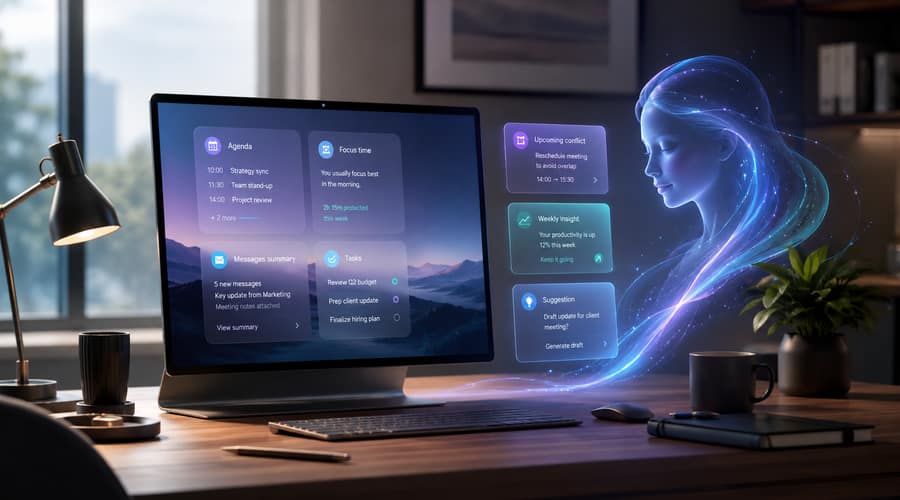
The company describes IrisGo as an on-device AI assistant for AI PCs, built around context awareness, local learning and workflow automation. Its own LinkedIn page says the product is designed to understand computer usage context, access local files and automate repetitive workflows after observing user actions. That is a sharper pitch than another chatbot window, because the value is not just in answering a question. It is in watching how work actually gets done.
That distinction matters. A lot of AI software still asks users to translate messy office work into prompts, then paste the output somewhere else. IrisGo is moving toward a different model, where the assistant sits closer to the operating system and learns from patterns: drafting an email from a document, pulling figures into a report, summarizing local files or repeating a routine that usually takes five tabs and too many clicks.
As The Information recently noted, IrisGo has been focused on Windows PCs, using system accessibility features to interact with apps and automate actions across the desktop. That is an important correction to the broader hype around agentic AI. The hard part is not making a model sound helpful. The hard part is getting software to move reliably through real user interfaces without creating privacy, security or trust problems along the way.
IrisGo's privacy argument is central to the product. The company says its assistant is built for local processing and on-device learning, which means personal files, preferences and workflow context are supposed to remain on the machine rather than being shipped off by default. In a market where users are increasingly wary of giving AI systems broad access to personal and company data, that design choice is not cosmetic. It may be the product.
The appeal is clear for office workers, but so is the risk. A desktop assistant that watches and learns must earn more trust than a chatbot. It needs to be transparent about what it observes, when it acts and what data leaves the device. If IrisGo gets that balance right, it could make AI feel less like a separate destination and more like a quiet layer inside the workday. If it gets it wrong, users will see surveillance before they see productivity.
Andrew Ng gives the startup a stronger signal
IrisGo has more than a neat product idea. Dealroom's news feed reported that the company raised $2.8 million in seed funding led by AI Fund, the venture studio founded by Andrew Ng. The same report said Acer is its first OEM partner, with IrisGo software expected to be preloaded on devices.
Ng's involvement matters because he brings unusual credibility across research, education and company building. He co-founded Coursera, helped launch Google Brain, served as chief scientist at Baidu and has spent years turning AI research into commercial products. For an early-stage startup selling a deeply technical desktop assistant, that kind of backer makes investors and partners look twice.
The Acer angle may matter just as much. Desktop AI is not only a software story. It is also a distribution story. If IrisGo can arrive on AI-ready PCs before users go looking for a standalone assistant, it has a better chance of becoming part of daily work instead of another app people try once and forget.
That is why the AI PC market is so important here. Microsoft, Intel, AMD, Nvidia and PC makers are all trying to convince buyers that local AI compute will make personal computers feel new again. IrisGo fits neatly into that story because it gives the hardware a practical reason to exist: faster, more private automation that runs close to the user's actual files and workflows.
The bigger test is habit
The market around IrisGo is moving quickly. Microsoft is pushing Copilot deeper into Windows and Office. Google is putting Gemini into more productivity surfaces. OpenAI has been expanding from chat into agents that can complete tasks. The direction is clear: AI companies want their products to act, not just respond.
IrisGo's opportunity is to be more personal and more focused than the giants. It does not need to own every productivity workflow on day one. It needs to prove that a local desktop assistant can safely learn a few valuable routines and save enough time that users keep it running.
That is also where the pressure lands. Ambient AI products often look impressive in demos because the scenario is controlled and the payoff is obvious. Daily work is less forgiving. Apps change, screens behave unpredictably, user intent shifts and one bad automated action can destroy trust faster than ten good ones can build it.
For now, IrisGo has a credible thesis at the right moment. AI is moving from chatboxes toward agents, PC makers need software that justifies new hardware and workers are still buried in repetitive digital chores. The next question is whether IrisGo can turn that timing into a durable habit. Watch the OEM rollout, the privacy controls and the first real user feedback. Those will say more than any polished demo.
Also read: OpenAI's newest reasoning model is pushing into frontier math • YouTube brings Gemini-powered remixing to Shorts, forcing creators to rethink ownership • 1Password and OpenAI move credential security into Codex