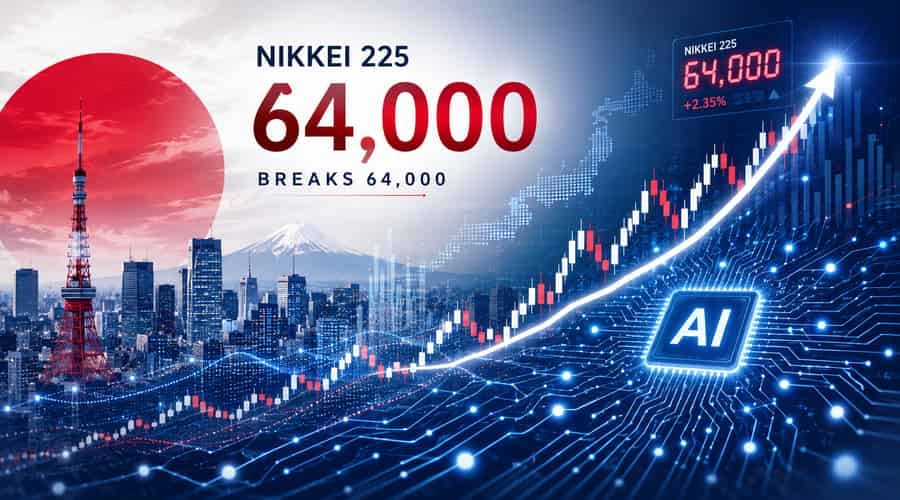
Japan’s stock market has moved from recovery story to AI momentum trade, and the Nikkei 225’s push above 63,000 shows how far that shift has travelled.
The Nikkei 225 has climbed to fresh record territory above 63,000, giving investors a clear reminder that the AI boom is no longer just a Wall Street story. Japan’s benchmark index has been lifted by the same force that has carried Nvidia, Microsoft and the wider US technology complex: the belief that spending on chips, servers, data centres and power-hungry computing infrastructure still has room to run.
That matters because Japan is not playing the same role as the US. It is not trying to produce one dominant AI platform company. Its market is being rewarded for supplying the picks and shovels. Semiconductor equipment makers, precision manufacturers, materials suppliers, electronics groups and data centre operators are becoming the local expression of a global trade.
According to recent market analysis from FXEmpire, AI-linked shares have been a central driver of the Nikkei’s record run, with investors pricing in continued demand for the hardware and infrastructure behind advanced computing. The move is not an isolated print. It is an extension of a rally that has been building through earnings, currency moves and foreign demand for Japanese equities.
The names leading the advance tell the story. Advantest, Tokyo Electron and Disco sit close to the semiconductor supply chain, where demand for advanced testing, wafer fabrication equipment and high-end manufacturing tools remains tied to the global AI buildout. SoftBank Group gives investors a more direct way to express conviction in AI infrastructure and private technology assets. Fujikura has drawn attention because AI data centres require huge amounts of connectivity, power management and optical components.
This is why the Japanese rally has a different texture from past export-led cycles. A weaker yen still helps companies with overseas earnings, and that remains part of the appeal. But the market is not simply buying Japan because its currency is cheap. It is buying companies that appear connected to the next round of capital spending by cloud providers, chip designers and data centre operators.
That distinction is important for readers watching the AI trade beyond US mega-caps. If the first phase of the cycle rewarded the companies building large language models and the chips that train them, the next phase is spreading into the machinery and infrastructure required to keep the boom alive. Japan has plenty of exposure there.
There is also a domestic investor angle. Japanese households have historically kept large pools of money in cash and deposits, but stronger markets and expanded investment accounts have made equities harder to ignore. A rising Nikkei does not automatically mean a lasting culture shift, but it does give retail investors a reason to look again at a market many had treated as a disappointment for decades.
The rally still depends on global liquidity
The risk is that a move this fast leaves little room for error. The Nikkei’s rise has been helped by strong corporate earnings, foreign buying and a yen that keeps many exporters competitive. If US rates stay higher for longer, if the dollar reverses sharply, or if investors begin questioning whether AI capital spending can keep expanding at this pace, Japan’s winners could feel the pressure quickly.
That does not make the rally fragile by default. It does mean the market is now priced for continued execution. Tokyo Electron and Advantest have to keep showing that chip investment is still translating into orders. SoftBank has to keep persuading investors that its AI exposure is an asset, not just a valuation story. Data centre and electronics suppliers need to prove that demand is broad enough to survive any cooling in sentiment toward US technology shares.
Japan’s broader market also has a structural case that goes beyond AI. Corporate governance reforms, stronger shareholder returns and the shift from household savings toward investment have changed how global fund managers talk about Tokyo. The old argument against Japan was that value stayed trapped on balance sheets. The new argument is that more of that value may finally be released.
Still, the area around 64,000 is a psychological level as much as a financial one. It invites momentum buyers, but it also invites profit-taking. Markets that climb on a powerful theme can keep moving longer than skeptics expect, yet they become vulnerable when everyone starts using the same explanation for every uptick.
For investors, the practical takeaway is straightforward. Japan is now one of the clearest places to track whether the AI trade is broadening or becoming crowded. If semiconductor suppliers, infrastructure groups and technology manufacturers keep leading together, the rally has a stronger foundation. If leadership narrows to only the most speculative names, the signal changes. The next test is not whether the Nikkei can print another round number. It is whether earnings can keep up with the expectations now built into it.
Also read: Japan’s stock rally is testing how far the AI trade can run • The ECB wants banks to treat AI cyber risk as urgent. • Rhode Island’s Kalshi fight could redraw prediction market rules