
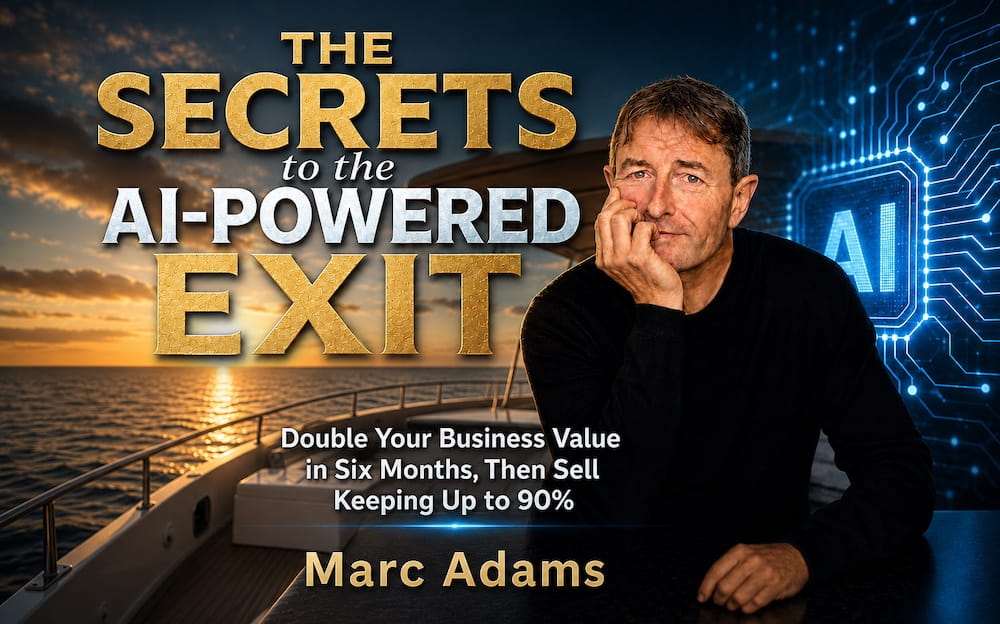
Marc Adams was given six months to live in 2020. He recovered, wrote an international bestseller, and now helps business owners keep far more of what they sell for, with AI doing much of the heavy lifting.
Most business owners spend decades building something valuable, then lose a third to half of it in the weeks around a sale. Marc Adams has spent his career on the other side of that math. He is a bestselling author and exit specialist who has worked on more than $2 billion of client growth and exit stories, and at the height of the pandemic he was diagnosed with stage four cancer and given six months to live. He recovered, and the questions that diagnosis forced on him became the foundation of the work he does today.
We sat down with Marc to talk about his journey, the AI-powered exit, and the business exit strategy he says should start long before an owner ever decides to sell.
Can you walk us through your journey to becoming a bestselling author and how your cancer diagnosis and recovery shaped the way you think about business and exits?
I’d spent thirty years around business growth, acquisitions and exits, over $2 billion of client growth and exit stories, when in late 2020, at the height of the pandemic, I was diagnosed with stage four cancer and given six months to live. When someone puts a date on your life, every plan gets shaken out onto the table, and the two questions that survived were: what is everything I’ve built actually worth, and how much of it would my family actually keep? Even I didn’t like my own answers. I had surgery in January 2021 and, remarkably, recovered. But the pivotal moment came during recovery, when my ten-year-old son Tommy asked me what happens to the families of business owners who die without ever being able to sell their businesses. I didn’t have a good answer. That question became my first book, The Secrets to 10Xing Your Business and Cashing Out Tax Free, which became an international bestseller and was featured in Times Square, and it became my life’s mission: to change the way companies are bought, valued and sold all over the world.
What inspired you to write about the AI-powered exit specifically, and what gap did you see that the book addresses?
Two facts collided. First, eight or nine out of every ten businesses that go to market never sell, and the owners who do sell typically lose 30 to 50 percent of the price to fees and taxes. Second, AI arrived, and every book about it was written for tech people, not for the owner of an engineering firm or a hotel or a gym. Nobody was telling that owner the thing that matters most: when a buyer values your business, every extra dollar of profit is worth roughly four to six dollars on sale day. So when AI takes cost out of your business, you’re not saving money, you’re minting exit value at four to six times face. The gap was a book that connects AI to a proper business exit strategy, written by someone who actually does exits for a living, and who built every AI system in the book himself, as a non-technical man in his fifties.
Can you explain your approach to doubling a business owner’s company value before a sale, and what that process typically looks like?
Value is a simple multiplication: transferable profit times a multiple. Owners spend their whole careers pulling the first lever, grinding profit upward, which is honourable and slow. The second lever, the multiple, moves faster and further. A business with a million in profit might sell for around four times on its own, while a group with five million in profit, in the same industry, sells for eight or more. Same work, different room. So our Double & Exit Framework works both levers: AI grows the profit and makes the business run without its owner, and then our aligned capital solution builds a group around the owner’s business, no equity given up, no debt, no personal guarantees, no disruption, and no broker fees, so their profit gets priced inside the bigger pool. That’s how doubling happens in six months or less. It isn’t a slogan, it’s arithmetic. And as far as we’re aware, we’re the only people in the world who can align capital this way.
You mentioned helping clients keep up to 90% of the transaction value instead of losing 30 to 50% to fees and taxes. How does that work in practice?
The leakage has three layers: broker fees, commonly around ten percent; deal costs; and the tax stack. Most owners discover all three weeks before completion, which is precisely when nothing can be done, because every legitimate structure needs time to be real. Tax authorities everywhere run on substance over form, and eve-of-sale cleverness fails. So in practice it works on a calendar, not a trick: we remove the broker layer entirely through how the exit is structured, and we meet the tax stack years early, so reliefs are genuinely earned and structures are properly seasoned, all disclosed, all within the rules, and always case by case with the owner’s own qualified professionals. Done early and done properly, the owner of a $5 million business who would have kept around $3 million can instead double to $10 million and keep up to $9 million. Same founder, same decades of work. The difference is knowing the game, and a calendar.
Your typical client is profitable, often between $500,000 and $20 million in profit, and usually 35 and older. What is the biggest misconception these owners have about exiting their business?
That the price gets decided during the sale. It doesn’t. By the time an owner “decides to sell,” the price was decided one to three years earlier, by whether the profit is evidenced, whether the business runs without them, and whether the structures had time to season. The second misconception follows from the first: owners assume the price and the proceeds are roughly the same number, and then discover, too late, that 30 to 50 percent was always going to leak away. That late discovery is actually what kills most sales: the owner realises he can’t afford to sell at the market price, raises it to compensate, and buyers walk past an overpriced business the way you walk past an overpriced house. A proper business exit strategy starts while nothing is wrong, which is exactly when nobody thinks they need one.
How has your own experience as a cancer survivor influenced how you counsel clients who are thinking about their legacy and what comes next after they sell?
It changed one thing above all: I refuse to treat an owner’s years as a free resource. Every valuation formula prices profit and risk, and none of them price your remaining time, which is the scarcest asset at the table. So when an owner tells me “someday,” I tell them what I learned with a countdown running: someday is a decision, and it’s a bad one. It also changed how I handle the day after the sale, because plenty of owners pull out of great deals at the finish line, frightened of who they’ll be on Monday morning. During my own recovery, my middle son Matthew, then fifteen, told me I’d nearly died and needed to spend more time on the things that matter. He was right. Today I run what I call a lifestyle business, I wrote this book from the deck of my boat between Venice and Greece, and I say that not as a brag but as the proof: there is life, income and meaning after the sale, and owners who know that before the closing table never flinch at it.
What is one story or example, without naming names if needed, that best captures the impact of your work?
The one giving me the most joy right now is a group of six automotive businesses, four-wheel-drive servicing specialists, each making around $500,000 a year in profit. Alone, each of those owners faces the brutal maths of selling small: by the time fees and taxes take their bite from a standalone sale, the owner clears a few hundred thousand for a lifetime of work, and many simply can’t afford to sell at all. That’s the trap most of the world’s small business owners are sitting in without knowing it.
Together, it’s a different game entirely. Combined, they hold around $3 million in annual profit, and we’re orchestrating the sale of that group at around $15 million using our aligned capital. Each owner’s share is roughly $2.5 million, several times what they could ever achieve alone, and because we’re structuring early, they’re positioned to keep up to 90 percent of it. Same businesses, same customers, same Monday mornings. The only thing that changed is the room their profit gets priced in.
Here’s what makes it special to me. There is almost no way these owners could do this themselves. The traditional route, buying up competitors on their own, would take seven years or more, and would demand bank debt, personal guarantees, and usually giving away equity to get the capital. The old way of doing this isn’t fit for purpose anymore. The new way changes how companies are valued, bought and sold, and it puts the difference in the owner’s pocket without the risk, without the time delay, and without it costing them the fortune it would take to buy those businesses themselves. Money loves speed, it’s one of my favourite sayings, and nothing captures why better than six ordinary garage owners walking away with life-changing money that the market said they’d never see.
Where do you see the intersection of AI and business exits heading over the next few years?
AI is moving along the same arc as every business technology: rare, then common, then mandatory. Right now, an owner who adopts it properly gets two payments, higher profit today and a higher multiple at sale, because a business that runs on documented systems instead of its owner’s heroics is exactly what acquirers pay premiums for. Within a few years, I expect AI maturity to become a standard diligence item, buyers will ask to see your AI operating layer the way they ask for management accounts today, and businesses without one will be priced like businesses without websites in 2010. Which means there’s a window, and it’s open now: the owners who build the machines while they’re still rare will sell into a market that hasn’t caught up yet. The whole intersection comes down to one sentence from the book: the same technology moves both sides of the value formula at once, and the window in which that looks exceptional is exactly the window in which it should be sold.
The through line
Marc’s message is consistent from the first answer to the last: the price of a business is decided long before it goes to market, and the owners who understand that, and who build with AI while it is still rare, walk away with far more than the ones who wait. For an industry used to treating an exit as a finish-line event, it is a reframing worth sitting with.
More on his work is available at acquisitions4you.com.