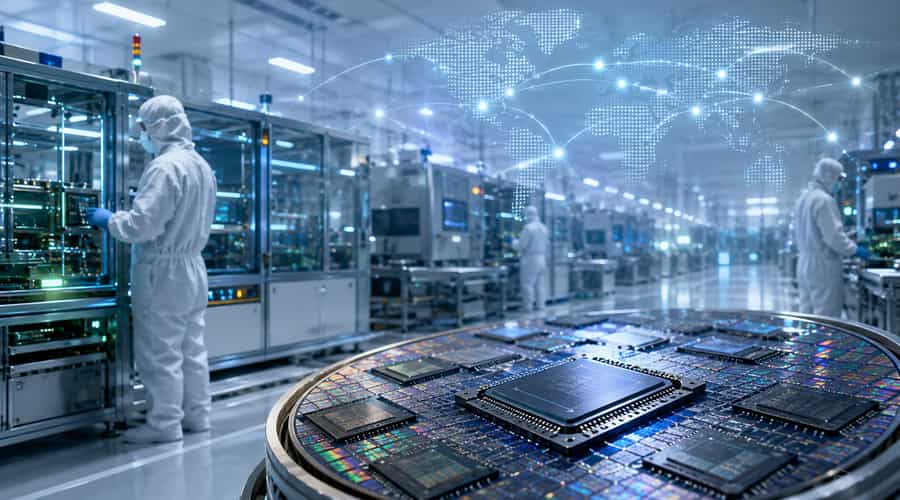
Samsung has reached a tentative labor deal that removes an immediate strike risk at a fragile moment for the global memory market.
Samsung Electronics has edged away from a strike that could have complicated semiconductor production just as AI hardware demand is forcing every major chip supplier to run hot. The company's South Korean labor union said on Wednesday that it will suspend its planned general strike and put a tentative pay agreement to a member vote, after another round of government-mediated talks with management, Reuters reported.
That matters because this was never just a wage dispute. Samsung is one of the most important suppliers of high bandwidth memory, or HBM, and NAND flash, two components that sit deep inside AI accelerators, servers and data center gear. A prolonged disruption at the world's biggest memory chipmaker would have reached far beyond its own factories, touching customers that rely on tightly timed deliveries and on a memory market that has already been stretched by the AI boom.
The tentative deal also shows how much leverage Samsung's workers have gained in a year when the company's chip business has returned to strength. Reuters said talks had been running for days under government mediation, while Bloomberg and CNBC both noted that the dispute centered on Samsung's performance-based bonus system, with the union pushing for a bigger share of operating profit and Samsung resisting the structure of that demand. The fact that the sides found enough common ground to pause a strike suggests neither wanted to test the market's tolerance for another supply shock.
The stakes were high because Samsung's semiconductor division sits at the center of the AI buildout. HBM has become a critical input for Nvidia's GPU roadmap and for other accelerator designs, which means any hesitation in Samsung's output can ripple into cloud providers, server makers and the startups trying to secure allocations before the next cycle of demand hits. Bloomberg described the talks as taking place at a delicate moment for the company, which has been benefiting from red-hot AI chip demand while also facing fierce competition from SK Hynix and Micron.
The union's strike plan had not been symbolic. Reuters reported earlier this week that the walkout was due to begin on Thursday if negotiations failed, after the sides had already spent multiple rounds trying to bridge differences over bonuses and compensation. CNBC and Yonhap both said the union had discussed an 18-day strike plan, a timeline that would have been long enough to create real anxiety for customers and investors even if actual production damage turned out to be limited.
South Korean authorities also treated the dispute as a broader economic issue. Reuters said the government had been considering intervention to block the strike, and CNBC reported that officials warned of costs not just to Samsung but to the wider economy. That response makes sense. Memory chips are not a side business anymore. They are one of the pressure points in the AI supply chain, and South Korea remains one of the few places where scale, advanced process know-how and industrial discipline still line up at the same time.
What the deal signals
The immediate relief is obvious. A strike threat over Samsung's semiconductor operations has been pushed back, which lowers the chance of near-term disruption in a supply chain that does not have much slack. For chip buyers, cloud operators and AI hardware startups, that is the kind of stability that matters more than any single headline because it preserves delivery schedules and reduces the odds of emergency sourcing at higher prices.
But the larger question is what this means for Samsung's cost base and bargaining power. The union's demands have been tied to the company's profits from AI-related demand, and Bloomberg noted that bonus terms were at the heart of the standoff. If Samsung concedes more generous compensation to keep labor peace, that could pressure margins even as the company tries to expand its HBM position against SK Hynix. If it resists too hard, it risks another round of labor tension right when customers are asking for reliability and scale.
That tension is why this agreement is best read as a truce, not a clean resolution. The member vote still matters, and until it passes, Samsung does not get to treat the issue as closed. Even so, the market reaction to the talks, and the intensity of the government involvement, underline a larger truth about the AI hardware trade. When one supplier sits that deep in the stack, labor peace becomes part of infrastructure planning.
The next test is whether Samsung can keep production momentum while protecting profitability in the segment that has become central to its future. For now, it has bought time. In this industry, time is often the most valuable asset of all.
Also read: Trump's new crypto order could open the door for fintech startups • Figma puts AI inside its canvas as design software turns more agentic • Exa's $2.2 billion valuation shows AI search has become a premium bet