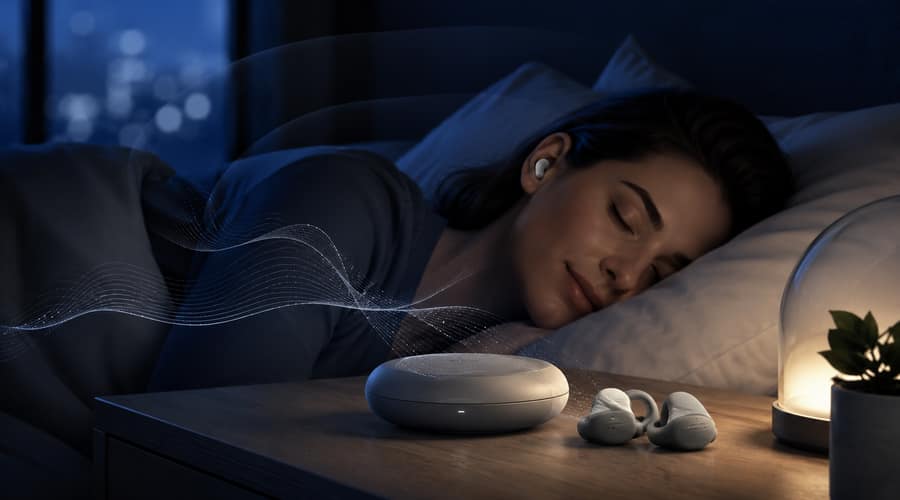
SOND has come out of stealth with a sleep product that leans on rare hardware credibility, and it arrives with 7 million in fresh funding.
The startup is trying to do something the sleep market still struggles with, move beyond tracking and into active improvement. According to TechCrunch, SOND was founded by Yadid Ayzenberg, who led Bose's sleep products work, and the company is now presenting its DreamBuds as a phone-free system that listens to the body and adapts in real time.
That matters because sleep tech has become crowded with devices that promise insight but stop short of intervention. The better question for consumers is not whether a ring, watch or mat can tell you that you slept badly, it is whether the product can actually help the next night go better. SOND is betting that earbuds, combined with AI coaching and biometric sensing, can move the category closer to that answer.
TechCrunch reported that the company raised 7 million in funding as it stepped out of stealth, with E14 Fund among the backers. That is a useful signal for a category where investors have remained interested, but where consumer hardware still has to prove it can earn trust, scale and repeat usage rather than just another round of buzz.
The Bose connection is not a throwaway detail. SOND's team brings experience from Bose's Sleepbuds effort, which gave them knowledge of comfort, miniaturized hardware, acoustic tuning and the challenge of building a product people can wear all night without thinking about it. That kind of experience is hard to fake, and in sleep tech, credibility often starts with whether the device disappears once it is on the body.
That lineage also helps explain why the company is framing DreamBuds as more than another pair of earbuds. The product is designed to capture 12 physiological signals and use a cloud-based AI coach to choose or create audio that responds to the user's state. In other words, SOND is trying to create a feedback loop, not just a sensor.
There is a reason that approach feels timely. Bose has already stepped back from the sleep category, and the vacuum it left behind gave former insiders room to build something more ambitious from the lessons learned there. SOND is effectively arguing that the category was not wrong, just underbuilt.
Why the product angle matters
The company's pitch is aimed at a part of the market that sits between wellness and clinical care. Consumers want something simple enough to use every night, while clinicians and serious users want a product that does more than count minutes and deliver vague advice. That is where AI-driven personalization becomes useful, because a static sound library is not the same thing as a system that adapts to breathing, movement and sleep state in real time.
SOND is also entering a segment where form factor matters as much as software. Eight Sleep has built a premium position around the bed itself, while Whoop has focused on the wearable layer and the recovery narrative. SOND is taking a different path by putting the experience in the ear, which may be less invasive than a mattress system and more sleep-specific than a general-purpose tracker.
That differentiation could help if the company can prove the earbuds are comfortable, effective and worth the price. But sleep hardware has always been unforgiving. People will not tolerate friction at bedtime, and they will not forgive devices that wake them up, confuse them or require too much setup. The winning product has to feel almost invisible.
There is also a broader market shift behind the launch. Sleep is no longer being treated as a side feature in wellness. It has become a standalone category where ambient sensing, biometrics and AI are converging, and startups are trying to own the moment between data collection and behavior change. SOND's wager is that this gap is large enough to build a company around.
For now, the funding and the founding team give the company a real opening. The next test is whether DreamBuds can turn a strong story into repeatable consumer demand. In sleep tech, that is the difference between a compelling demo and a business that lasts.
Also read: Jacob Eells Built NutriTracker for the People Who Quit Every Other Health App • OpenRouter's valuation shows where AI infrastructure is moving • Human Archive wants India’s gig workers to train tomorrow’s robots