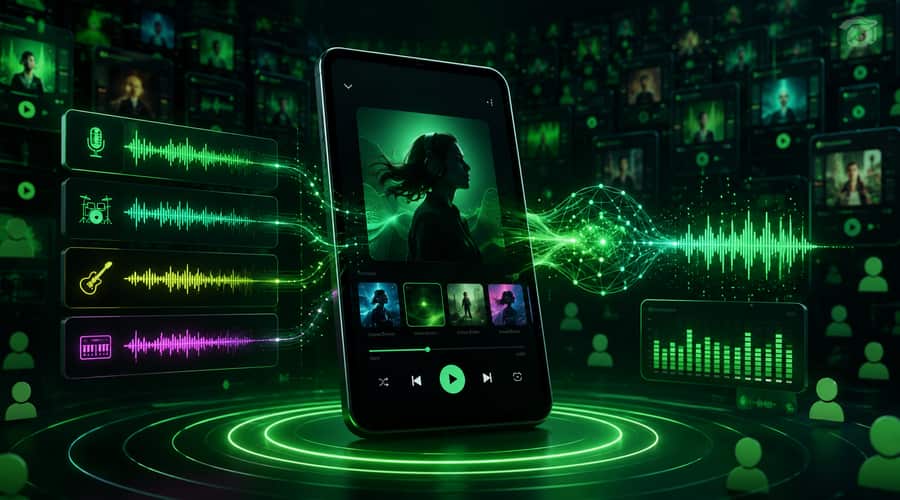
Spotify is turning the AI music fight into a licensed product. Its deal with Universal Music Group gives Premium users a paid way to make AI covers and remixes while sending money back to participating rights holders.
Spotify and Universal Music Group have moved the AI copyright debate from the courtroom into the product roadmap. According to The Verge, the companies struck a licensing deal that will let Premium subscribers pay for an add-on to create AI-generated covers and remixes of participating songs, with artists and songwriters credited and compensated when their work is used.
The timing matters because Spotify now has the scale to make this more than a novelty. The company reported 761 million monthly active users and 293 million Premium subscribers in its first-quarter 2026 results, giving any new paid feature immediate reach across a global audience. If even a small share of those users pay to experiment with remixes, the feature could become a meaningful new revenue stream for Spotify, labels, publishers, and artists willing to opt in.
The framework rests on a simple principle: permission first. Spotify co-CEO Alex Norstrom has described the approach as being built around consent, credit, and compensation. That is not just careful language. It is the dividing line between a platform trying to commercialize AI music inside existing rights structures and startups still defending whether their training practices were legal in the first place.
Why Spotify's model looks different
The structure differs sharply from the path taken by standalone AI music companies. Suno and Udio built large consumer products around prompt-generated songs, then faced lawsuits from major labels that alleged they trained their models on copyrighted recordings without permission. Warner Music Group has settled with both companies, Universal Music Group has settled with Udio, and Sony Music remains the major holdout in litigation.
Spotify is taking the opposite route by licensing first and launching later. That gives the company a commercial advantage, but it also gives artists a clearer choice. If participation is genuinely opt-in, artists and songwriters can decide whether AI derivatives help their catalog or dilute it. That question will not land the same way for everyone. A pop act with a large fan base may see value in official remix activity. A smaller artist may worry that AI versions compete with the original work they are still trying to build around.
Universal Music Group CEO Sir Lucian Grainge has framed licensed AI as a way to support human artistry and create new revenue opportunities. That position fits UMG's broader strategy, which has been to litigate against unauthorized AI training while cutting deals with companies willing to build controlled, compensated products. In plain terms, the label is not rejecting AI music. It is trying to decide who gets to profit from it, and under what rules.
The pressure on AI music startups
For AI music startups, the Spotify-UMG deal raises the bar. A startup can still build a clever model or a better creation interface, but it now has to compete with a platform that already owns the listening habit, the subscription relationship, and the licensing infrastructure. That is a difficult combination to match.
This does not mean every startup in the category is boxed out. The opportunity shifts toward companies that can provide useful technology inside licensed environments. A startup that helps platforms generate clean stems, manage rights attribution, detect voice likeness, or calculate compensation may have a stronger path than one trying to build a consumer music app around unlicensed catalogs.
The bigger lesson is that the market is moving from permissionless experimentation to negotiated access. That is a slower model than the usual startup playbook, but music has always been a rights-heavy business. The companies that understand publishing, master recordings, likeness rights, and artist consent will be in a better position than those treating music as just another dataset.
What to watch next
Important details are still missing. Spotify has not announced the add-on's price, launch date, participating artists, or whether the underlying AI model is built in-house or supplied by a partner. It is also unclear how generated tracks will be shared, labeled, ranked, and counted for royalty purposes. Those operational choices will determine whether artists see the feature as a useful fan tool or another way for platforms to flood listening surfaces with cheap derivatives.
The catalog question is just as important. The current deal centers on Universal Music Group, but Spotify will need broader participation from Sony Music, Warner Music Group, independents, publishers, and collecting societies if it wants the feature to feel complete. A remix tool that covers only part of the music people actually listen to may feel limited. A tool that reaches most of the commercial catalog could reshape how fans interact with songs.
For founders watching the space, the signal is clear. The future of AI music will not be decided only by model quality. It will be decided by rights access, trust, and distribution. Spotify has all three within reach, which is why this deal matters beyond one product feature. The next phase of AI music belongs to companies that can make permission feel seamless and make compensation real.