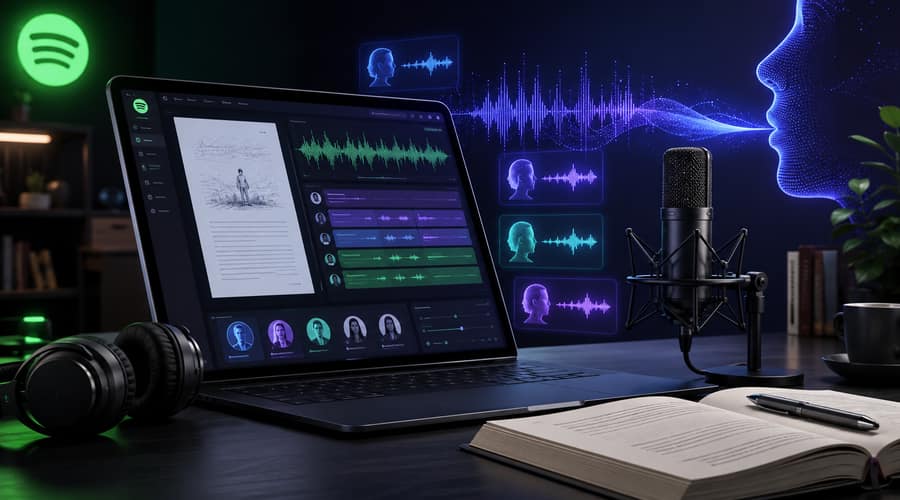
Spotify is moving AI audiobook creation directly into its author tools. The bet is simple: if production gets easier, the audiobook catalog gets bigger, and Spotify gets more reasons for listeners to stay inside its app.
Spotify used its May 21 Investor Day to make a clear point about books: audiobooks are no longer a side experiment for the company. They are becoming part of the core platform. The newest signal is an ElevenLabs-powered creation tool for Spotify for Authors, set to launch in beta in early June for self-published authors, with digital voice generation built directly into the workflow and no exclusive deal requirement.
That last detail matters. Authors who use the tool will not be forced to give Spotify exclusive control over the resulting audiobook. They can still think like independent publishers, choosing where and how to distribute their work rather than trading flexibility for access to a production shortcut. For writers who already publish across Amazon, Apple Books, Google Play Books, and other channels, that could make the tool more useful than a closed platform offer.
Spotify already accepted AI-narrated audiobooks through partners including ElevenLabs and Google Play Books. The change now is where the work happens. Instead of creating audio somewhere else and submitting it later, authors will be able to generate narration inside Spotify for Authors itself. That pulls the production layer closer to the distribution layer, which is exactly where Spotify wants more of the creator workflow to live.
Audiobooks become a real revenue line
The launch comes as Spotify's audiobook business reaches meaningful scale. According to Spotify's Investor Day recap, its audiobook catalog has grown from 150,000 titles to more than 700,000 across 22 markets in two years. Listening hours grew 60 percent from 2024 to 2025, and nearly half of audiobook consumers on the platform started listening within the past twelve months.
Audiobooks+ is also beginning to look like a serious add-on business. Spotify said the product is on track to reach $100 million in annualized recurring revenue in July, and the company is preparing higher-hour tiers as well as Family and Student plans. That explains the push into creation tools. More supply gives Spotify more listening inventory, more subscription value, and more chances to turn book discovery into a regular habit rather than an occasional purchase.
The economics are attractive because traditional audiobook production is expensive. A professionally narrated book can require a narrator, studio time, editing, mastering, quality checks, and coordination that many self-published writers cannot justify. AI narration does not remove every cost or every judgment call, but it can make the first version of an audiobook much easier to produce. For an author with a backlist, that changes the math quickly.
What this means for indie authors
For self-published writers, the practical upside is access. A novelist with several finished books could use AI narration to test audio demand without committing thousands of dollars per title. A nonfiction author with a niche audience could put a book into audio faster, then decide later whether a human-narrated edition is worth the investment. That is not a small shift in a market where production costs have often decided who gets to participate.
Spotify also brings distribution that most author tools cannot match. The company had 761 million monthly active users at the time of Investor Day and nearly 300 million subscribers. Audiobooks sit inside the same app people already use for music and podcasts, which means discovery can happen without asking listeners to build a new habit. For authors, that is the real prize: not just cheaper narration, but placement inside an existing listening routine.
The caveat is quality. ElevenLabs voices have improved sharply, but audiobook narration is not only about reading words cleanly. Good narrators make choices about pacing, emphasis, character, silence, and emotional weight. AI can handle some books better than others. It may be perfectly acceptable for straightforward nonfiction, business titles, guides, and reference-heavy work. Literary fiction, memoir, and character-led novels will be a harder test.
Transparency will decide how much trust the market gives this model. AI-narrated audiobooks need to be clearly labeled, because listeners should know whether they are hearing a human performance or a synthetic voice. Spotify has already required disclosure for AI-narrated titles distributed through its existing process, and that same clarity will become more important as the tools move closer to authors and the output becomes harder to distinguish from conventional narration.
The competitive landscape
Spotify is not alone here. Amazon has been testing AI-narrated audiobooks through Virtual Voice for Kindle Direct Publishing authors, and Google Play Books supports digitally narrated titles. What makes Spotify's move notable is the combination of ElevenLabs voice technology, author-friendly distribution terms, and a platform where audio is already the central behavior.
For ElevenLabs, this is a distribution win. The company already offers tools for long-form narration, but being embedded inside Spotify for Authors puts its technology in front of writers at the moment they are deciding whether to make an audiobook at all. That is a stronger position than waiting for authors to visit a standalone AI voice platform and figure out the publishing path themselves.
The beta in early June will show how much friction remains. Spotify still has to prove that the workflow is simple, that quality controls are strong, and that listeners respond to AI-narrated books as useful inventory rather than cheap filler. If it gets those pieces right, the broader lesson for founders is clear. In AI media, the strongest products may not be standalone tools. They may be the ones embedded inside platforms where creators already work and audiences already spend time.