Switch is trying to raise close to $2 billion because private capital still wants the pipes behind AI, even while public investors are punishing the companies paying for them.
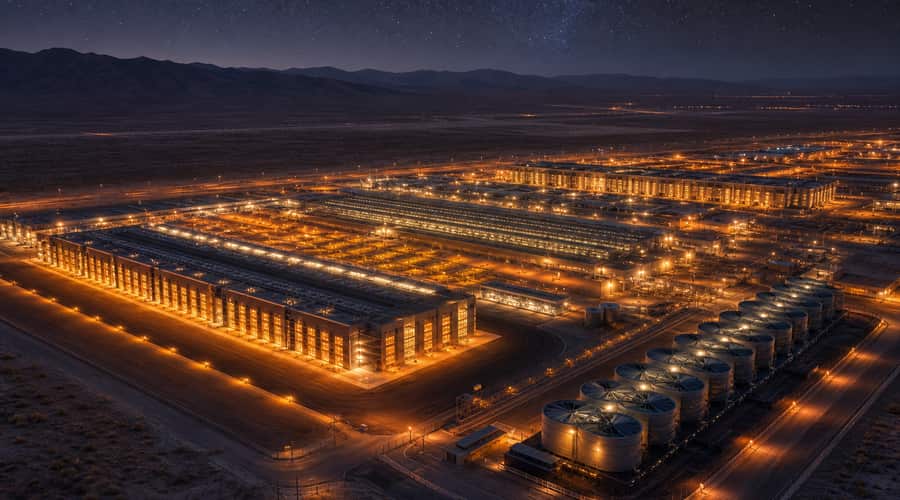
Switch Inc. is not a small side bet on the AI boom anymore. The Las Vegas-based data center operator, majority owned by DigitalBridge, is seeking roughly $2 billion in fresh private funding, according to Bloomberg's July 2 report. Andreessen Horowitz is leading the round with about $400 million, while Goldman Sachs and JPMorgan are arranging the financing. The proposed deal values Switch's equity at about $19 billion before the new money, and close to $50 billion when debt is included.
You should read those two numbers together. The $19 billion figure tells you what investors think the company itself is worth. The $50 billion figure tells you how much leverage and infrastructure spending sits underneath the story. Data centers are not apps. They are land, power contracts, cooling systems, fiber, racks and long construction timetables. That is exactly why the valuation is so striking now.
Bloomberg reported that the round is meant to prepare Switch for a possible IPO as soon as 2027. Switch knows the public market route already. It priced its first IPO at $17 a share in 2017, then left the market in 2022 when DigitalBridge and other investors bought it for about $11 billion. If this round lands near the reported target, Switch will have nearly tripled that equity value in less than four years.
Frankly, that is a bold reset. It says private investors still believe scarce data center capacity is worth paying for before public markets are ready to reward the spending.
The awkward part is what is happening in listed AI infrastructure stocks at the same time. Oracle's shares fell sharply after its latest results, as investors focused less on cloud growth and more on the cash cost of building capacity. Investor's Business Daily reported that Oracle's fiscal 2026 capital expenditure reached $55.7 billion, while free cash flow was negative $23.7 billion, compared with negative $394 million the year before. The company also expects to raise about $40 billion in debt and equity financing in fiscal 2027, including a planned $20 billion equity issuance.
That is the tension. Oracle can point to real demand, including remaining performance obligations of $638 billion. Investors can still look at the cash drain and decide they have seen enough for now. When AI spending turns up as debt before it turns up as profit, public shareholders become much less patient.
The pressure has spread well beyond Oracle. The Financial Times reported this week that the Magnificent Seven lost more than $2.2 trillion in market value in June, with investors questioning whether Meta, Amazon, Microsoft and Alphabet can turn enormous AI infrastructure budgets into returns at scale. Associated Press data from July 2 showed the same anxiety hitting Asia, where South Korea's Kospi fell 7.9% and SK Hynix and Samsung Electronics dropped 14.6% and 9.1%, respectively.
Private money is moving in the opposite direction. Axios, citing Bloomberg, reported last week that Abu Dhabi-backed MGX had raised nearly $50 billion for AI investments. MGX already has exposure to OpenAI, Anthropic and xAI, and it joined BlackRock's Global Infrastructure Partners in the Aligned Data Centers deal announced last October. The Wall Street Journal reported that transaction at roughly $20 billion for the company, or $40 billion including debt.
Switch fits neatly inside that appetite. Its business is closer to industrial infrastructure than software: lease capacity to hyperscalers and AI labs, build campuses where power and connectivity work, and lock customers into contracts that can run for years. You don't need to believe every AI application will become a great business to believe that the companies training and serving those models will keep fighting for capacity.
That doesn't make the bet clean. It only makes it understandable.
If the public selloff is just a summer panic, Switch could come to market in 2027 with a cleaner story than Oracle: less quarterly scrutiny behind it, more visible demand in front of it, and a fresh valuation set by deep-pocketed private investors. If the selloff is an early warning that too much AI capacity is being built too quickly, then Switch's IPO window could look very different by the time it opens.
DigitalBridge and Andreessen Horowitz are making the more aggressive call. They are betting that data center scarcity lasts longer than investor nerves. That may be right. But the next two years will decide whether Switch is being valued like essential infrastructure or like the latest place private capital went looking for yield during an AI spending frenzy.
Also read: Anthropic's Fable 5 Pricing Mess Is Handing Chinese Rivals an Opening • Base44 built its own AI model because generic chatbots make ugly apps • Nvidia Will Take a Cut of AI Startups' Future Revenue Instead of Cash Upfront