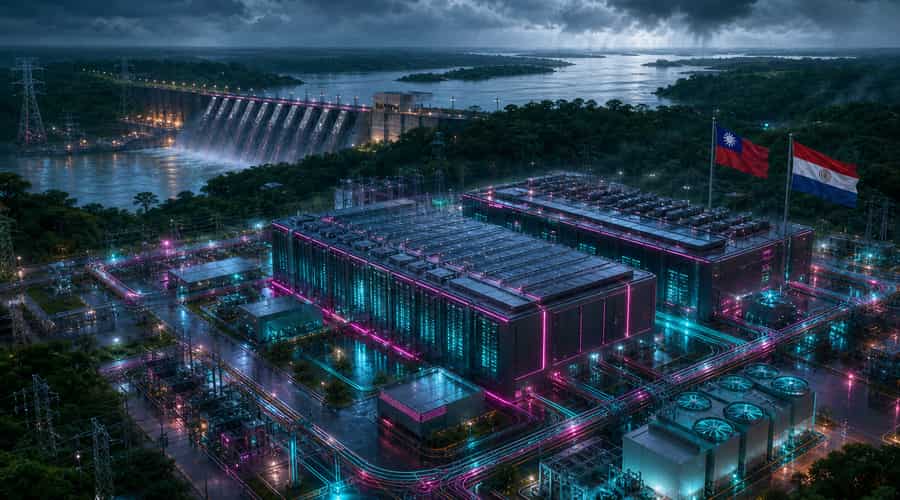
Taiwan and Paraguay are building a jointly owned AI data center, splitting $200 million in a deal that doubles as a lifeline for Taipei's shrinking circle of formal diplomatic allies.
Bloomberg reported on Thursday that Taiwan's International Cooperation and Development Fund has reached out to Google, Microsoft, and Amazon about potentially investing in the facility or becoming anchor customers for its computing capacity. The project will deliver 10 megawatts of compute, targeted for operations by end of 2027, and will be governed by a newly created binational digital entity answering to both governments simultaneously. Paraguay President Santiago Peña announced the deal publicly after meeting Taiwan President William Lai in Taipei in May.
The structure is deliberately symmetrical: equal financing, equal ownership, equal governance. What each side brings is asymmetric. Paraguay has surplus hydroelectric power, one of the cheapest and cleanest grid profiles in Latin America thanks to its position as a major exporter from the Itaipu Dam. Taiwan brings chip expertise and institutional access to technology supply chains that no Latin American country can access through commercial procurement alone. According to reporting by Rio Times Online, the deal is distinctive precisely because it ties advanced semiconductor supply directly into the project rather than relying on commercial chip procurement, a structural edge no other AI infrastructure project in the region currently has.
Paraguay is Taiwan's only remaining South American diplomatic ally. China has steadily peeled off Taiwan's Latin American partners over the past decade: Panama in 2017, the Dominican Republic and El Salvador in 2018, Nicaragua in 2021, Honduras in 2023. Taiwan's remaining 12 formal diplomatic partners worldwide include small Pacific island states, the Vatican, and Paraguay. Keeping Asunción in the fold is not just symbolic. It is what remains of Taiwan's formal presence in an entire hemisphere.
The use of technology infrastructure as a diplomatic instrument is not new, but the AI era is making the scale of these investments both more visible and more consequential. China's Belt and Road Initiative included data cables, surveillance platforms, and telecom buildouts as standard components of its soft-power toolkit. What Taiwan is doing in Paraguay is a version of the same playbook, built around semiconductor credibility rather than construction financing. The implicit offer to Paraguay is compute access and the technical relationships that come with it, along with the prospect of becoming a regional AI hub in a part of the world that currently has nothing comparable in scale.
Whether this facility becomes something more than a diplomatic gesture depends almost entirely on what Google, Microsoft, and Amazon decide. Taiwan's ICDF has approached all three, according to Bloomberg, but no commercial agreements have been announced. The pitch is legible: sovereign bilateral hubs could offer hyperscalers a lower-risk path into frontier markets where direct investment remains politically complicated. A facility anchored by a government-to-government treaty is structurally different from a hyperscaler building its own regional cloud presence from scratch, and the energy infrastructure, cheap hydroelectric power from Itaipu, is already in place.
The risk for hyperscalers runs the other direction. Being visibly embedded in a geopolitical arrangement that Beijing will read as support for Taiwan's international legitimacy is a real exposure. Amazon, Microsoft, and Google all have significant commercial operations in mainland China, and each has navigated that relationship with care. Becoming an anchor customer in a facility that Taiwan's development fund financed as an explicit diplomatic move raises that calculation considerably.
If no major cloud provider signs on, the 10-megawatt facility will still get built, because both governments have committed the funding. But its influence as a template for similar bilateral arrangements, in Pacific island states, in Central America, in parts of Africa where Taiwan still holds formal ties, will depend on whether commercial interest validates the model or leaves it as a diplomatic artifact that computes for nobody in particular. That answer will come well before 2027.
Also read: Europe 2031 gives the continent until summer to avoid AI irrelevance • MetaX seeks a Hong Kong listing after shocking Shanghai with a 700 percent debut • Apple bets its anti-flattery Siri AI will outperform ChatGPT's engagement play