The 2026 tech layoff wave is not just a labor story. It is a signal that companies are moving money from payroll into AI, and startups now have to decide what kind of team they really want to build.
Tech workers are entering another hard year, but this one has a different shape. The cuts are not coming only from companies that missed revenue targets or overhired during the pandemic boom. They are also coming from companies that are still investing heavily, especially in AI infrastructure, automation and tools that promise to make smaller teams look more productive.
That is why founders should pay attention. A layoff cycle can look like a recruiting opportunity from the outside, especially in San Francisco, where a single round of cuts at Cisco, Coinbase, Cloudflare or Autodesk can send experienced engineers, product managers and go-to-market leaders back into the market. But if the reason those jobs disappeared was a new operating model, not a simple downturn, then startups need to read the signal carefully.
According to Statista, using Layoffs.fyi data, tech and startup companies had already cut more than 100,000 jobs worldwide by early May 2026, including about 81,700 in the first quarter and roughly 20,000 more in the first six weeks of the second quarter. That nearly matches the 124,201 layoffs Layoffs.fyi recorded across all of 2025, and it puts 2026 back in the territory of earlier downturn waves rather than the calmer market many workers expected after two years of adjustment.
The important part is where the money is going. The Associated Press reported this week that companies from Cisco to Block are increasingly pointing to AI when they announce job cuts, even when AI is not the only reason for the restructuring. That distinction matters. In many cases, companies are not saying a model directly replaced a person. They are saying the business now needs fewer people in some functions because budgets are being redirected toward compute, automation and AI-centered workflows.
Cisco is a useful Bay Area example. SFGATE reported on May 13 that the company is cutting thousands of roles after record revenue, with a restructuring plan expected to cost about $1 billion. That is not the classic picture of a company fighting for survival. It is the picture of a large business trying to reshape itself while still telling investors it can fund the next phase of AI demand.
Coinbase shows a similar pressure from another corner of the market. The formerly San Francisco headquartered crypto exchange is laying off about 700 workers, or 14% of its staff, as part of a restructuring tied to market volatility and wider use of AI tools. Freshworks has also been reported as cutting about 500 jobs, or 11% of its workforce, while leaning more heavily on AI and automation for routine work.
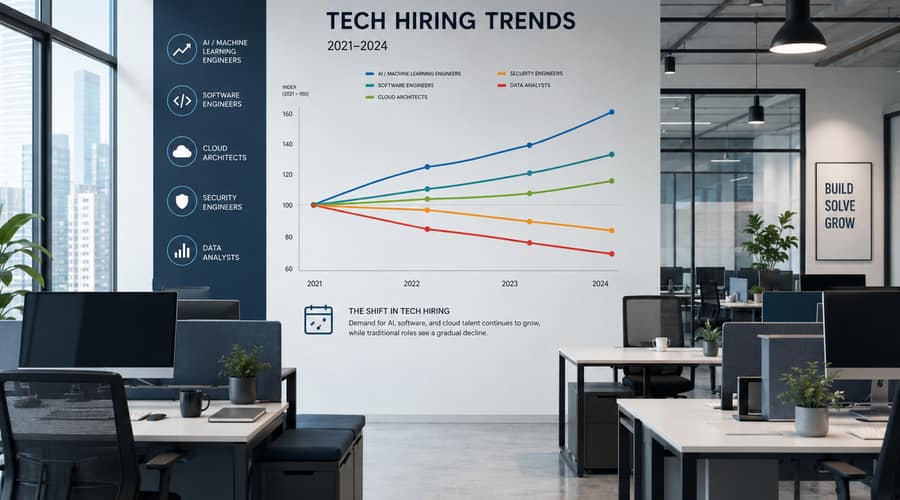
For startups, this changes the hiring math. The market may contain more available talent, but not all talent is becoming cheaper in the same way. Engineers who can build with AI systems, manage data infrastructure, secure model-enabled products or turn automation into real margin improvement will still have leverage. Generalist roles that once grew naturally as companies scaled may face more pressure, because investors are asking whether a startup really needs the old headcount curve.
Founders Get Opportunity And Risk
There is an obvious upside for early-stage companies. A founder who could not compete with Big Tech compensation in 2021 may now have access to people with serious operating experience. Some laid-off workers will want smaller teams, faster decisions and a clearer connection between their work and the product. That can be a gift to a startup that has real customers and a disciplined plan.
But founders should not confuse availability with fit. People coming out of repeated restructuring rounds may be exhausted, skeptical or trained by large-company habits that do not travel well to a ten-person team. A startup cannot afford to hire someone simply because their previous employer had a famous name. The better question is whether they can work in ambiguity, talk to customers, make tradeoffs without layers of approval and use AI tools without pretending the tools solve the whole business problem.
There is also a more subtle danger. Big companies are now teaching the market to expect leaner teams to produce more output because AI is in the stack. Some of that expectation is reasonable. Some of it is financial storytelling. If founders absorb only the headline, they may build teams that are too thin, then wonder why quality slips, customers churn or the best people burn out.
The practical move is to hire around judgment, not just resumes. A smaller team can outperform a larger one when it is focused, technically fluent and close to the customer. It can also fail quickly when every person is expected to cover three jobs while AI tools are treated as a substitute for management discipline.
The 2026 layoff wave gives startups a rare chance to recruit strong people at a moment when large companies are reorganizing around AI. It also gives them a warning. The winners will not be the founders who simply copy Big Tech efficiency language. They will be the ones who know which roles should shrink, which roles should become more valuable and which human decisions still make the company worth building.
Also read: LTX Director turns AI video into an editable indie workflow. • TurboQuant gives AI startups a useful reminder about inference costs • InclusionAI brings trillion parameter reasoning closer to startups