Tiny plastic heads being sold to Tesla drivers in China show how weak a safety system becomes when it has to police people who are actively trying to beat it.
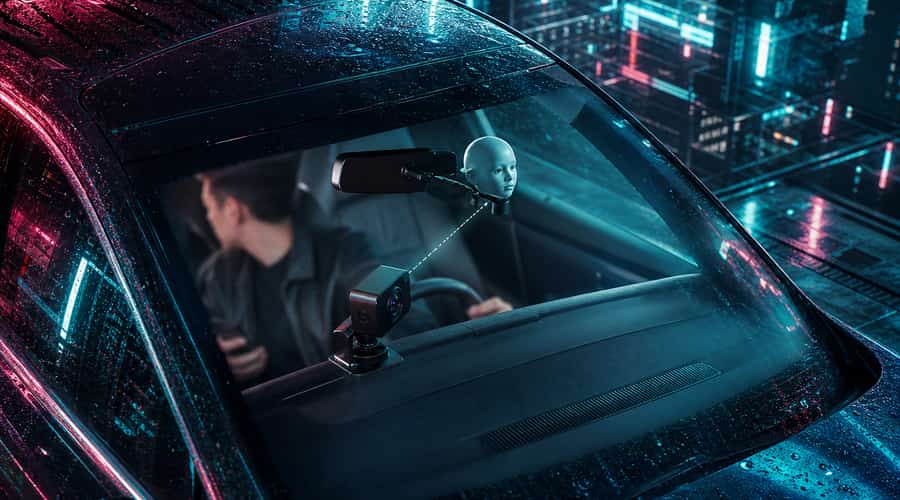
The most interesting thing about the latest Tesla workaround in China is not that it is clever. It is that it is so cheap. Wired reported this week that some Tesla drivers are buying small plastic heads, often for about $10 to $40, and mounting them near the rearview mirror so the car’s in-cabin camera sees an attentive face while the real driver looks away.
That is a bad enough image on its own: a driver-assistance system watching a toy while the person behind the wheel checks a phone, eats, films a video, or simply stops doing the job the software still requires them to do. But the larger problem is not the figurine. It is the assumption that camera-based supervision can be treated as a thin software layer on top of semi-automated driving and still hold up once users start behaving like adversaries.
According to Wired, the gadgets have been appearing on Chinese e-commerce and social platforms including Taobao, Xianyu, and Douyin after Tesla tightened distracted-driver checks through a recent software update. Some are crude, about the size of a ping pong ball. Others use static pictures, lenticular cards that appear to blink, or small display screens looping a video of a moving human face. One Chinese Tesla Model 3 owner told Wired he used a fake head on part of a 400-mile trip and could go about 30 minutes without the usual interruption.
This is not a story about a fully driverless car being fooled. Tesla’s driver-assistance features still require the human in the seat to pay attention, whether the feature is branded Autopilot or Full Self-Driving (Supervised). The company’s China status has also been changing quickly, with The Wall Street Journal reporting in May that Tesla said FSD Supervised had become available in China after years of regulatory delay. The important point is more basic: supervised systems are only as safe as the supervision.
A driver-monitoring camera is supposed to close the gap between what the software can do and what Tesla still asks the driver to do. If the car is handling speed, lane position, and some steering decisions, the camera is there to make sure the person remains ready to take over. The fake head attacks that exact handoff.
There is an old pattern here. Tesla owners in other markets have used steering-wheel weights, sunglasses, camera covers, and other tricks to reduce alerts. The difference in China is the absurd clarity of the workaround. A small bald plastic head resembling Dwayne Johnson is not a complex AI attack. It is a physical prop placed in the right spot. If that is enough to keep assistance running longer than intended, the system is not only reading attention poorly. It is reading a stage set.
Regulators have already shown they care about this boundary. In December 2023, the Associated Press reported that Tesla recalled more than 2 million vehicles in the United States after the National Highway Traffic Safety Administration found that Autopilot’s driver-monitoring controls could be inadequate and allow foreseeable misuse. That recall was handled through software updates, with more warnings and limits on where Autosteer could be used. The Chinese plastic-head market is a fresh reminder that warnings alone are a weak answer when the driver’s goal is to silence the warning.
The uncomfortable truth for the auto industry is that driver monitoring is not a dashboard feature. It is safety infrastructure. A seatbelt latch has to resist cheap defeat devices. A breathalyzer interlock has to consider the possibility that someone else blows into it. A camera watching a driver in a Level 2 automation system has to assume the driver may not be cooperative.
Autonomy claims meet human behavior
Tesla has built its autonomy story around scale, data, and neural networks trained on real-world driving. That matters for how a car sees lanes, traffic lights, pedestrians, and vehicles. It does not solve the separate problem of whether a person in the cabin is honestly participating in the task.
For startups and investors watching AI-assisted mobility, this is the part that should not be ignored. Model performance is only one layer of the product. Compliance, human factors, hardware placement, tamper detection, and regulatory trust may decide how far these systems can be deployed. A system that works in a test drive but can be fooled by a $30 object sold online has a different risk profile once it reaches millions of drivers.
There is also a China-specific pressure around this. Tesla is competing in the world’s largest electric-vehicle market against companies such as BYD, XPeng, Nio, Xiaomi, and Huawei-linked systems that are racing to make assisted driving a selling point. The more these features become part of everyday car marketing, the more the safety layer has to survive everyday consumer behavior, including the lazy, reckless, and inventive parts of it.
Tesla did not respond to Wired’s questions about whether it knew of the products or planned action against sellers. If the market stays small, the company may treat it as another round of misuse to patch around. If the gadgets spread, regulators may see something more serious: proof that driver-monitoring systems need anti-tamper standards, not just better prompts on the screen.
A toy head should not be able to become a co-pilot. If supervised autonomy depends on the car knowing when the human has checked out, then the camera has to know the difference between a driver and a doll. That is not a side issue. It is the safety case.
Also read: Anthropic's model shutdown turns AI exports into a customer risk • Oil falls as traders price in a possible US Iran deal • Paramount has cleared its biggest U.S. hurdle to buy Warner Bros