STT GDC India's reported $500 million IPO plan is more than another listing story. It is a test of whether investors will treat data-center capacity as India's cleanest public-market AI infrastructure bet.
STT Global Data Centres is said to be preparing a roughly $500 million initial public offering for its India business, and the timing tells you almost as much as the size. AI has made data centers feel less like back-office real estate and more like strategic infrastructure. In India, that shift is now moving toward the stock market.
According to Bloomberg's May 15 report, the company is working on an India listing that could raise about $500 million, though the details may still change. That follows STT GDC India's own February statement that it was evaluating long-term strategic options, including a potential IPO targeted for the first half of 2027. The market now has something more concrete to watch: whether a large, established data-center operator can turn AI demand into a listed growth story.
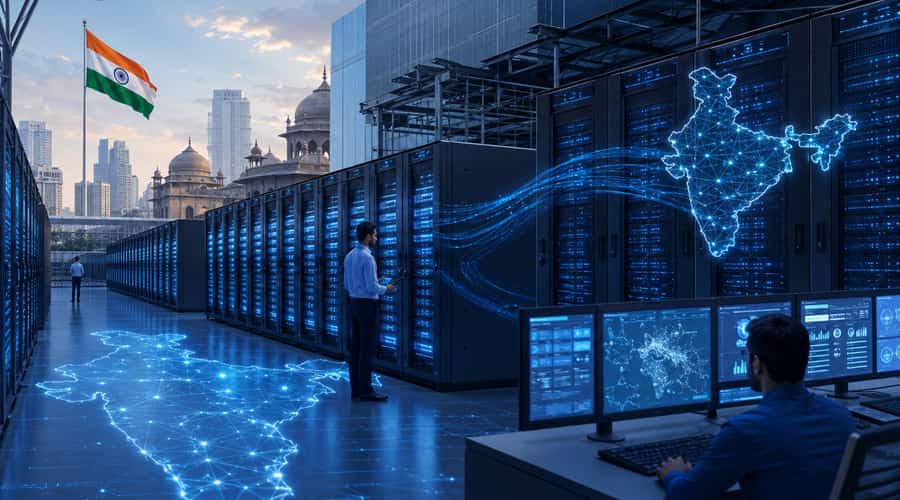
The business has the right shape for that argument. STT GDC India operates 30 data centers across 10 Indian cities and has more than 400 MW of critical IT load. That is not a speculative footprint. It is the kind of installed capacity that cloud providers, enterprises and hyperscalers need when AI workloads begin moving from pilots into everyday business operations.
India already has public companies with exposure to telecom towers, cables, software services and cloud adoption. What it does not yet have in abundance is a pure listed way to own the physical layer underneath AI. That makes STT GDC India interesting. It sits close to the actual bottleneck: powered, cooled, connected space where compute can run.
The comparison with Sify Infinit Spaces is unavoidable. Sify's data-center unit was earlier reported to be preparing a $500 million IPO of its own, potentially making it one of the first Indian data-center operators to list locally. If STT GDC India follows, investors could soon have more than one way to price the same question: how much is reliable AI infrastructure worth in a market where capacity is still catching up with demand?
That question matters because AI changes the economics of data centers. Traditional enterprise workloads need uptime and connectivity. AI workloads need those too, but they also demand heavier power density, more advanced cooling and faster access to large blocks of capacity. A facility that can handle AI clusters is more valuable than one built only for conventional server racks. The market will want proof that STT GDC India can keep expanding without letting capital costs run ahead of returns.
The company has been moving in that direction. In Chennai, STT GDC India launched the first 7.2 MW phase of its STT Chennai 7 facility at Siruseri, part of a planned 45 MW AI-ready campus. It has also committed to expansion across markets including Mumbai, Noida, Pune, Jaipur, Hyderabad and Bengaluru. These locations matter because data-center demand is local as well as national. Customers want capacity near users, networks, cloud zones and enterprise hubs.
The Constraint Is The Story
The bullish case is straightforward. India has more than 1.4 billion people, rising digital consumption, government support for data localization and a fast-growing AI ecosystem. ICRA has estimated that India's data-center demand could more than double over three years, requiring about Rs 90,000 crore of investment. That kind of capital need usually pulls public markets into the story.
But investors should not confuse demand with easy execution. Data centers are not software. They need land in the right places, long-term power agreements, water or alternative cooling systems, grid connectivity, fiber routes and regulatory permissions. Every megawatt added has to be financed before it produces revenue. Every delay can change the return profile.
Power may be the biggest valuation question. AI-ready facilities consume much more electricity than older enterprise halls, and customers increasingly care about renewable procurement and efficiency. India has a growing renewable base, but grid reliability and local distribution remain uneven across states. A data-center operator that can secure power at scale will look very different from one that merely announces capacity.
Cooling is another test. High-density AI hardware generates more heat and can push operators toward liquid cooling, better airflow design and higher upfront engineering costs. These investments can improve performance and efficiency, but they also raise the bar for execution. Public investors will need to understand whether STT GDC India's existing footprint can adapt smoothly, or whether growth will require a more expensive buildout than headline capacity numbers suggest.
The ownership backdrop adds another layer. STT GDC India is part of ST Telemedia Global Data Centres, which KKR and Singtel agreed in February to acquire from ST Telemedia in a S$6.6 billion transaction valuing the platform at S$13.8 billion in enterprise value. That gives the India listing a serious sponsor base and a global infrastructure context. It also means the IPO could help fund local growth while giving the broader platform a market price for one of its most important regions.
If this deal reaches the market, it will not just test appetite for one company. It will test whether India's AI buildout can support a new public-market category. The most important number may not be the $500 million fundraising target. It may be the multiple investors are willing to pay for power, land and cooling capacity when those assets become the rails of AI.
Also read: ADTEK is testing Hong Kong's appetite for AI infrastructure listings • Kioxia is chasing a U.S. listing as AI makes storage scarce • POET turns a $50 million Lumilens order into a bigger AI optics test