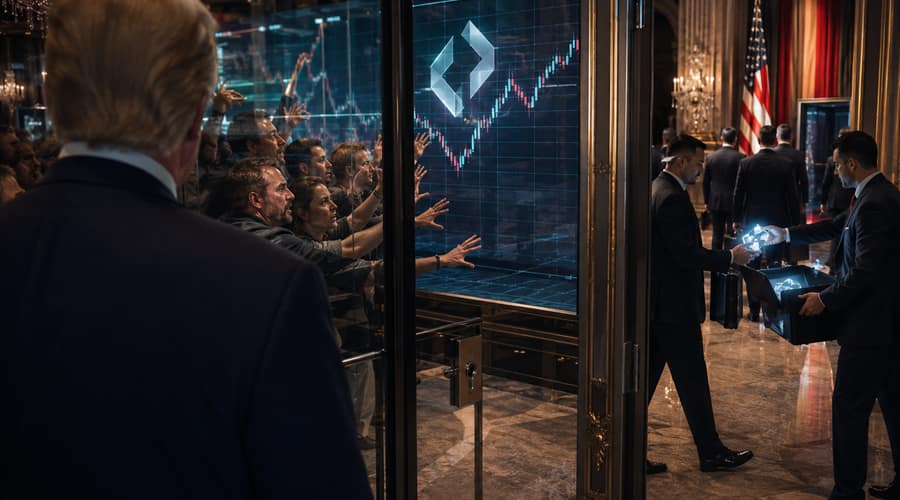
Investors in a crypto venture tied to the Trump family say insiders quietly sold billions of tokens while retail holders were left unable to exit, a development that sharpens scrutiny of political-brand token launches.
Early this month Bloomberg and other outlets reported that World Liberty Financial, a token project tied to Donald Trump and family interests, raised more than $550 million in prior fundraising and then sold an additional 5.9 billion tokens privately to accredited buyers, moves that left many retail holders effectively locked into positions as the token fell in value, according to reporting that surfaced after onchain analysis and governance filings flagged unexplained allocation increases.
Bloomberg said the extra sales were identified after Tokenomist.ai found discrepancies in governance filings, and World Liberty described the deals as "white glove" private transactions while declining to name buyers or disclose where funds went.
The episode matters because political and celebrity-backed token launches create a distinct insider-risk profile, where brand power draws retail demand but governance, tokenomics and disclosure often favour founders and early insiders, leaving regular buyers exposed when private sales or lockup changes occur, as Bloomberg and Cointelegraph coverage of recent celebrity token episodes have illustrated.
According to the reporting, early backers were allowed to sell only a small share at launch, while roughly 80% of holdings remained locked and a governance proposal later surfaced proposing extended or staggered unlocks that would keep many tokens illiquid for years, a structure that concentrates control and timing of liquidity in the hands of project insiders.
What to watch in these launches
First, check token allocation and unlock schedules in public filings and smart contracts, not marketing material, because private allocations or off‑book transfers can change supply dynamics quickly, as onchain analysts flagged in this case.
Second, watch whether founders or affiliated entities are entitled to outsized proceeds, and whether private sales to accredited investors are disclosed clearly, because undisclosed or late-revealed private placements can drain liquidity from public markets, leaving retail holders exposed.
Third, expect reputational spillovers. When high-profile projects appear to privilege insiders, regulators and conventional investors take notice, and the effect is not just reputational, it can change funding terms for legitimate crypto startups that rely on retail trust and institutional onramps.
Is the market pricing regulatory risk?
There are signs the market is already factoring in greater regulatory and reputational risk from politicized token launches. Coverage across Bloomberg and other outlets, plus a string of high-profile celebrity or politician-linked token failures and insider sell-offs earlier this year, have drawn greater attention from onchain analytics firms and journalists, and that attention tends to increase compliance and disclosure demands from exchanges and institutional counterparties.
Regulators have shown renewed interest in token offerings that resemble securities sales in disguise, and when reporting reveals large private sales or opaque allocations, that can trigger enforcement queries or policy pressure that raises the cost of capital for similar projects, according to legal and market commentary following these stories.
For founders this means that leaning on a political brand may boost early awareness, but it can accelerate regulatory scrutiny and accelerate reputational risk for an entire sector, a dynamic investors should factor into valuations and exit planning.
Practical due diligence for founders and investors
Founders should publish full tokenomics, make allocation changes public, and lock founder tokens in verifiable, transparent contracts with clear timetables to avoid perception and legal risk, advice echoed by analysts after recent high‑profile launches.
Investors should use onchain analytics to track token movements and allocation changes, insist on written disclosure of any private placements, and treat political endorsements as signaling higher reputational risk rather than reduced commercial risk, a posture that would have flagged the sales and lockup issues in the World Liberty case sooner.
The World Liberty episode is not an isolated curiosity, it falls into a pattern that includes other celebrity or politician‑adjacent token incidents where insiders exited early or liquidity was removed, moves that have reset expectations about how to value and verify brand‑driven crypto projects.
For StartupFortune readers building or backing crypto startups, the takeaway is straightforward, check the contracts and allocations first, treat brand endorsements as a risk factor, and expect that headline political connections bring scrutiny that can quickly become a liability if governance and disclosure are unclear.
","excerpt":"Bloomberg and onchain analysts say World Liberty Financial, a Trump family‑linked token, quietly sold 5.9 billion tokens to private buyers after raising more than $550 million, leaving many retail holders with locked positions and sparking fresh scrutiny over political-brand token risks.","categories":["crypto","business"],"tags":["World Liberty","Donald Trump","token lockups","political tokens","insider selloffs","celebrity token due diligence"],"imagePrompt":"An editorial, metaphorical composition showing a gilded family crest dissolving into tiny, faceless tokens that scatter across a dark, grid-like network; cold, clinical lighting, muted palette, high detail, symbolic of concentrated power converting reputation into opaque financial flows.
Also read: A Reddit dev turned NVENC into a cheap, local multi‑GPU bridge and the startup world should pay attention • THORChain's halt turns a $10.8 million exploit into a DeFi test • Monad and Rain are testing stablecoin cards as real payment rails