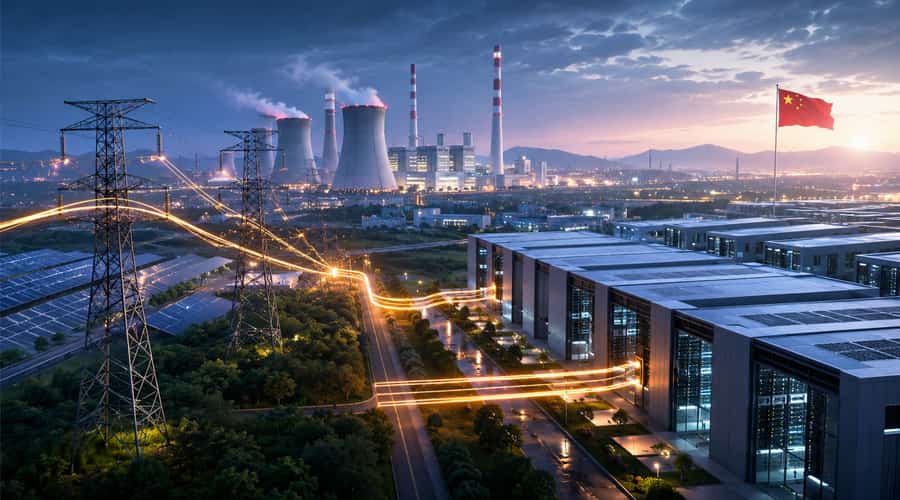
China's giant energy buildout is no longer just a climate or industrial story. It is starting to look like a structural advantage in AI, because the cheapest model in the world still needs a grid that can power it.
The argument that electricity is becoming the real bottleneck in artificial intelligence is moving from theory to strategy. Bloomberg reported in February that China's surging energy capacity, powered by huge solar, wind, battery and broader generation additions, could let the country undercut rivals on AI compute costs, and the latest data suggests that idea is getting harder to dismiss.
That matters because AI economics are brutally simple. Training and running large models is not just a software problem, it is a power problem, and the company or country that can secure cheap, reliable electricity has a real edge. China has been building exactly that cushion, while the US and Europe are running into the opposite problem, grids that are strained, slow to expand, and more expensive to use for power-hungry data centers.
Bloomberg's reporting said China added more renewable capacity last year than the rest of the world combined, and BloombergNEF projected in February that the country would add more than 3.4 terawatts of electricity generation capacity over the next five years, almost six times the US total over the same period. Reuters has also reported that China's new five-year plan is pushing hyper-scale computing clusters supported by affordable and plentiful electricity, which shows this is becoming an explicit policy goal rather than an accidental outcome.
That is a meaningful distinction. A lot of countries can talk about AI leadership, but if the grid cannot absorb the load, the rhetoric stops at the transformer. China's recent renewable buildout, plus continued investment in storage and other generation sources, gives it room to scale compute without immediately colliding with the kind of scarcity pricing that is starting to define Western markets.
Reuters has also noted that Chinese leaders are openly linking AI development with better coordination between power and computing resources, which tells you where the state sees the leverage point. In other words, this is not only about cleaner electricity. It is about who can promise large AI users the one thing they care about most, a stable power bill they can actually forecast.
The Western squeeze
The contrast with the US is stark. PJM, the largest US power grid, has spent much of this year responding to AI-driven demand growth, with Reuters reporting in January that it unveiled a plan to speed up connections for big loads and push some new users toward on-site generation or flexible consumption. TechCrunch reported in May that PJM now says it has "years, not decades" to make fundamental changes, which is not the kind of language that reassures cloud customers shopping for long-term capacity.
Bloomberg has already shown what this looks like on the ground. Its September 2025 reporting found wholesale electricity costs were rising sharply in areas near data centers, and the same pattern is now feeding through to AI users who are effectively bidding against each other for access to electrons. Reuters also reported in May that US power demand is expected to hit record highs in 2026 and 2027 as AI use surges, which means the pressure is not temporary.
That creates a very different operating environment for startups. In the US and Europe, founders are learning to think like energy buyers, not just cloud buyers. The location of a model training run may soon matter as much as the choice of framework, because power costs, grid delays and interconnection queues can change the economics of a product before it even reaches market.
What founders should watch
For early-stage founders, the practical question is not whether China becomes the cheapest place to train every model. It is whether Chinese compute becomes a meaningful arbitrage opportunity for certain workloads, especially those that are capital-intensive and sensitive to electricity prices. If that happens, the discussion around cloud providers stops being just about latency, regulation or vendor lock-in, and starts including energy policy as a first-order variable.
There is also a broader strategic point. If Western AI companies are forced to pay more for power, or wait longer for grid access, the advantage compounds over time. China can absorb more experimentation, more retraining, and more infrastructure-heavy AI deployment because the underlying energy system is being built to support that load. That is the kind of advantage that does not show up in a demo, but it can shape an entire ecosystem.
For policymakers in the US and Europe, the message is just as blunt. AI competition is not only about chips, talent or regulation. It is about transmission lines, storage, generation and permitting, the unglamorous machinery that determines whether a model can be trained at scale without destroying the economics of the business. China appears to understand that better than most of its rivals right now, and that may be the real story Bloomberg was pointing to.
Also read: DeepSeek's 1 million token push could redraw the AI cost curve for startups • Startups need a new pitch as Suleyman warns white‑collar work could vanish in 18 months • AI video is about to make render farms look expensive