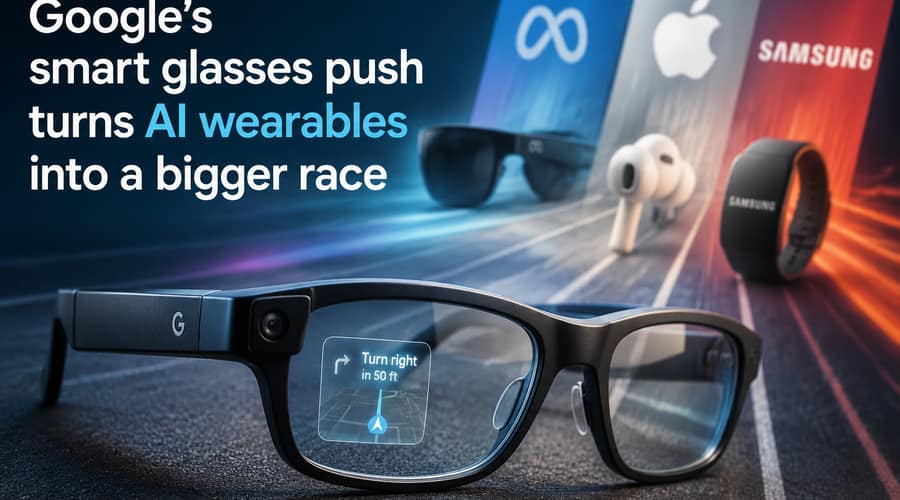
Google's AI glasses push is no longer just a prototype story. The company is now putting Android XR, Gemini, and major eyewear partners behind a real consumer race with Meta.
Google has moved its smart glasses effort into a more serious phase, and the timing matters. At I/O 2026, the company showed updated Android XR glasses prototypes and gave the clearest signal yet that it wants Gemini to live beyond phones, browsers, and search boxes.
This is not the old Google Glass story with better marketing. The new strategy is built around Android XR, the mixed-reality platform Google first announced in December 2024 with Samsung, and then showed more fully at I/O 2025 through glasses demos that included live translation, navigation, messaging, and contextual help. The difference now is that the ecosystem is starting to look more commercial than experimental.
As Axios reported from Google I/O 2026, Google is working on updated smart glasses prototypes with Samsung, Warby Parker, and Gentle Monster, with voice-only models due this fall and a version with a small display set for expanded testing by the end of the year. That detail is important because it separates two use cases that often get blurred together: simple AI eyewear that listens and responds, and display glasses that put information directly in the user's field of view.
The basic pitch is easy to understand. Gemini can sit on the glasses, use the camera and microphones to understand context, and respond without forcing the user to pull out a phone. Google's own Android XR materials have described the assistant as something that can see and hear what the wearer does, which gives the product a very different role from a chatbot in an app. It becomes a layer over daily life.
Meta is the reason this race now feels urgent. Ray-Ban Meta glasses proved that consumers might actually wear AI-enabled eyewear if it looks normal, works reliably, and does a few useful things well. The product does not need to replace the phone to matter. It only needs to capture moments when a phone feels too slow, too awkward, or too disconnected from what the user is seeing.
That creates a sharper challenge for Google. The company has impressive software, deep Android distribution, and a strong AI model family, but consumer hardware has not always been its cleanest execution lane. Glasses make that problem harder because the margin for discomfort is small. If the frames are heavy, odd-looking, or socially uncomfortable, the AI does not get a chance to prove itself.
The Platform Fight
The most interesting part of Google's push is not the frame design. It is the platform strategy. Android became powerful because it let many manufacturers build phones around a common software layer. Google appears to be trying a version of that model for AI glasses, with Samsung, XREAL, Warby Parker, and Gentle Monster each pointing at different parts of the market.
That matters for startups because the interface is changing. A founder building computer vision tools, spatial apps, personal assistants, translation software, fitness coaching, or field-work automation now has to think beyond the phone screen. If glasses become a serious Android XR category, developers will want software that can handle visual context, short voice interactions, and small bursts of useful information.
Apple adds another pressure point. Bloomberg has reported this year that Apple is working on smart glasses designed to rival Meta's, including multiple frame styles and camera-equipped designs. That does not mean Apple, Google, and Meta will all ship category-defining products on the same schedule. It does mean the largest consumer technology companies are now treating AI eyewear as a strategic surface, not a side experiment.
The privacy question will follow quickly. Glasses with cameras and microphones are more sensitive than phones because they are worn in public and point outward by default. Google can talk about trusted testers and careful design, but the broader market will judge the product by visible cues, recording controls, data handling, and whether people around the wearer feel respected. The technology may be impressive, but social permission is part of the product.
For Google, the reward is obvious. If Gemini becomes useful on glasses, the company gains a new place to deliver search, maps, translation, messaging, memory, and agent-style assistance. That gives Google another path to defend its role as the starting point for digital tasks at a moment when AI apps are pulling users away from traditional search behavior.
The next phase will be practical. Watch whether the voice-only models arrive on time this fall, whether the display version is useful without feeling intrusive, and whether developers get tools that make Android XR more than a demo platform. Smart glasses do not need to become the next smartphone overnight. They only need to become useful enough that people stop treating them like a novelty.
Also read: Google redesigns Search around Gemini agents, forcing startups to rethink SEO • OpenAI's image provenance push moves authenticity closer to a compliance baseline • Google bets on agents with Gemini 3.5 Flash, shifting Flash from speed to autonomy