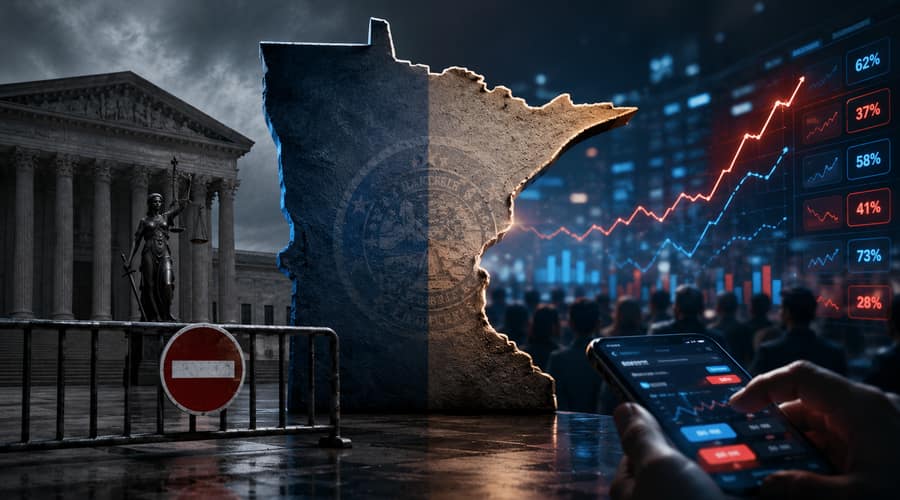
Minnesota has become the first U.S. state to ban prediction markets, and the federal response came almost immediately.
The move matters because it turns a fast-growing niche into a live test of who gets to regulate it, states or Washington. Governor Tim Walz signed the law on Monday, the Commodity Futures Trading Commission sued to block it on Tuesday, and platforms like Kalshi and Polymarket are now at the center of a fight that could shape the industry's next phase.
The law is broad. It makes it a crime to host, operate, or promote prediction markets in Minnesota, and it reaches beyond the platforms themselves to cover services that help users bypass the ban, including virtual private networks. The law is set to take effect on August 1, and violations could carry felony penalties, which is why the issue has moved so quickly from a policy dispute to a direct legal clash.
That escalation is not happening in a vacuum. The CFTC has already been reviewing prediction markets through an advanced notice of proposed rulemaking, a process the agency opened in March to gather comment on event contracts, prohibited contracts, and cost-benefit questions tied to the sector. In other words, Minnesota is moving in the same area the federal regulator is already examining, but it is doing so with a far more aggressive posture.
The state's bill was pitched as a consumer protection measure, but it also reflects a wider state-level skepticism toward products that blur the line between financial markets and gambling. Reuters reported that the CFTC's lawsuit argues Minnesota's law intrudes on markets Congress assigned to federal oversight, while the agency's own statement said the state is criminalizing trading in markets that have been regulated federally for decades.
That tension matters because prediction markets have grown by leaning on a simple pitch: they let users trade on outcomes that matter, from elections and economic releases to sports and weather. Polymarket has been one of the best-known names in the space, and its rise has made the category impossible for regulators to ignore. Minnesota's ban is the clearest sign yet that at least some states no longer want to wait for federal action before drawing a line.
There is also a practical political angle. Minnesota is an agricultural state, and the CFTC noted in its lawsuit that weather-related event contracts can serve a real hedging purpose for farmers. That point reveals the hard part of writing rules here, because the same product family can look like speculation in one setting and risk management in another.
What this means for startups
For prediction market startups, the immediate problem is not just Minnesota. It is the possibility that the state becomes a template. If more states follow, operators could end up with a patchwork of restrictions that raises compliance costs, complicates user acquisition, and weakens the national market that has helped these businesses scale.
Geo-blocking is the obvious response, but it is not free. Every restricted state adds legal review, product complexity, and enforcement risk, and Minnesota's law even reaches some support tools that could help users evade blocks. That makes the compliance burden heavier than a simple map of excluded jurisdictions, and it changes the economics for companies that have been built around rapid national growth.
The legal uncertainty also cuts into product design. Event contracts can be framed as information markets, hedging tools, or wagering products depending on who is speaking, and that ambiguity is exactly why this space keeps drawing regulators from both the gambling and derivatives worlds. As Reuters noted in earlier coverage, prediction markets have also drawn attention because of suspicious trades and a broader debate over whether they should be treated as financial instruments or betting products.
That debate is now moving faster. The CFTC's lawsuit suggests federal officials are not willing to let states create their own definition of what counts as a lawful event contract market. Minnesota may have opened the door to more bans, but it also seems likely to produce the first major court ruling on whether a state can shut down this category on its own.
For founders, the message is blunt. This is no longer just a growth story. It is a regulatory one, and the next phase will be decided as much in courtrooms and agency filings as it will be in product launches and user metrics.
","excerpt":"Minnesota has become the first U.S. state to ban prediction markets, and the CFTC is already suing to stop the law. For operators like Polymarket, the bigger risk may be a widening patchwork of state bans.","categories":["financial-markets","news"],"tags":["Minnesota","CFTC","Polymarket","prediction market ban","event contracts regulation","state-level gambling law"],"imagePrompt":"An editorial illustration of a courtroom gavel striking a trading terminal that is split by a state border line, with legal papers, warning signs, and abstract event symbols floating around it, conveying regulatory conflict around prediction markets. No text, no logos, no coins, no charts.","content":"
Minnesota has become the first U.S. state to ban prediction markets, and the federal response came almost immediately.
The move matters because it turns a fast-growing niche into a live test of who gets to regulate it, states or Washington. Governor Tim Walz signed the law on Monday, the Commodity Futures Trading Commission sued to block it on Tuesday, and platforms like Kalshi and Polymarket are now at the center of a fight that could shape the industry's next phase.
The law is broad. It makes it a crime to host, operate, or promote prediction markets in Minnesota, and it reaches beyond the platforms themselves to cover services that help users bypass the ban, including virtual private networks. The law is set to take effect on August 1, and violations could carry felony penalties, which is why the issue has moved so quickly from a policy dispute to a direct legal clash.
That escalation is not happening in a vacuum. The CFTC has already been reviewing prediction markets through an advanced notice of proposed rulemaking, a process the agency opened in March to gather comment on event contracts, prohibited contracts, and cost-benefit questions tied to the sector. In other words, Minnesota is moving in the same area the federal regulator is already examining, but it is doing so with a far more aggressive posture.
Why Minnesota acted now
The state's bill was pitched as a consumer protection measure, but it also reflects a wider state-level skepticism toward products that blur the line between financial markets and gambling. Reuters reported that the CFTC's lawsuit argues Minnesota's law intrudes on markets Congress assigned to federal oversight, while the agency's own statement said the state is criminalizing trading in markets that have been regulated federally for decades.
That tension matters because prediction markets have grown by leaning on a simple pitch: they let users trade on outcomes that matter, from elections and economic releases to sports and weather. Polymarket has been one of the best-known names in the space, and its rise has made the category impossible for regulators to ignore. Minnesota's ban is the clearest sign yet that at least some states no longer want to wait for federal action before drawing a line.
There is also a practical political angle. Minnesota is an agricultural state, and the CFTC noted in its lawsuit that weather-related event contracts can serve a real hedging purpose for farmers. That point reveals the hard part of writing rules here, because the same product family can look like speculation in one setting and risk management in another.
What this means for startups
For prediction market startups, the immediate problem is not just Minnesota. It is the possibility that the state becomes a template. If more states follow, operators could end up with a patchwork of restrictions that raises compliance costs, complicates user acquisition, and weakens the national market that has helped these businesses scale.
Geo-blocking is the obvious response, but it is not free. Every restricted state adds legal review, product complexity, and enforcement risk, and Minnesota's law even reaches some support tools that could help users evade blocks. That makes the compliance burden heavier than a simple map of excluded jurisdictions, and it changes the economics for companies that have been built around rapid national growth.
The legal uncertainty also cuts into product design. Event contracts can be framed as information markets, hedging tools, or wagering products depending on who is speaking, and that ambiguity is exactly why this space keeps drawing regulators from both the gambling and derivatives worlds. As Reuters noted in earlier coverage, prediction markets have also drawn attention because of suspicious trades and a broader debate over whether they should be treated as financial instruments or betting products.
That debate is now moving faster. The CFTC's lawsuit suggests federal officials are not willing to let states create their own definition of what counts as a lawful event contract market. Minnesota may have opened the door to more bans, but it also seems likely to produce the first major court ruling on whether a state can shut down this category on its own.
For founders, the message is blunt. This is no longer just a growth story. It is a regulatory one, and the next phase will be decided as much in courtrooms and agency filings as it will be in product launches and user metrics.
Also read: Polymarket's hantavirus bet shows how fast prediction markets can go wrong • Nvidia's seven-day surge is squeezing the AI startup stack • LLMs are turning Polymarket into a live benchmark for forecasting , and startups should worry about rules not just models