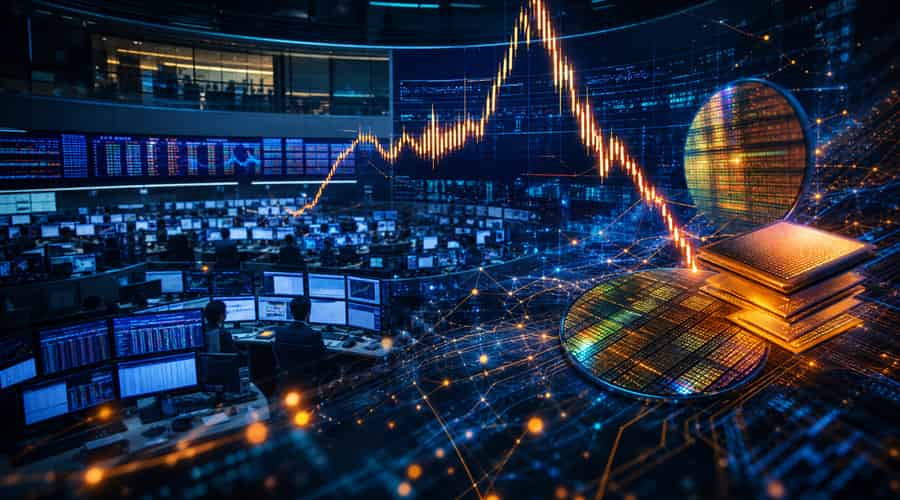
South Korea's AI-heavy stock market staged a sharp Friday rebound, but the violent move said as much about leverage and concentration as it did about confidence in SK Hynix, Samsung, and the memory chips behind the AI boom.
The important signal from Seoul on June 12 was not that investors had suddenly stopped believing in high-bandwidth memory. They had not. The KOSPI jumped more than 8% at one point before closing up 4.6%, a powerful rebound after a brutal week in which chip stocks had pulled the benchmark lower and trading halts had reminded investors how narrow the rally had become.
That distinction matters. A market can still have a strong earnings story and a weak trading structure at the same time. SK Hynix and Samsung Electronics sit at the center of the AI infrastructure trade because their memory chips are essential to Nvidia accelerators and the data centers being built around them. But when two companies become the main expression of a national equity market, every shift in sentiment gets amplified. Good news runs hard. Bad news runs harder.
As Business Insider reported Friday, the KOSPI surged more than 8% during the session before paring its gains, helped by improved global risk sentiment after President Donald Trump said the U.S. was nearing a peace deal with Iran. Samsung Electronics rose as much as 13% before ending 7.9% higher, while SK Hynix gained as much as 9.6% before closing up 2.3%. Those are not normal moves for companies of this size. They are the kind of moves that tell you investors are trading the same thesis through the same few names.
The week had already shown how fragile that setup could be. On June 8, the KOSPI fell more than 8% as the global semiconductor selloff hit South Korea harder than most markets. Samsung and SK Hynix were among the biggest weights on the index, not because the AI memory story had collapsed overnight, but because the market had become deeply dependent on a small group of chip stocks to carry the broader rally.
The AI Memory Story Is Still Doing The Work
The fundamentals behind SK Hynix are still hard to ignore. The company crossed the $1 trillion market capitalization mark in late May after its shares more than tripled in 2026, putting it alongside Samsung, TSMC, and a small group of global companies whose valuations have been reshaped by AI demand. That milestone did not happen because investors suddenly discovered memory chips. It happened because HBM has become one of the most important components in the AI supply chain.
Nvidia's role is central here. Its accelerators need advanced memory to feed data quickly enough for large AI workloads, and that has made suppliers such as SK Hynix strategically important in a way the memory industry has rarely enjoyed for this long. On June 8, Nvidia announced a new multiyear partnership with SK Hynix to develop memory solutions for AI infrastructure, a reminder that the commercial demand behind the stock move remains real even when the share price is moving violently.
Samsung is part of the same trade, though in a different position. It remains one of the world's most important memory makers, but investors have watched closely to see how quickly it can close the gap with SK Hynix in the most advanced HBM products. That competitive tension is one reason both stocks can move together on broad AI enthusiasm while still trading on different expectations about execution, pricing, and customer wins.
Concentration Is The Risk Investors Can See Now
The concern is not simply valuation. It is concentration. When Samsung and SK Hynix account for such a large share of the KOSPI's market value, the index becomes less of a broad South Korean equity benchmark and more of a leveraged view on the global AI hardware cycle. That can make the market look stronger than it really is during the climb and more vulnerable than expected during a reset.
This is where the recent volatility becomes useful for anyone watching the AI trade from outside Korea. The memory cycle can be healthy, Nvidia demand can remain strong, and SK Hynix can still have a convincing long-term case, while short-term trading becomes unstable because too much money is crowded into the same idea. A rally that depends on a handful of companies needs constant confirmation. When that confirmation pauses, investors do not wait politely.
The Friday rebound does not erase the warning from earlier in the week. It shows that buyers are still willing to step back into the trade when global risk appetite improves, but it also confirms that South Korea's market is now highly sensitive to every change in the AI narrative. Peace headlines, U.S. chip moves, Nvidia commentary, memory pricing, and foreign flows can all hit the same narrow channel at once.
For investors, the practical takeaway is clear. The AI memory thesis may still be intact, but the easy part of the trade is over when trillion-dollar valuations and index-level concentration are already in place. From here, the next phase depends less on whether demand exists and more on whether earnings, capacity plans, and pricing can keep justifying the speed of the move. The story is still alive. The margin for disappointment is smaller.
Also read: A scaffolding company's earnings reveal who really pays for the AI buildout • The Senate Has Eight Weeks to Settle Who Governs Crypto in America • Japan's central bank is hiking to 1% while its governor is in the hospital