BrandSafway, the scaffolding and access-services group controlled by Clayton, Dubilier and Rice, is showing how quickly AI infrastructure costs move beyond chips and servers.
The hyperscalers get the headlines. Amazon, Google, Meta, and Microsoft are now expected to spend about $725 billion on capital projects in 2026, according to figures compiled from first-quarter company guidance and reported by the Financial Times. Most of that money is tied to AI infrastructure. But the spending does not turn into profit in one clean motion. It runs through contractors, power providers, landowners, equipment suppliers, and specialty operators before anyone can see whether the economics actually work.
BrandSafway is one of those operators, and its latest earnings show the strain. The Atlanta-based company, which provides scaffolding, access, forming, shoring, and specialty services for industrial and commercial construction, reported Q1 2026 EBITDA of $71 million, down 20% from a year earlier. As Bloomberg reported on June 11, the pressure came from startup costs tied to the company's push into data center construction. Revenue from that pivot has not yet arrived at the scale needed to absorb the investment. That is the mechanical truth of a real infrastructure shift: costs arrive first, and the return can lag by several quarters.
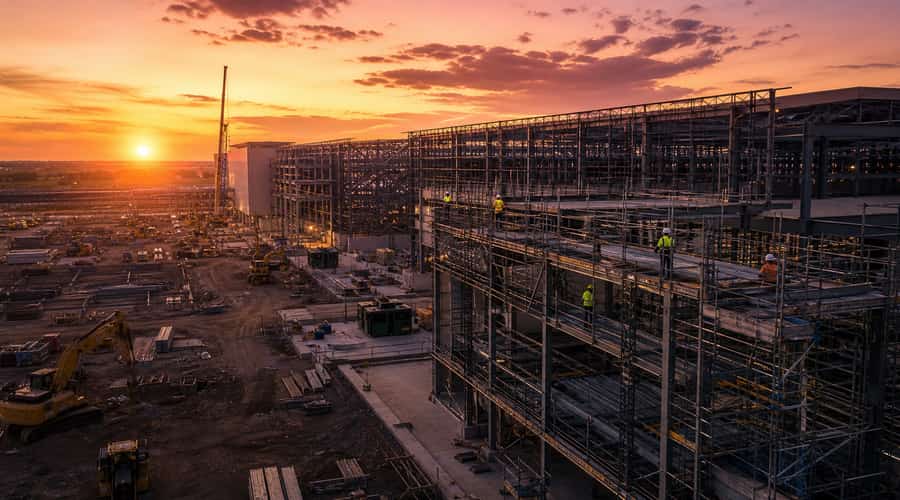
BrandSafway is not a marginal contractor trying to chase a trend. The company describes itself as a global provider of access and specialty services, with approximately 340 locations in 25 countries. Its products sit inside the practical layer of construction: scaffolding, hoists, suspended platforms, industrial services, project management, labor, and safety systems. That is not glamorous work, but it is the kind of work that determines whether a hyperscale campus can move from a rendering to an operating facility.
That is what makes CD&R's position interesting. The private equity firm is not simply buying a data center landlord and waiting for lease income. Through BrandSafway, it has exposure to construction volume itself. The bet is narrower, more operational, and less forgiving. If data center projects accelerate, the company can capture demand for access services and specialty labor. If projects slip because power, permitting, or financing slows, BrandSafway still has to carry the people, equipment, and training costs it put in place to chase the opportunity.
The physical economics of AI data centers make that timing problem more severe than it would be in ordinary commercial construction. AI facilities need dense power distribution, advanced cooling, tighter sequencing, and larger up-front coordination across trades. JLL's 2026 data center market outlook puts the global average shell-and-core cost at $11.3 million per megawatt, up from $7.7 million in 2020. AI-optimized facilities can clear $20 million per megawatt, while full builds including GPU fit-out can run between $30 million and $40 million per megawatt. For the companies serving those builds, mobilization becomes expensive before the billing cycle catches up.
For BrandSafway, that means the data center push is not just a sales initiative. Skilled crews need training for a different jobsite environment. Safety procedures differ from refinery work or utility maintenance. Project sequencing on a hyperscale campus is less forgiving because delays in one trade can hold up enormous amounts of capital downstream. The startup cost line in the Q1 report is not accounting noise. It is the entry fee for competing in a construction market where customers are moving fast but still demand industrial-grade execution.
The broader private capital rush into AI infrastructure adds context. Blackstone has become one of the largest private investors in AI-related infrastructure, with more than $150 billion already invested and a large development pipeline behind it. KKR has expanded its data center exposure and, this week, announced Helix Digital Infrastructure with Nvidia, Vistra, and the Kuwait Investment Authority, backed by more than $10 billion in commitments. Apollo and Blackstone have also joined Broadcom on a $35 billion AI infrastructure platform. The money is moving because the demand signal is real, but most of those deals sit at the asset ownership, financing, or platform layer.
BrandSafway sits lower in the stack. That can be attractive, because construction activity creates work before a facility is stabilized and leased. It can also be harsher, because service margins are thinner and labor capacity has to be built before demand fully converts into revenue. A data center owner may underwrite returns over many years. A contractor feels the pressure quarter by quarter.
The next test is whether the margin compression is temporary pain or an early warning. Power availability remains a major bottleneck for new campuses, with grid interconnection timelines stretching for years in some markets. That could slow the pace at which booked demand becomes active construction. It could also favor companies that invest early in trained crews, safety systems, and specialized equipment. Once the volume arrives, customers are unlikely to swap out proven operators casually.
For other industrial services companies watching this market, BrandSafway's Q1 report is a useful calibration point. The AI buildout is not a free lunch for the physical layer. It rewards companies willing to carry costs before the payoff is visible, but it also exposes how much of the AI story depends on uncelebrated work far from the model lab. CD&R appears to have made that judgment. The back half of 2026 will show whether data center revenue catches up, or whether the margin math is tougher than the strategy looked on paper.
Also read: Singapore will reward SMEs that make AI show its working • Avataar builds video AI on Indian cultural data, winning HP and Victoria's Secret as customers • Your website should follow the data, not your personal taste