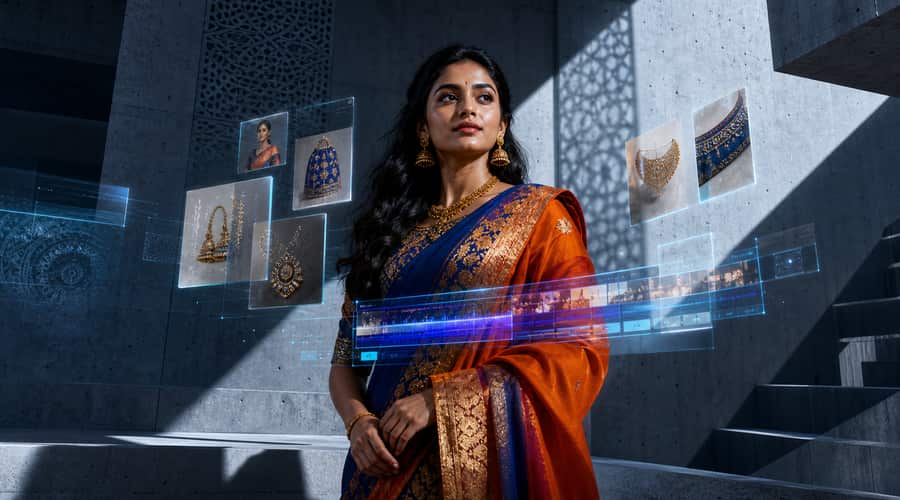
India's Avataar is using open video models and Indian cultural data to build a more useful commercial AI product for brands selling into South Asia.
The model is called Varya. Ask it to render a woman celebrating Dussehra or a street vendor selling vada pav and it is designed to avoid the generic, vaguely Asian approximation that still shows up in many video generation tools. Avataar built the system around the specifics of Indian life: clothing, festivals, food, architecture, street scenes. That sounds like a narrow technical choice until a brand tries to use AI video at scale and finds the model keeps getting the sari, storefront, or festival setting wrong.
Varya is not a from-scratch foundation model. Avataar started with Wan 2.2, part of Alibaba's open video model family, and used distillation to compress its capabilities into a leaner, faster system, then added cultural fine-tuning on top. The company says the result can generate a second of video at about Rs 0.48, roughly half a cent. The plan is to release Varya as open-weight on India's AI Kosh portal, along with training data, so developers can self-host or modify it. That fits the structure of the IndiaAI Mission, the government's roughly $1.25 billion program that gives selected startups subsidized compute in exchange for making useful models available to the wider ecosystem.
The commercial product runs separately under the name Velocity. Feed Velocity a product URL and it produces a finished marketing video without the usual studio process. Avataar says HP, Victoria's Secret, Newegg, Lowe's, TVS, and Bajaj have used the product since its September 2024 beta. The target is not the expensive campaign film. It is the mid-tier product listing that needs motion to perform on an e-commerce page but will never justify a shoot, an editor, and a full creative workflow. Sravanth Aluru, who founded Avataar after stints at Microsoft and Deutsche Bank, has been building in this direction since 2015, beginning with 3D product experiences before moving toward automated video as the models became strong enough to carry the job.
The harder question is whether cultural fine-tuning on an open model is a durable moat or just a head start that Google, Meta, Alibaba, or another well-funded competitor could close quickly. The answer is probably both, depending on what Avataar does with the time it has. Once Varya is released openly, the model itself becomes easier to study and copy. What is harder to copy is the commercial layer around it: integrations with brand workflows, relationships with marketing teams, and the accumulated knowledge of which AI videos actually lift conversion on Indian e-commerce pages. A technically stronger model does not automatically inherit those accounts.
The IndiaAI Mission structure deserves attention on its own. Instead of trying to build a single sovereign GPT-4 rival, India is backing startups that can build or adapt specialized models for local needs, then release them back into the market. The Economic Times reported in May that twelve startups had been selected under the mission to develop indigenous AI models, with compute access already granted in several cases even as paperwork and IP questions delayed some formal agreements. Sarvam AI has already released Indian language models under the broader sovereign AI push, including Sarvam-30B and Sarvam-105B. The logic is practical. No Indian startup is likely to outspend OpenAI on frontier pretraining runs, but many can build models that understand Indian languages, culture, shopping behavior, and regulatory constraints better than a general-purpose Western system.
That lesson travels beyond India. Nigeria, Indonesia, Brazil, and other large markets have the same problem in different forms. Their companies do not only need more powerful AI. They need AI that understands local commerce, local idioms, local clothing, local food, local streets, and local trust signals. A generic model may be impressive in a demo, but businesses pay for output that works in their market. That is where smaller companies can still find room, even when the infrastructure layer is dominated by giants.
With $55.5 million in total funding and government compute support behind it, Avataar has a serious chance to test that thesis. The bet is not that Varya beats Sora, Veo, or Kling on every benchmark. It is that a model tuned to know what Diwali looks like in Tamil Nadu, what street fashion looks like in Mumbai, and what a proper biryani looks like in Hyderabad is more useful to many Indian brands than a technically superior model that misses the context. Narrow? Yes. But specificity is often where defensible businesses begin.
Also read: Nvidia courts China with Vera CPU while aiming directly at AMD and Intel • The Big Four are selling AI governance while their own reports hallucinate • US insurance regulators are opening formal inquiries into the credit risks piling up inside AI data centre financing